Lending Guidelines Mortgage: The Complete Guide for 2026
Can a mortgage file be “within the numbers” and still fail a sound underwriting review? Yes. A borrower may meet a familiar debt-to-income benchmark, yet the income calculation, documentation, automated recommendation, or fair-lending review may raise a different concern. That tension is the central subject of lending guidelines mortgage work in 2026.
Mortgage guidelines are more than a list of credit, income, down-payment, and property rules. They're an evolving control system shaped by secondary-market eligibility, federal regulation, lender risk appetite, automated underwriting, and the need to explain decisions to borrowers, auditors, and regulators. New underwriters who understand that history make better decisions than those who memorize thresholds.
Table of Contents
- Understanding Mortgage Lending Guidelines
- The Evolution of Mortgage Guidelines
- Core Underwriting Criteria Explained
- Agency Versus Non-Agency Guidelines
- Codifying and Enforcing Internal Guidelines
- Real-World Guideline Edge Cases
- Navigating Evolving Compliance Requirements
- Building a Guideline Compliance Framework
Understanding Mortgage Lending Guidelines
An underwriter receives a loan file with stable income, a documented employment history, and a debt ratio that appears acceptable. The lender's internal policy points one way, the agency rulebook adds conditions, and the automated underwriting recommendation requests documentation that the initial checklist didn't anticipate. The file isn't necessarily weak. It's incomplete as a decision record until the underwriter can reconcile each rule and explain the final result.
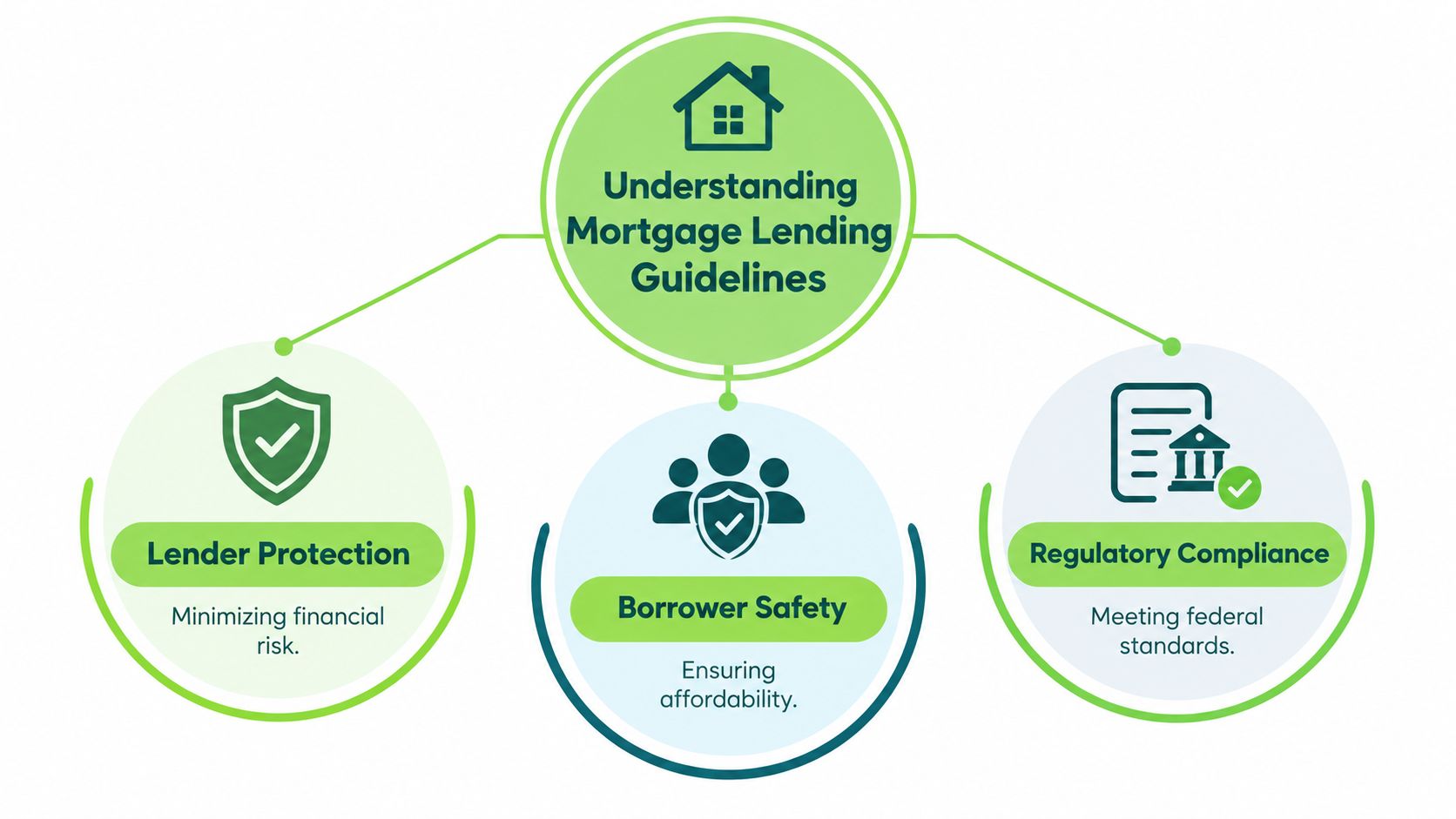
That example captures why mortgage guidelines exist. They give lenders a repeatable way to evaluate repayment capacity, collateral risk, credit behavior, documentation quality, and eligibility for a particular funding channel. They also protect borrowers from loans structured without a reasonable affordability analysis. The rules act as guardrails, but they can also become gatekeepers when staff apply them without understanding their purpose or the evidence behind them.
Who creates the rules
No single institution created one permanent national mortgage rulebook. Local lenders historically made decisions according to local practices, funding sources, and their own risk tolerances. As secondary-market institutions expanded, eligibility standards became more important because lenders needed loans that could be sold, securitized, or retained under defined risk controls.
The framework now combines several layers:
- Federal regulation, including ability-to-repay and fair-lending obligations.
- Agency requirements, such as the underwriting standards used for loans eligible for purchase by Fannie Mae or Freddie Mac.
- Investor and insurer rules, which may add conditions to an otherwise eligible loan.
- Lender overlays, where an institution adopts stricter internal requirements.
- Operational procedures, which determine how employees collect, verify, document, and review information.
The practical question isn't only, “Does this borrower qualify?” It's, “Which rule applies, what evidence supports the conclusion, and can another qualified reviewer reproduce the decision?” That mindset turns guideline compliance into quality control rather than checkbox administration.
The Evolution of Mortgage Guidelines
Modern mortgage underwriting developed through standardization, not through a single legislative event. HUD's housing-finance history records that Fannie Mae established underwriting guidelines in 1954, including a maximum loan-to-value ratio of up to 80%. The same historical record helps explain why LTV became such a durable underwriting variable: lenders used it to connect the borrower's equity position with collateral risk.
Early lending remained more fragmented than today's agency market. The cited mortgage-lending history notes that many lenders required LTV below 80% unless mortgage insurance supported the loan, while Duke's account describes underwriting becoming more uniform from the 1970s to the 1990s as Fannie Mae and Freddie Mac increasingly purchased and securitized loans. The result was a gradual shift from lender-specific judgment toward eligibility standards that could support secondary-market transactions.
Why secondary-market rules matter
Secondary-market participation changed the meaning of a guideline. A lender wasn't only deciding whether it personally liked a loan. It was also deciding whether the loan fit a broader framework for sale, securitization, servicing, and risk transfer.
That's why variables such as LTV, debt-to-income, income stability, credit history, and documentation became central. They made decisions more consistent and gave investors a common language for evaluating mortgage risk. Standardization improved comparability, but it also made exceptions more consequential. A deviation could affect sale eligibility, representations and warranties, servicing expectations, and loss exposure.
The post-crisis control framework
The financial crisis exposed the danger of origination practices that failed to document whether borrowers could repay. The CFPB's mortgage rules fact sheet states that the Ability-to-Repay rule took effect on January 10, 2014 and required lenders to evaluate repayment ability before making a mortgage loan. The CFPB connected the rule to the crisis and foreclosure epidemic, including risky features such as “no doc” and “interest only” loans.
The OCC also points lenders to mortgage-lending standards in 12 CFR 30 and 12 CFR 34, and states that residential mortgage guidelines in 12 CFR 30, appendix C are enforceable under Section 39 of the FDIA. That history explains the modern compliance expectation: a lender must show not only that a decision was reasonable, but also that the process was documented, consistent, and reviewable.
Core Underwriting Criteria Explained
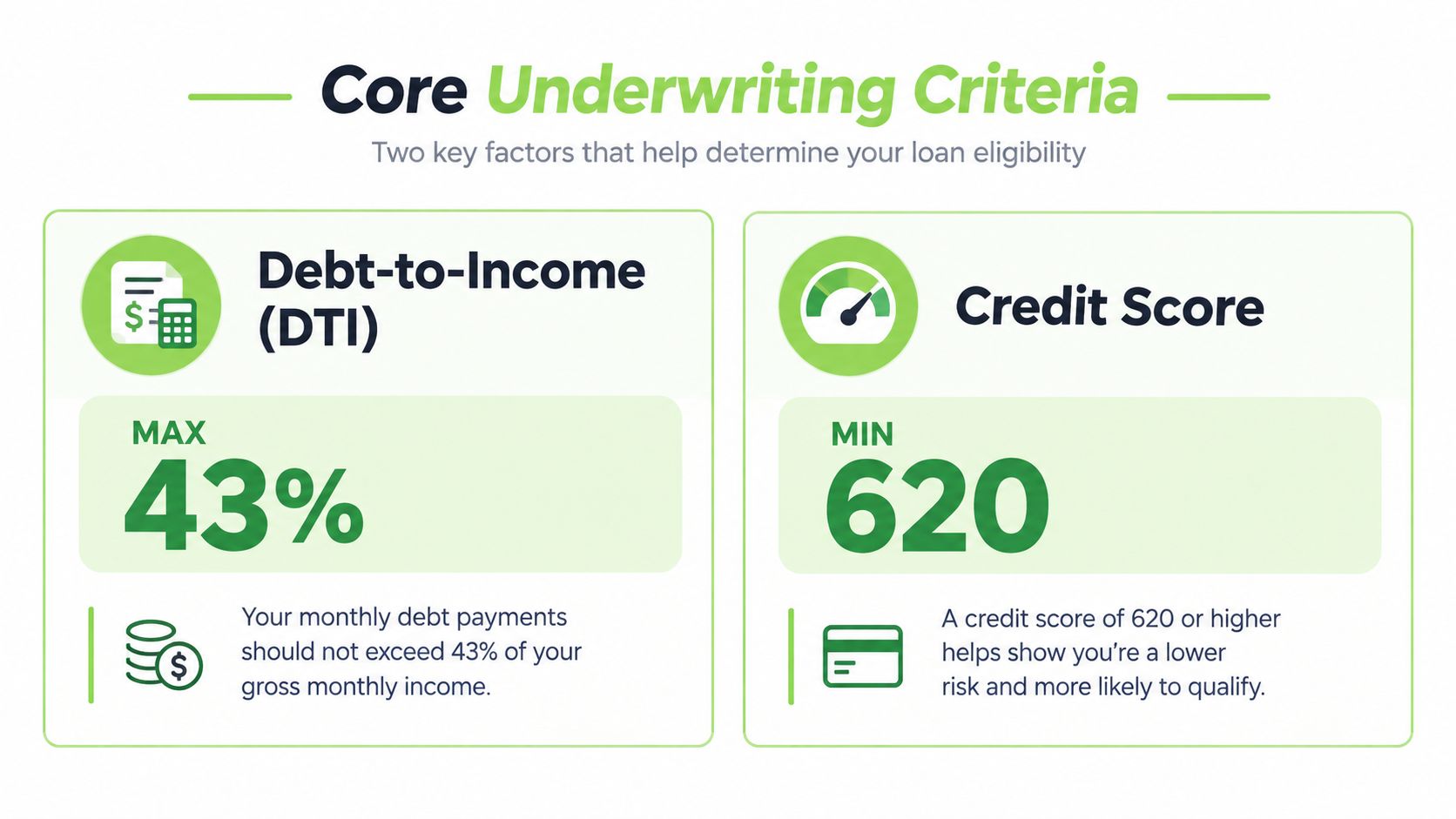
What does each underwriting criterion really prove? DTI tests whether documented income can support the proposed obligations. LTV measures the lender's collateral cushion. Credit history describes past repayment behavior, while income and asset documentation test whether the application's stated facts are reliable. Treating these measures as interchangeable creates weak reasoning. Each answers a different risk question.
Start with the repayment picture
Debt-to-income is a decision input, not a universal approval switch. Applicable underwriting rules may set different limits for manually reviewed and automated files, and exceptions can depend on documented strengths. A higher ratio means greater payment pressure. Stronger credit, sufficient reserves, stable income, and reliable records may help offset that pressure where the governing framework permits it.
Automated underwriting can produce an eligible result without explaining the reasoning in a way a second reviewer can readily follow. The underwriter should identify the income used, the recurring debts included, the applicable channel, and the compensating factors supporting the outcome. The file should show why the result fits the rule, not merely repeat the system's recommendation.
Then test the collateral position
LTV compares the loan amount with the property value or purchase price, subject to the applicable guideline. Lower LTV usually means more borrower equity and a larger cushion if liquidation becomes necessary. Higher LTV may still fit a program when mortgage insurance, transaction structure, or another control addresses the added exposure.
Eligibility and risk comfort are separate judgments. A file can satisfy a program rule while still requiring review of valuation quality, property condition, subordinate financing, and evidence of the borrower's contribution. Rigid thresholds do not eliminate judgment. They define where judgment must be documented and applied consistently.
Review the evidence, not just the output
Credit history, employment, income, assets, and liabilities should form a coherent account. Fixed salary supported by consistent records differs from variable income requiring a longer history and careful calculation. A large deposit may be acceptable only after its source and ownership are established.
Use this sequence:
- Identify the applicable channel. Establish whether the file is manually underwritten, processed through an automated system, agency-eligible, portfolio, or governed by another program.
- Calculate the core ratios. Confirm the income base, recurring obligations, loan amount, and property value.
- Test documentation quality. Check that material figures are supported and records agree.
- Evaluate compensating factors. Record why a permitted strength offsets a weakness.
- Write the rationale. State the rule, evidence, exception or condition, and conclusion.
A compliant file lets another reviewer retrace the decision without relying on undocumented intuition. It also helps identify whether an automated outcome conflicts with fair-lending expectations. The ratio is only one input. The defensible decision is the documented interpretation of all relevant inputs.
Agency Versus Non-Agency Guidelines
What changes when a mortgage is sold to an agency instead of retained by the lender? The answer is more than a stricter or looser credit standard. Agency and non-agency lending use different funding structures, risk-transfer arrangements, and decision authorities. Agency loans must fit an eligibility framework that supports sale or securitization. Portfolio lenders retain the credit risk and can shape policy around their balance sheet and risk appetite.
| Criterion | Agency, Conventional | Non-Agency or Portfolio |
|---|---|---|
| DTI | Governed by the applicable agency and automated or manual underwriting path. The thresholds in Fannie Mae guidance are governance controls, not substitutes for judgment. The reviewer must confirm the correct path, data accuracy, findings, and any required strengths or conditions. | May use lender-specific affordability analysis, compensating factors, or alternative documentation. There is no single non-agency threshold. |
| LTV | Must satisfy the applicable agency, mortgage insurance, property, and transaction requirements. | May reflect portfolio risk, collateral quality, pricing, and the lender's retention strategy. |
| Credit assessment | Follows the agency framework, credit history requirements, automated findings, and documented conditions. | May give greater weight to credit depth, recent events, asset strength, and borrower context under internal policy. |
| Documentation | Standardized documentation and resolution of automated findings support eligibility and later review. | Documentation may be customized, but it must still support repayment capacity and policy compliance. |
| Flexibility | Consistency supports marketability and investor confidence. | Discretion may accommodate unusual borrowers, while increasing the need for oversight and clear explanations. |
| Primary trade-off | Predictable rules can limit discretion and may expose errors in the underlying data. | Broader discretion can address complexity, but weak controls can produce inconsistent or unfair outcomes. |
The underwriter's boundary
Portfolio flexibility does not remove the obligation to verify evidence. Retained risk makes the reasoning more important, because an exception can affect both the institution and similarly situated applicants. Policy should identify approval authority, acceptable support, review requirements, and how comparable cases receive comparable treatment.
Agency lending presents a different explainability problem. An underwriter may accept an automated finding mechanically, even when the file contains inaccurate data or an unresolved contradiction. Automated systems apply coded rules, but they cannot replace the reviewer's responsibility to test inputs and reconcile conflicts.
The defensible decision in either channel connects a named rule to reliable evidence and a recorded rationale. That connection supports investor review, internal quality control, and fair-lending oversight without treating flexibility as permission for inconsistency.
Codifying and Enforcing Internal Guidelines
A lender's policy manual has no operational value if underwriters can't apply it consistently. The first task is to convert external rules, investor requirements, overlays, authority limits, and internal risk appetite into usable decision instructions. That means identifying effective dates, definitions, exceptions, required evidence, escalation paths, and conflicts between documents.

From rulebook to review logic
A sound codification process separates a rule from its explanation. For example, “maximum DTI” is not enough. The system or checklist should identify the income definition, included debts, calculation method, applicable underwriting path, exceptions, required compensating factors, and evidence location.
The same discipline applies to qualitative requirements. “Document employment history” should become a reviewable set of questions:
- Continuity: Does the record support stable and predictable income?
- Calculation: Is the income amount derived using the applicable method?
- Consistency: Do applications, pay records, tax documents, and statements agree?
- Exceptions: Does the borrower's history require a permitted alternative analysis?
- Escalation: Who reviews uncertainty or a policy conflict?
Automated underwriting systems can accelerate this work, but an automated recommendation isn't a substitute for governance. Data errors, stale rules, unsupported overrides, and unexplained exceptions can move through a fast workflow just as easily as a correct file.
Explainability as a control
Explainability should appear at the moment of review. A useful flag states what failed or requires attention, identifies the relevant evidence, cites the applicable rulebook section, and distinguishes a hard stop from a request for clarification. Plain-language reasoning lets an underwriter challenge bad inputs instead of accepting a black-box result.
FigTrig is one example of an AI review layer for underwriting teams. It can evaluate underwriting notes against uploaded organizational guidelines and return explainable flags with citations to the relevant rulebook sections. Its operating model is designed to sit alongside existing systems, with API integration available for structured review workflows.
Protect the decision record
An audit trail should preserve the rule version, source document, input considered, reviewer response, override authority, and final rationale. Customer data controls also need explicit treatment, including tenant isolation, retention terms, processing arrangements, and data residency choices aligned with the lender's obligations.
Control principle: Automation should make judgment easier to inspect, not harder to question.
Real-World Guideline Edge Cases
The difficult files rarely announce themselves as difficult. A borrower may have strong current income but a non-traditional employment path. An asset statement may show sufficient funds, but the transaction history may contain deposits that require explanation. An automated system may return a recommendation that looks decisive while the supporting documents reveal a mismatch.
Consider a borrower who recently changed from salaried employment to contract work. A rigid reviewer may reject the file because the employment pattern doesn't resemble a standard history. A careful reviewer asks a narrower question: what does the applicable guideline require for this income type, and what documents establish its stability, continuity, and amount? The answer must come from the governing rule, not from an informal preference for conventional employment.
A second edge case involves alternative income documentation. The underwriter may have bank records, contracts, invoices, or other evidence, but each source answers a different question. Bank deposits can show cash flow, yet they may not explain the source, business expenses, seasonality, or whether the income will continue. The underwriter should document both the calculation and the reason the evidence satisfies the applicable policy.
When an algorithm and a reviewer disagree
Automated underwriting can identify patterns consistently, but consistency doesn't guarantee fairness or accuracy. A Philadelphia Federal Reserve working paper on automated underwriting found that Black and Hispanic applicants were less likely than White applicants to receive algorithmic approval recommendations from automated underwriting systems. That finding makes model governance a practical underwriting responsibility, not an abstract technology issue.
HUD-reviewed guideline research also documents how conventional employment-history expectations may not fit every borrower profile. The appropriate response isn't to ignore a rule or invent an exception. It's to verify whether the rule permits an alternative analysis, escalate when it doesn't, and record the reason for the final treatment.
Documentation protects the institution only when it explains the decision. “System declined” is not enough. The record should identify the relevant input, the applicable rule, the reviewer's response, and any escalation or remediation.
Navigating Evolving Compliance Requirements
Mortgage compliance now changes on two tracks. Regulators continue to adjust substantive expectations, while lenders are also changing the tools used to collect data, assess risk, and communicate decisions. That combination creates a familiar operational hazard: a rule changes, but the model, checklist, vendor configuration, training material, and audit test do not change together.
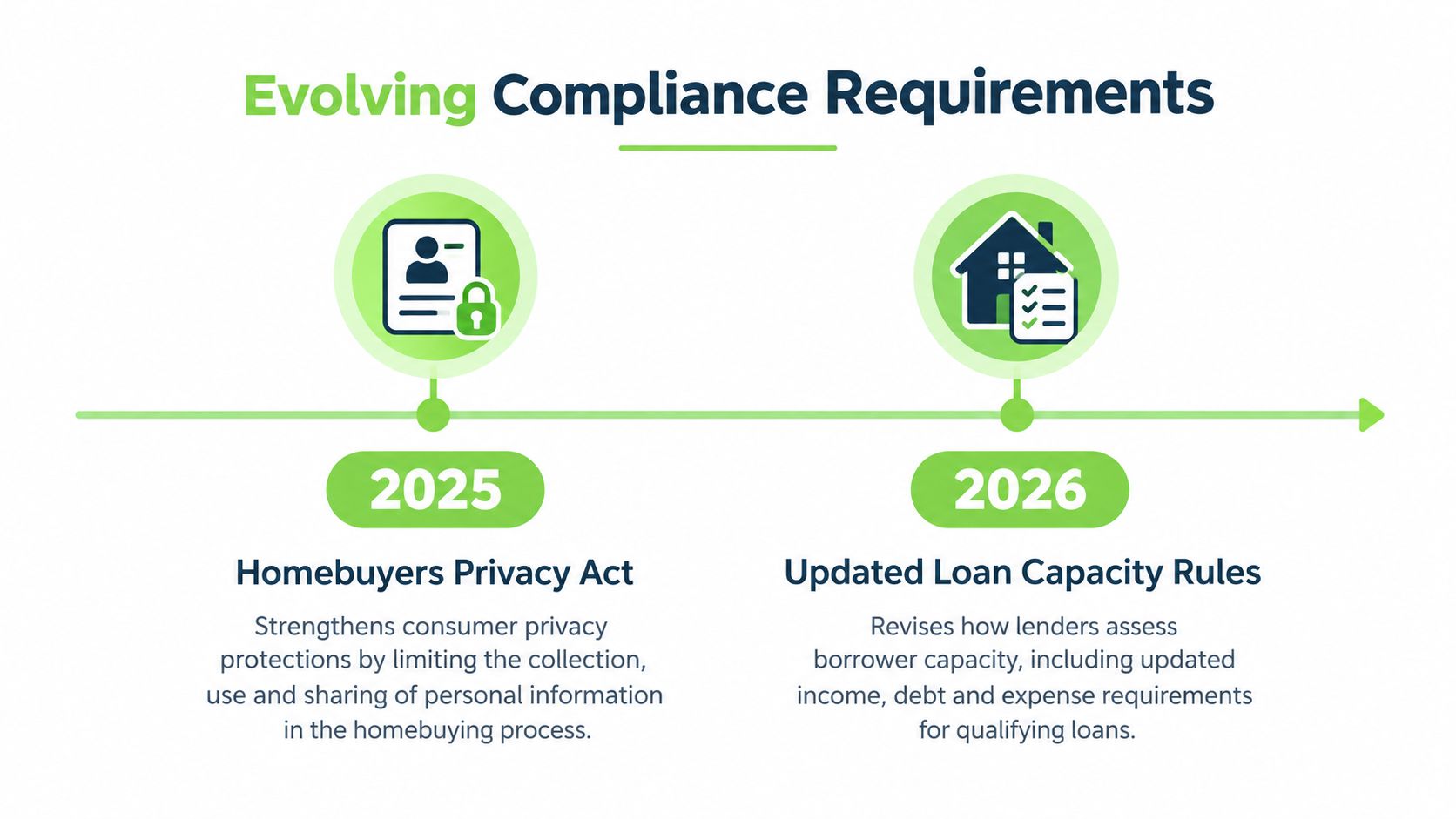
The 2025 Homebuyers Privacy Protection Act discussion states that the Act becomes effective on March 4, 2026 and limits the use of credit reports for unsolicited marketing. The same source describes a CFPB 2026 rule change that narrows ECOA enforcement by removing disparate-impact liability. Those developments don't eliminate the need for fair-lending monitoring. They make the monitoring question less settled, especially as state-level expectations may assume a larger role.
Use a change-control loop
A practical framework has five linked controls:
- Detect: Assign ownership for monitoring federal, state, agency, investor, and privacy developments.
- Interpret: Translate the change into affected products, borrower communications, models, data fields, and procedures.
- Implement: Update policy text, automated rules, forms, training, and escalation instructions together.
- Test: Run representative files, including borderline and unusual cases, before releasing the change.
- Evidence: Preserve the approval record, effective date, test results, version history, and staff communication.
Privacy deserves its own data map. Identify why each credit or borrower field is collected, who can access it, how long it is retained, and whether a marketing use differs from an underwriting use. Lenders should also document borrower consent and vendor responsibilities rather than assuming an existing permission covers every new purpose. Internal privacy expectations should be easy for staff to locate in the organization's privacy policy.
Make automated decisions reviewable
An explainable underwriting process should answer four questions for every material flag. What data triggered it? Which rule applied? What action did the reviewer take? Who approved an exception?
That record helps management monitor consistency even when enforcement priorities shift. It also gives model-risk, compliance, and internal-audit teams a common object to review. The strongest operating model treats automation as a controlled assistant, with human underwriter judgment retained and every override documented.
Building a Guideline Compliance Framework
A workable framework starts with ownership, not software. Name the policy owner, compliance reviewer, business approver, and technology owner for each guideline set. Then create a controlled inventory showing the source, version, effective date, affected products, exceptions, and retired rules.
A practical implementation sequence
- Collect the rules: Gather agency manuals, investor requirements, internal overlays, authority schedules, and procedures.
- Normalize the logic: Separate thresholds, definitions, evidence requirements, exceptions, and escalation points.
- Map the workflow: Identify where data enters, where calculations occur, where an underwriter reviews findings, and where approval is recorded.
- Test representative files: Include clean files, borderline files, conflicting documents, alternative income, and automated recommendations that need challenge.
- Verify the audit trail: Confirm that each issue links to the rule version, source evidence, reviewer response, and final authority.
- Monitor after release: Sample outcomes, investigate recurring flags, and update training when reviewers make the same mistake repeatedly.
Integration should fit the lender's existing environment. A review layer may operate beside the underwriting system or connect through a REST API, provided data access, retention, tenant isolation, and residency controls match the institution's obligations. Teams should document these arrangements in their terms and conditions and vendor governance records.
The final test is simple: can an independent reviewer reconstruct why the lender approved, conditioned, suspended, or declined the file? If not, the process needs clearer rules, better evidence, or stronger decision logging.
FigTrig reviews underwriting notes against an organization's own guidelines and returns plain-language flags linked to specific rulebook sections, helping teams identify documentation and compliance issues before final approval. Visit FigTrig to assess whether an explainable review layer fits your mortgage quality-control workflow.