10 Model Risk Management Software Platforms
The popular advice is to compare model risk management software by feature count. That's the wrong starting point. Model risk management isn't one uniform category: a purpose-built MRM platform may prioritize inventory, independent validation, approvals, monitoring, and examiner-ready evidence, while an enterprise GRC suite extends existing controls and a ModelOps platform governs models in production. Those operating models create different ownership, integration, implementation, and assurance demands.
This comparison evaluates ten platforms against the questions that matter in practice: inventory quality, validation depth, lifecycle control, documentation, monitoring, evidence, integration effort, implementation burden, and fit for insurers. The distinction matters because the modern governance standard began with Federal Reserve Supervisory Guidance on Model Risk Management, which defined a model as a quantitative method, system, or approach that converts inputs into quantitative estimates. Software can organize the resulting governance work, but it doesn't automatically provide an independent reference point proving that outputs are correct.
For insurers, underwriting quality controls can complement MRM governance. FigTrig's underwriting review platform checks underwriting notes against an insurer's own guidelines, linking explainable flags to specific rulebook sections before policies are bound. That's decision-level oversight, not a substitute for model inventory or validation.
Table of Contents
- 1. SAS Model Risk Management
- 2. IBM OpenPages Model Risk Governance
- 3. MetricStream
- 4. Wolters Kluwer OneSumX
- 5. Moody's Analytics Model Lifecycle Management
- 6. ServiceNow Model Risk Management
- 7. Archer
- 8. ModelOp Center
- 9. ValidMind
- 10. Yields.io
- Top 10 Model Risk Management Software Comparison
- Match Governance Depth to Your Operating Model
1. SAS Model Risk Management
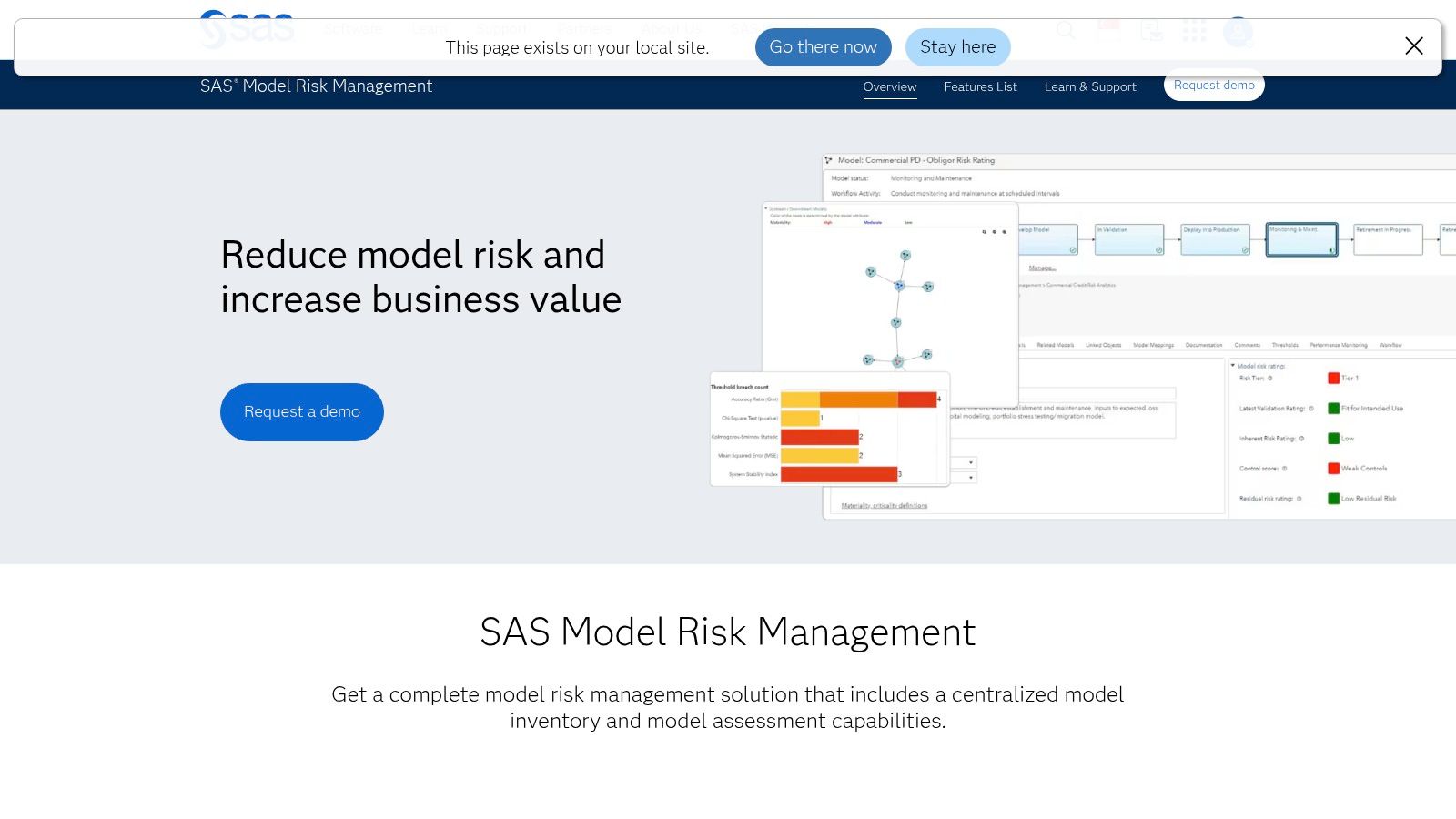
SAS Model Risk Management suits organizations that already depend on SAS analytics and want governance connected to that operating model. It is a purpose-built enterprise MRM platform, with workflows for model inventory, documentation, validation, performance monitoring, approvals, and change control. Product information is available from SAS Model Risk Management.
Its main advantage is the depth of governance available for regulated financial risk. Teams overseeing credit, pricing, reserving, or machine learning models can assign ownership, apply risk tiers, record validation work, manage approvals, and monitor performance within a shared process. Reporting and audit trails address the evidence required during regulatory review. Existing SAS customers may also reduce integration work by connecting governance with their established risk analytics environment.
Where SAS fits best
SAS is a stronger fit for banks and insurers with formal model risk teams, multiple model classes, established analytics standards, and demanding documentation requirements. A smaller risk function may find the platform harder to justify if its immediate need is a lightweight registry, clearer ownership, or basic approval tracking.
- Validation depth: Supports structured validation workflows, repeatable tests, and documented review activities.
- Lifecycle control: Covers inventory, approvals, change management, monitoring, and retirement.
- Integration effort: Usually lower when SAS is central to model development, and higher across mixed toolchains.
- Operational fit: Favors regulated enterprises with dedicated model risk ownership and defined governance roles.
Implementation capacity remains an important constraint. SAS may feel heavier while an organization is still identifying undocumented models or standardizing ownership. Insurers should also keep model governance separate from underwriting decision review. FigTrig's underwriting review platform checks underwriting notes against an insurer's guidelines and links flagged decisions to relevant rulebook sections. SAS can govern the models and supporting evidence, while FigTrig addresses compliance at the individual underwriting decision level.
2. IBM OpenPages Model Risk Governance
IBM OpenPages Model Risk Governance treats MRM as part of an enterprise GRC operating model, rather than as a standalone specialist application. Its IBM OpenPages Model Risk Governance connects model inventories and validation activities with policies, controls, issues, risks, and audit evidence. That operating model fits large, heterogeneous institutions seeking a shared governance structure across risk domains.
OpenPages can support model inventory, tiering, validation workflows, approvals, monitoring, issue management, and evidence capture. Configurable methodologies allow business lines to apply different requirements to different model types. The main benefit is coordination: model findings can enter the same reporting and remediation processes used for broader enterprise risk.

Breadth creates configuration work
OpenPages' breadth also determines its implementation demands. Teams must define model-specific fields, workflow stages, roles, approval rules, and evidence standards before configuration produces consistent records. Platform expertise and partner support may be needed, particularly where the institution is aligning MRM with existing GRC processes.
Practical rule: Choose OpenPages when connecting model risk with enterprise GRC is a current requirement, not a possible future integration.
For a large insurer, that connection can support board reporting, risk acceptance, and escalation of unresolved findings. It can also reduce the chance that validation issues remain isolated in a specialist repository. The limitation is scope, not workflow coverage. OpenPages can route a validation and store its evidence, but it does not define suitable benchmarks, testing procedures, or independent-review judgments for every model class.
That distinction should guide evaluation. Assess validation depth, lifecycle control, documentation quality, and integration effort separately. OpenPages is strongest when shared governance and operational fit outweigh the simplicity of a purpose-built MRM platform.
3. MetricStream
MetricStream operates as enterprise GRC configured for model and AI risk, so its value depends more on governance design than on prebuilt MRM functionality. Its risk management platform covers risk registers, control libraries, workflows, KRIs, KCIs, issues, remediation, and audit reporting. Institutions can adapt these components to support model lifecycle governance and AI oversight, but the platform does not supply a complete validation methodology by default.
For organizations with an established GRC program, that operating model can reduce fragmentation. A model can become a governed risk object linked to owners, controls, assessments, findings, and reports. Configurable workflows can handle intake, tiering, approval, periodic review, exceptions, and remediation, while compliance and internal audit teams use the same control records.

The operating model sets the workload
Before configuration, teams must define what counts as a model, which data validators need, how risk tiers change controls, who approves exceptions, and how monitoring evidence is captured. Poorly defined rules can leave the organization with a broad repository and inconsistent records.
The practical trade-off is clear:
- Validation depth: Determined by the organization's methodology, templates, and integrations.
- Lifecycle control: Strong for routing, approvals, findings, and remediation, while model-specific detail requires design.
- Documentation quality: Can support audit review when evidence fields and review standards are applied consistently.
- Implementation effort: Often substantial because the MRM use case is built on an enterprise GRC foundation.
MetricStream fits a risk function seeking one control architecture across models, AI, third parties, and other risk categories. It is less suitable when validation productivity is the main problem and reviewers need specialized testing workflows with limited solution design. For insurers, the decision turns on operational fit: shared control governance may justify the configuration work, while a purpose-built MRM platform may provide greater depth with less adaptation.
4. Wolters Kluwer OneSumX
Wolters Kluwer OneSumX applies a compliance-led operating model rather than presenting MRM as a standalone analytics workbench. Its relevant capabilities include risk and controls assessments, policy mapping, regulatory content, documentation, case management, and audit trails. The OneSumX compliance risk and controls assessment solution is therefore suited to institutions where compliance obligations and regulatory accountability drive model governance.
Teams can connect policies and controls, collect evidence, manage issues, and report to senior stakeholders. For insurers, this structure fits a program that places model oversight within a wider regulatory control framework. It is less aligned with a validation group whose main constraint is testing throughput.
Compliance coverage requires model-specific configuration
The implementation question is how precisely OneSumX will represent the model lifecycle. Policy obligations and control ownership may be straightforward to organize, while model inventories, validation scopes, technical test results, performance thresholds, dependencies, and change events may require additional design. Independent reviewers need those records to be detailed enough for challenge and follow-up, not limited to attestations or control assessments.
That trade-off separates OneSumX from purpose-built MRM platforms. Its broader compliance context can reduce fragmentation across regulatory work, but a dedicated MRM product may offer deeper validation workflows with less adaptation. The decision should reflect the operating model, integration effort, and documentation standard the risk function must maintain.
- Best fit: Compliance-led organizations linking model risk to regulatory content and controls.
- Strength: Evidence capture, policy mapping, issue management, and senior-level reporting.
- Watch point: Verify that technical validation evidence is supported alongside attestations and control assessments.
- Insurer question: Can it distinguish actuarial, pricing, reserving, underwriting, and vendor models without applying identical review requirements to each?
5. Moody's Analytics Model Lifecycle Management
Moody's Analytics Model Lifecycle Management centers on lifecycle standardization and risk-domain expertise. The Moody's Analytics Model Risk Governance solution is designed for banks, insurers, and corporates that need centralized inventories, validation workflows, monitoring, dashboards, collaboration, and audit-ready records.
Its main advantage is alignment with established financial risk practices. A common lifecycle lets a central model risk function compare records, track approvals, review status, and documentation gaps across a portfolio. Moody's risk content and domain expertise may also suit organizations whose MRM program is concentrated in credit and financial risk.

Standardization versus portfolio diversity
A standardized lifecycle works only when it preserves differences between models. An insurer's reserving, claims, pricing, and underwriting models may require distinct validation evidence, approval routes, and monitoring logic. The platform can provide a shared governance structure, but teams should confirm that model-specific requirements remain visible rather than being reduced to common fields and stages.
That makes Moody's a plausible fit for organizations seeking consistent governance within an established financial risk operating model. Buyers should test coverage for models outside core credit and financial risk, including machine learning systems, vendor models, and operational tools that influence decisions. They should also compare validation depth and integration effort with broader GRC extensions or ModelOps systems, which may offer different workflow and technical controls.
Independent validation needs more than a complete record. A platform can show that a model was documented, approved, and monitored. External benchmarks or trusted reference data may still be needed to assess whether its outputs are accurate.
Implementation is likely to require enterprise-level sales and design work. That may suit a large institution with mature governance resources. Smaller risk teams should assess whether the platform's lifecycle structure, documentation demands, and financial-risk orientation match their operating model.
6. ServiceNow Model Risk Management
ServiceNow Model Risk Management fits organizations that have already chosen ServiceNow for integrated risk management, GRC, or workflow automation. The ServiceNow Model Risk Management application connects model identification, assessment, validation, approval, monitoring, issues, remediation, policies, controls, and CMDB-related data within that environment.
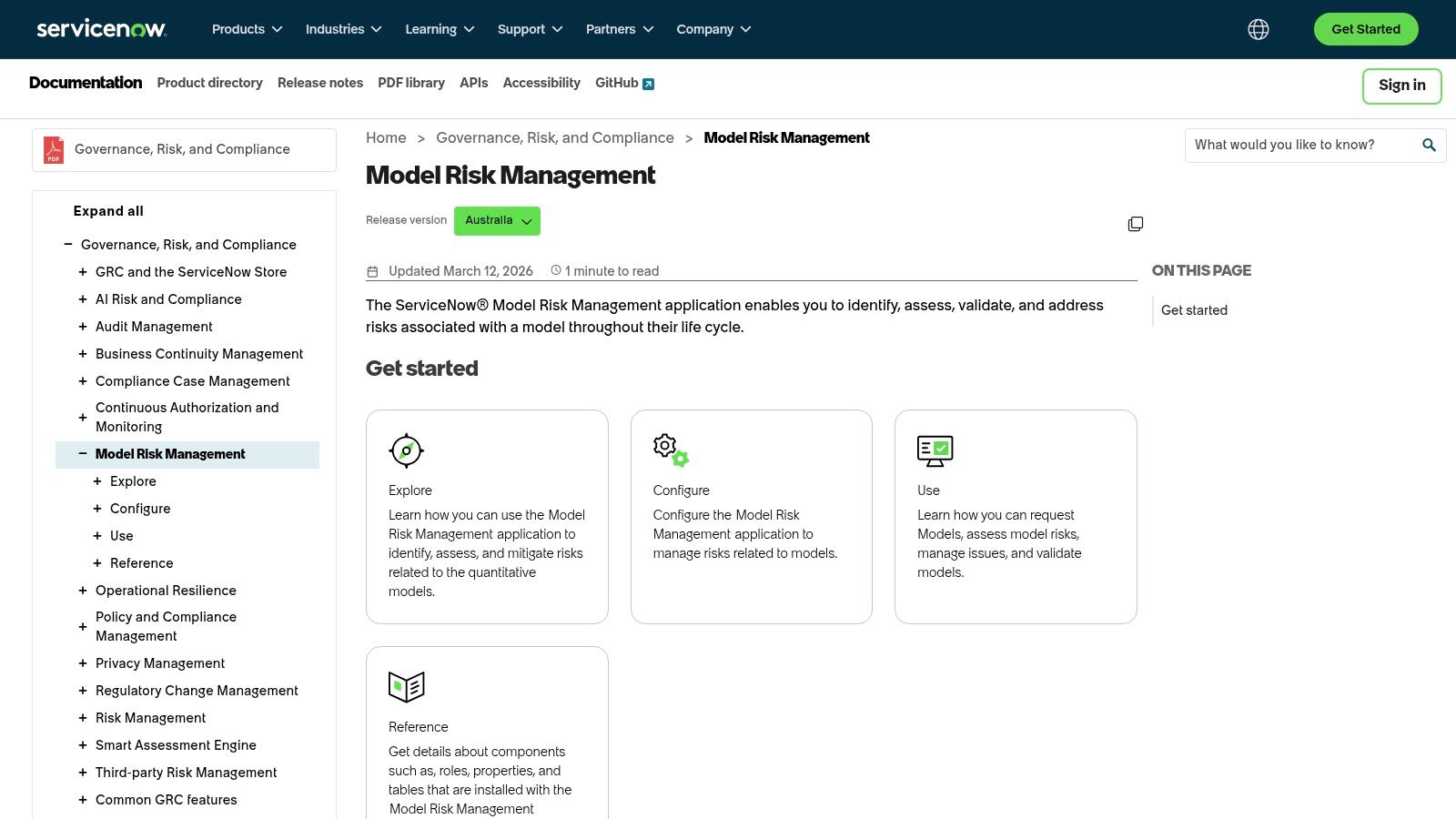
The operating model is enterprise workflow first, specialist MRM second. Its value comes from workflow consolidation. Existing ServiceNow users can manage approvals, findings, evidence, escalations, and remediation through familiar processes. Risk leaders can associate models with wider policies and controls, while technology teams can apply established administration and integration patterns.
That fit matters for insurers with distributed ownership. Model records can sit alongside technology assets, data responsibilities, and control owners, giving governance teams a shared route for escalation. It does not, however, establish model lineage across development, data science, deployment, and production monitoring systems by itself.
Implementation effort depends on the depth of the MRM requirement. Teams may need to configure model classes, validation tests, documentation standards, monitoring thresholds, and technical evidence. CMDB relationships can support asset context, but they do not replace independent validation or specialist assessment of model performance.
ServiceNow is therefore a practical choice for process automation and integration with an existing ServiceNow IRM program. Buyers should test model-specific evidence structures, validation templates, lifecycle controls, and connections to analytics and monitoring tools. A shared workflow may improve accountability without providing the technical assurance layer of a purpose-built MRM or ModelOps platform. The strongest fit is a risk function that values enterprise coordination and remediation over highly specialized validation depth.
7. Archer
Archer places model risk inside Integrated Risk Management, so its operating model starts with enterprise risk coordination rather than specialist model development. The Archer IRM platform can represent model inventories, assessments, controls, issues, attestations, evidence, and reporting. This suits banks and insurers that want model risk handled through the same ownership, escalation, and committee processes as other risk categories.
Its configurable data model can capture MRM fields, model owners, tiering, findings, validation events, approvals, exceptions, and review records. Reporting and workflow support can help risk committees and internal audit, particularly where Archer already holds enterprise risk registers and remediation activity.
The trade-off is implementation ownership. Archer requires the organization to define how models, validation cycles, decisions, monitoring results, and evidence will appear in the system. That flexibility can align the platform with internal policy, but it also increases design, configuration, and maintenance demands. A bank or insurer with Archer expertise may prefer this control. A smaller risk function may need a platform with more predefined MRM structures.
The relevant buying question is whether the organization wants to configure its MRM operating model inside a broader IRM system. Buyers should assess validation depth, lifecycle control, documentation quality, integration effort, and the skills available to maintain the configuration.
Teams should also separate underwriting control from model governance. FigTrig's terms and governance information may help explain a decision-review layer, while an underwriting note check tests adherence to guidelines at the decision level. Archer can still organize the related enterprise risk, ownership, issue, approval, and remediation records. Its strongest fit is an enterprise risk function prioritizing coordinated governance over specialist validation or technical ModelOps control.
8. ModelOp Center
ModelOp Center operates as a ModelOps governance platform, so its buying case differs from enterprise GRC and specialist MRM tools. Its financial services solution emphasizes operational oversight across models and business use cases, including inventory visibility, policy rules, automated governance checks, risk scoring, monitoring, and audit evidence.
The platform fits banks and insurers with models distributed across development, deployment, and monitoring environments. Its focus is the production estate: applying governance policies across modeling stacks, showing where models run, identifying applicable controls, and highlighting changes in operational conditions. That can reduce reliance on periodic reviews and manually updated records, particularly where AI and ML deployments change faster than formal review cycles.
The distinction matters for implementation. ModelOp Center needs connections to development, deployment, monitoring, and lineage sources. Without those integrations, policy checks and inventory coverage may remain incomplete. It also does not replace independent validation, an enterprise control library, risk acceptance workflows, or board reporting held in a GRC system.
Best fit: Organizations managing varied production estates and seeking continuous operational oversight.
Primary strength: Policy enforcement and visibility across modeling stacks.
Likely complement: A GRC platform for enterprise controls or specialist MRM tooling for validation depth and documentation.
Buyers should test how the platform detects deployment changes, misuse, overrides, documentation gaps, and shifts in model performance. They should also assess ownership of integrations and the process for resolving alerts. For insurers and risk teams, ModelOp Center is most suitable when lifecycle control extends into production and operational fit matters as much as the model inventory. A platform designed mainly for periodic review may leave that control gap open.
9. ValidMind
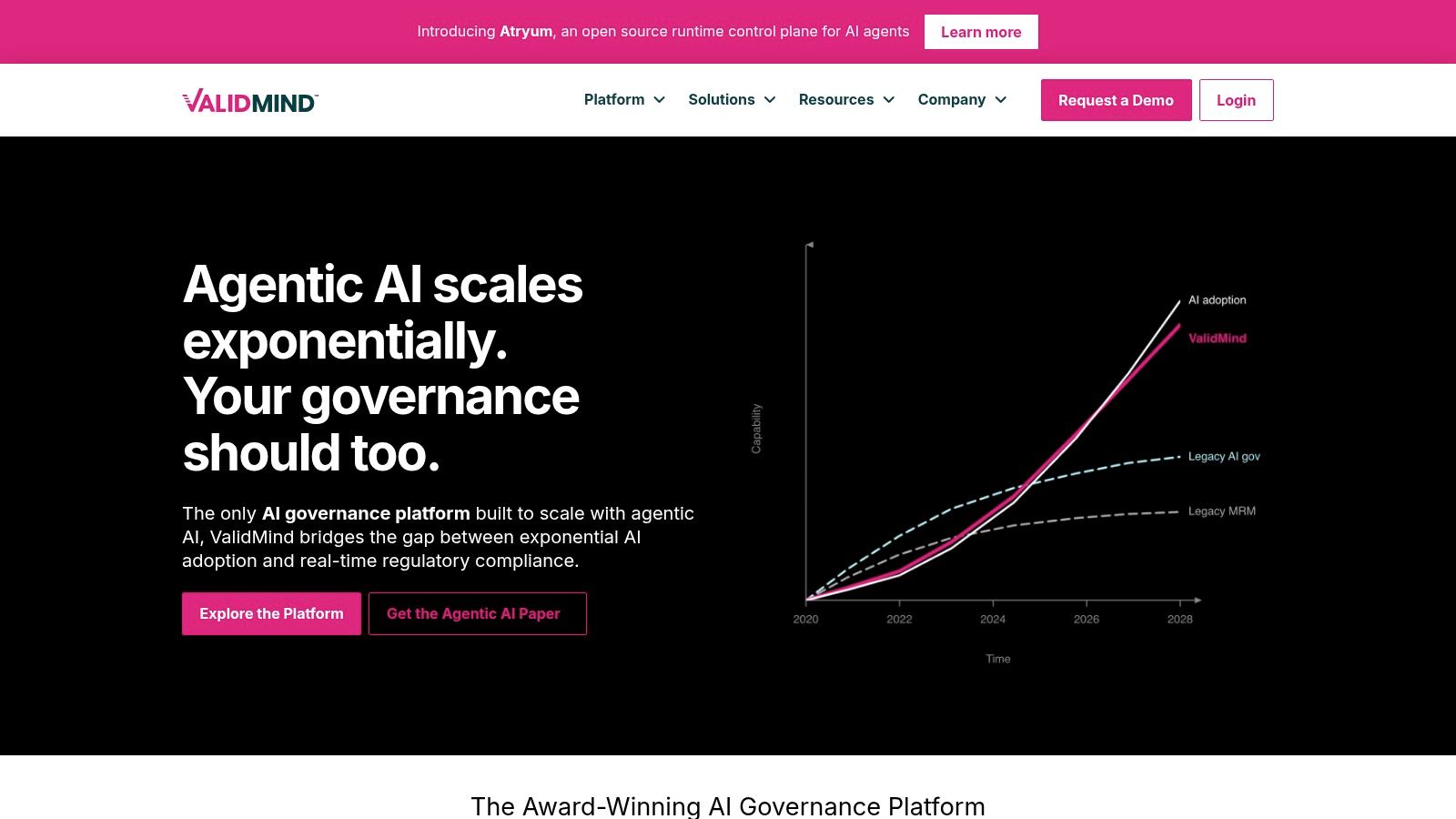
ValidMind is a purpose-built MRM and AI governance platform centered on validation productivity, documentation, approvals, and audit-ready evidence. Its ValidMind platform targets financial institutions seeking standardized workflows and structured artifacts aligned with SR 11-7-style obligations.
Its operating model differs from enterprise GRC extensions and ModelOps governance tools. The emphasis is a validation workbench, with model inventories, lifecycle tracking, approval routes, validation templates, evidence capture, compliance checks, and reporting. This fits teams whose main constraint is reviewing models consistently and assembling defensible records for internal audit or regulators.
Validation productivity is the buying lens
Buyers should test whether the platform improves the validator's work. Can reviewers reuse suitable test structures? Can evidence remain tied to a specific model version? Can model owners, validators, approvers, and auditors view the same status without rebuilding documents in separate systems?
The main trade-off is ecosystem maturity relative to legacy GRC suites. Organizations may still require connections to enterprise policy libraries, issue management, identity systems, data platforms, and broader risk reporting. ValidMind can structure validation, but independent challenge and trusted external benchmarks remain separate responsibilities. For data handling details, see FigTrig privacy information.
Ask for evidence of review quality, not just workflow speed. Faster processing matters only when challenge is appropriately scoped, reproducible, and independent.
ValidMind suits specialist MRM teams seeking dedicated validation capabilities rather than a generic GRC configuration. Insurers and risk teams should assess validation depth, documentation quality, lifecycle control, and integration effort. They should also test whether templates and connections support actuarial and underwriting models alongside machine learning use cases.
10. Yields.io
Yields.io is positioned as a purpose-built platform that combines traditional model risk management with AI governance. Its Yields model risk management and AI governance platform covers model cataloguing, lifecycle workflows, validation, evidence generation, policy alignment, and compliance documentation. The combined scope may suit banks and insurers managing established quantitative models alongside newer AI use cases.
The clearest buying question is whether this breadth improves control quality or adds another governance layer. Yields.io places particular emphasis on structured validation and evidence production. A central catalogue can record ownership and lifecycle status, while defined workflows support review, approval, monitoring, and reporting. For risk teams, that can reduce fragmentation between model records and AI policy documentation, provided the underlying requirements are clearly specified.
Operating-model fit matters more than feature count. A reserving model, pricing model, and AI-enabled decision-support tool may pass through similar lifecycle stages, yet require different tests, evidence, human oversight, and monitoring. Yields.io can support a shared framework, but the organization still needs to set risk tiers, validation standards, ownership, and evidence requirements before implementation.
Its specialist focus distinguishes it from enterprise GRC extensions and compliance-led configurations. That may reduce the amount of MRM design required, while creating questions about integration depth, procurement, support capacity, operational resilience, and enterprise architecture. Teams should confirm how the platform connects with policy libraries, issue management, identity systems, data platforms, third-party tools, and production monitoring.
For insurers, the practical assessment is whether actuarial, underwriting, and AI records can follow appropriate review paths without forcing every model into one template. Yields.io is most relevant when MRM and AI oversight are planned as one operating model. It is less suitable where broad enterprise GRC ownership, extensive legacy integrations, or highly customized compliance reporting already determine the governance architecture.
Top 10 Model Risk Management Software Comparison
| Product | Core capabilities | Unique strengths | Integration & deployment | Compliance & fit |
|---|---|---|---|---|
| SAS Model Risk Management | Central model inventory, validation templates, monitoring & governance | 🏆 Deep financial-risk heritage; ✨ mature regulatory workflows | Best with SAS stack; heavier implementation/time-to-value | ★★★★★ audit-ready; 👥 large banks/insurers; 💰 Premium, license‑centric |
| IBM OpenPages Model Risk Governance | End‑to‑end model lifecycle within enterprise GRC (inventory, approvals, issues) | 🏆 Tight linkage to enterprise GRC; ✨ single governance data model | Requires OpenPages expertise; partner‑assisted rollouts | ★★★★★ regulator-grade; 👥 large, heterogeneous orgs; 💰 High, enterprise GRC pricing |
| MetricStream (Model/AI Risk) | Risk/control libraries, KRIs/KCIs, dashboards, remediation tracking | ✨ Flexible data model; 🏆 strong SI/ecosystem support | Configurable build; design‑dependent time‑to‑value | ★★★★☆ strong reporting; 👥 large financial institutions; 💰 Enterprise, configurable |
| Wolters Kluwer OneSumX | Policy/regulatory mapping, risk & controls assessment, evidence capture | 🏆 Regulatory content pedigree; ✨ compliance‑first workflows | Integrates with compliance modules; may need solution design | ★★★★☆ compliance‑focused; 👥 compliance/audit‑driven firms; 💰 Mid‑to‑high |
| Moody's Analytics Model Lifecycle Management | Model catalogue, standardized validation, monitoring dashboards | 🏆 Moody's risk content; ✨ lifecycle standardization & templates | Cloud SaaS; enterprise sales cycle | ★★★★☆ audit‑ready; 👥 banks/insurers seeking consistency; 💰 Enterprise SaaS |
| ServiceNow Model Risk Management | Model inventory, validation workflows, issues/remediation tracking | 🏆 Strong workflow automation & UX; ✨ integrates with IRM/GRC & CMDB | Best for existing ServiceNow customers; configurable app | ★★★★ compliance workflows; 👥 ServiceNow customers; 💰 Subscription/enterprise |
| Archer (IRM) | Risk registers, controls, workflows, attestations | ✨ Highly configurable data model; 🏆 mature IRM reporting | Implement as MRM use case within Archer; build‑out required | ★★★★ governance‑capable; 👥 orgs standardizing IRM; 💰 Enterprise |
| ModelOp Center | Operational model governance, policy rules, risk scoring & monitoring | 🏆 Built for production ModelOps; ✨ automated policy enforcement | Integrations across modeling stacks required; production focus | ★★★★ production audit trails; 👥 ML/AI in production (banks/insurers); 💰 Mid‑high |
| ValidMind (AI & MRM) | Model inventory, validation automation, approvals, audit artifacts | ✨ Automation for validation productivity; 🏆 audit‑ready artifacts | SaaS, newer vendor; integrates with GRC as needed | ★★★★☆ validator‑focused; 👥 validation teams in finance; 💰 Competitive SaaS |
| Yields.io (Yields) | Model catalogue, automated validation, AI compliance & evidence | ✨ Combines MRM + AI compliance (EU AI Act readiness); 🏆 validation automation | End‑to‑end SaaS; implementation depends on client processes | ★★★★ AI/compliance focus; 👥 firms needing AI governance; 💰 Mid (vendor scale dependent) |
Match Governance Depth to Your Operating Model
The right model risk management software choice starts before the shortlist. First, define the inventory. Include models in development and production, identify owners and users, record the decisions each model influences, and establish risk tiers based on materiality and exposure. The Federal Reserve's SR 11-7 guidance remains a foundational reference for the lifecycle concepts that platforms now automate, including inventory, validation, monitoring, documentation, and governance.
Next, specify the evidence independent validators and regulators need. Don't settle for a record showing that someone completed a review. Ask whether the system preserves versioned assumptions, data lineage, test results, benchmarks, limitations, approvals, exceptions, monitoring results, and remediation history. The underserved issue is important: lifecycle software can prove that a process was followed, but it may not provide the external reference point needed to establish that model outputs are correct.
Then choose the operating model. SAS Model Risk Management, ValidMind, Moody's Analytics Model Lifecycle Management, and Yields.io are the stronger candidates when specialist MRM, validation productivity, and lifecycle standardization lead the decision. IBM OpenPages, MetricStream, ServiceNow, Archer, and OneSumX make more sense when MRM must sit inside an established GRC, compliance, control, issue, and reporting ecosystem. ModelOp Center is the better complement when production AI and ML oversight, policy enforcement, and cross-tool visibility are the main gaps.
Test the integration and ownership model
A demonstration should follow one model from intake to retirement. Ask the vendor to show:
- Inventory control: How are ownership, tiering, dependencies, intended use, and third-party status captured?
- Validation independence: Can the validator work separately from the model owner, preserve effective challenge, and attach evidence to a precise model version?
- Monitoring: Can the platform detect performance drift, data drift, misuse, overrides, exceptions, and deployment changes?
- Documentation: Does evidence emerge from normal work, or must teams assemble reports manually?
- Integration: How will data science tools, model registries, deployment systems, GRC, identity, issue management, and audit repositories connect?
- Operational ownership: Which team maintains taxonomies, templates, policies, integrations, and reporting?
The market remains early enough that adoption patterns don't point to a single universal winner. A 2025 market estimate valued the global model risk management software market at $5.2 billion, with North America representing 42.5% of revenue, software representing 62.3%, and cloud deployment representing 53.2%. That outlook projected growth to $13.8 billion by 2034, at a 12.4% CAGR. These are projections, not guarantees, but they indicate why buyers should expect continued platform expansion and category overlap.
The adoption picture also argues against rushing into consolidation. PwC's 2023 survey, as reported in market research on MRM adoption, found that almost half of surveyed financial institutions had adopted an effective technology solution, while 54% had not. Among institutions without one, about half planned implementation soon. The result is a market in transition, not a saturated category where every product has converged.
For insurers, keep underwriting decision review separate but connected. Model governance manages the models, data, validation, monitoring, and approvals that support risk decisions. A tool such as FigTrig reviews every underwriting note against the carrier's own guidelines, raises explainable flags in seconds, and maintains an audit-ready record linking each flag to the relevant rulebook section. That's a complementary control layer for decision quality before binding, not a replacement for MRM validation.
Choose the platform only after you can explain who owns each control, what evidence proves it worked, and how the organization will respond when a model changes or its operating conditions shift. That sequence will usually produce a better decision than selecting the product with the longest feature list.
FigTrig adds a decision-level quality layer for insurers by reviewing underwriting notes against their own guidelines and linking clear flags to exact rulebook sections. Visit FigTrig to see how explainable, audit-ready underwriting checks can complement your model risk management program.