
Audit Trail Policy Template and Implementation Guide
A broker disputes a declination six months after bind. An account manager has moved on, the underwriter's notes sit in three systems, and the claims team can't tell which guideline version was in force when the decision was made. That's when an audit trail policy stops being a controls document and becomes the only thing standing between a defensible reconstruction and a mess of recollections, screenshots, and excuses.
Underwriting leaders should treat the policy as a reconstruction contract. It has to promise, in plain terms, what evidence will still exist when regulators, internal audit, claims handlers, or litigators come back months or years later and ask who changed what, when, why, and under whose authority. If your policy can't support that replay, it isn't strong enough.
Table of Contents
- Why an Audit Trail Policy Matters for Underwriting Decisions
- Purpose, Scope, and What the Policy Covers
- Core Components of an Audit Trail Policy
- Roles, Responsibilities, and Accountability
- Access Controls and Segregation of Duties
- Retention Periods, Storage, and Legal Hold Handling
- Example Clauses You Can Adapt Today
- Monitoring, Review Cadence, and Audit Readiness
- Extending the Policy to AI-Assisted Underwriting
- Implementation Roadmap and First-Year Review
- Quick Reference Checklist and Common Pitfalls
Why an Audit Trail Policy Matters for Underwriting Decisions
A challenged underwriting decision rarely starts as a compliance problem. It starts as a disagreement over the facts. A commercial property risk is declined in March, the broker files a misrepresentation complaint in October, and 18 months later a regulator wants the file reconstructed from submission to bind. Without a written audit trail policy, the team is left piecing together emails, portal notes, and system screenshots after the fact.
That's a bad place to be. Regulators and auditors don't want a story, they want evidence that the decision path was controlled, traceable, and reviewable. The policy needs to make that promise explicit, because a trail that exists only by habit disappears the moment a key person leaves, a system changes, or a manual workaround becomes the norm.
Practical rule: if a decision could be questioned in a complaint, a market conduct exam, or an internal review, it must be replayable without asking the original underwriter to remember the details.
For underwriting leadership, the issue is not whether logs exist. It's whether the organization can reconstruct the premium, exclusion, condition, and any override long after the decision-maker has moved teams. That's why the policy has to cover capture, retention, access, and review together. Leaving any one of those out turns the trail into background noise.
The strongest benchmark here is long-horizon evidence preservation, not short operational convenience. The Sarbanes-Oxley Act of 2002 established a widely used 7-year retention benchmark for audit workpapers and financial records, and that standard is echoed across compliance programs because it matches the reality of investigations and disputes that surface far later than day-to-day operations DiliTrust audit trail guidance. The policy logic is simple, preserve enough evidence to reconstruct the decision when the challenge arrives, not just while the file is still fresh.
Purpose, Scope, and What the Policy Covers
The purpose of the policy is straightforward. It defines what evidence the organization commits to capturing, preserving, and producing when an underwriting decision is challenged. If the policy can't answer that question clearly, it's too vague to govern real work.
Scope has to be tight. Include binding and quoting systems, bordereaux processing, delegated authority interactions, pricing engines, rule engines, document management for slips and endorsements, underwriter workstation actions, model and AI inference logs, and broker portal submissions. Exclude marketing analytics, HR access logs, and unrelated telemetry that doesn't support a decision or its underlying evidence.
A useful way to draw the line is this, if the event could affect a quote, limit, coverage form, or premium, it belongs in scope. If it can't be tied to a decision, it belongs somewhere else.
| Scope Boundaries for an Underwriting Audit Trail Policy | |
|---|---|
| In Scope | Out of Scope |
| Quote, bind, endorsement, cancellation, and referral actions | Marketing dashboards and campaign analytics |
| Underwriter notes, approvals, overrides, and authority exceptions | HR access logs and employee productivity monitoring |
| Rule engine lookups and model inference events | Generic infrastructure telemetry with no decision link |
| Broker submissions, delegated authority messages, and bordereaux records | Device diagnostics unrelated to a file action |
| Document version changes on slips, forms, and endorsements | Casual collaboration chat not tied to a controlled decision |
This scope should also cover human actions, system actions, and automated actions. That matters because modern underwriting chains aren't just people typing into a screen. They're a mix of rule engines, portals, document stores, reviewer actions, and exception handling. If the policy only covers the system and not the people around it, it won't survive regulatory scrutiny.
Keep the scope tied to the decision classes your organization is willing to defend. If the file could end up in front of a regulator, an internal auditor, or a claims handler, it needs to be inside the policy boundary.
Core Components of an Audit Trail Policy
A usable policy starts with event capture, not abstract principles. NIST frames audit trails as records of both successful and failed actions, including user IDs, timestamps, and event outcomes, and NIST SP 800-171 expects logs to support monitoring, analysis, investigation, and reporting of unauthorized activity NIST audit trail guidance. For underwriting, that means the trail has to show the full decision path, not just the final answer.
What must be captured
At minimum, capture creation, modification, approval, override, referral, declination, endorsement, cancellation, and any privileged access to the file. These are the moments an examiner, claims handler, or internal auditor will ask about first. If they're missing, the trail fails its basic job.
Each event needs the same core fields:
- Timestamp with timezone, so the sequence can be reconstructed accurately.
- Actor identity, so accountability is attached to a real person or system account.
- Source system, so reviewers know where the event originated.
- Record identifier, so the event can be linked to the file.
- Action type, so the meaning of the event is clear.
- Before-and-after values, so the actual change can be proven.
- Justification or reason code, so the decision isn't just visible, it's explainable.
- Correlation key, so the event links back to the parent submission.
Integrity controls that make the record credible
The policy should require write-once storage, cryptographic hashing, time synchronization, and tamper detection. It should also require reconciliation between source system logs and the centralized audit store. That last control matters because a trail that exists in one system but not the other raises obvious questions in review.

If you can't prove the change, the change didn't happen as far as audit is concerned.
Omit the before-and-after values, and you've got activity, not evidence. Omit the timezone, and you've lost sequence. Omit the justification, and you've left the reviewer guessing. The policy should make these fields mandatory, not optional.
Roles, Responsibilities, and Accountability
A policy without named ownership fails in the first review. The control owner is accountable for the policy itself, the log custodian is accountable for capture and storage, and reviewers need read-only access to challenge the evidence without changing it. That division is not bureaucratic overhead, it's the only way to keep the trail trustworthy.
The cleanest model is a RACI structure. The control owner, usually a senior underwriter or operations head, owns policy attestation and scope decisions. The log custodian, usually an IT or platform lead, owns timestamping, storage integrity, and exportability. Compliance, internal audit, and second-line risk act as reviewers. The approver, often a CCO or committee chair, signs off on retention exceptions, legal hold releases, and policy version changes.
| RACI for Audit Trail Policy Ownership | |
|---|---|
| Role | Primary Duties, Accountability |
| Control Owner | Owns policy content, annual attestation, and business approval of scope |
| Log Custodian | Owns capture, timestamping, storage integrity, and export controls |
| Reviewer | Samples logs, investigates gaps, and validates trail completeness |
| Approver | Signs policy changes, retention exceptions, and legal hold releases |
Escalation paths need to be written, not assumed. If a review finds a missing event sequence or a broken correlation key, the reviewer escalates to the control owner, who then engages technology and compliance. If the issue affects retention or preservation, the approver has to decide whether a legal hold applies.
Written acceptance matters here. Every named role should confirm the assignment at least annually, because a role nobody acknowledged is a role nobody will defend when the file gets tested. For a practical template structure, even a policy glossary page like FigTrig's terms and definitions reference can help teams keep control language consistent across documents.
Access Controls and Segregation of Duties
Audit logs are evidence, so access to them should be tighter than access to the underlying work queue. Use least privilege and split access so no single person can both change a decision and rewrite its trail. That's the standard regulators will look for, even if they don't say it in exactly those words.
Define three access tiers
Read-only reviewers include compliance, internal audit, and claims handlers. They can query and export, but they cannot modify. Privileged administrators include platform engineering and infrastructure support. They manage the environment, but they should not originate underwriting decisions. Emergency access holders are the break-glass group, and they need dual approval plus tamper-evident session records.
The prohibitions should be blunt. No underwriter may have write access to their own decision logs. No IT administrator may hold both delete rights and reviewer rights. Those two rules eliminate the easiest path to self-protection after a mistake.
Joiner-mover-leaver controls belong here too. Access should be granted on role entry, recertified on a schedule, and removed the day a person leaves or changes function. Quarterly recertification is the minimum discipline I'd expect to see in a mature program.

Who could have changed this record, who reviewed it, and how do you prove it?
That's the question every access control design should answer before go-live. If the answer is fuzzy, the control isn't finished.
Retention Periods, Storage, and Legal Hold Handling
Retention should follow the longest applicable rule, not the easiest one. A policy that sets one blanket period for every log class almost always gets it wrong somewhere. Investigators search by event type, so the policy should classify retention by log class.
Set retention by log class
Underwriting decision logs, model invocation records, and approval chains should be retained for the longest period your record regime requires. Authentication logs can sit in a shorter tier. System operational logs can sit in an even shorter tier if they aren't needed to reconstruct a decision.
| Retention Rules by Log Class | |
|---|---|
| Log Class | Retention Period, Storage Control, Primary Driver |
| Underwriting decision logs | Longest applicable regulatory period, tamper-evident storage, decision reconstruction |
| Model invocation records | Longest applicable regulatory period, immutable or append-only storage, model governance |
| Approval chains and override trails | Longest applicable regulatory period, exported with chain of custody, accountability |
| Authentication logs | Shorter operational period if allowed, protected storage, access investigation |
| System operational logs | Shorter operational period if allowed, monitored archive, technical troubleshooting |
Use WORM, cryptographic hashing, or an append-only database if you want the trail to carry evidentiary weight. Exports should preserve chain of custody, because a copied file with no provenance is weak evidence. GDPR also matters here, because logs that contain personal data should be minimized and protected with role-based access, while still remaining available for legitimate review ISO records-management standard.
Legal hold handling must be explicit. Only the designated approver should declare a hold, the hold should name the affected log classes, and normal deletion cycles must pause until formal release. If you don't test the hold process, you don't really have one.
For a privacy-aware retention checklist, teams can pair the policy with FigTrig's privacy guidance page so they don't accidentally over-collect or under-preserve the wrong evidence.
Example Clauses You Can Adapt Today
Policy language should be tight enough to survive review and flexible enough to fit local law. Don't hide behind phrases like “as needed” or “authorized personnel” without defining what they mean. Auditors will push on that wording because it creates escape hatches.
1. Scope and applicability
“1.1 This policy applies to all systems, users, automated services, and third-party interfaces that create, modify, approve, decline, endorse, cancel, or otherwise affect an underwriting decision, associated evidence, or supporting record.
1.2 This policy excludes records that do not support the reconstruction of an underwriting decision, including general marketing analytics and unrelated workforce telemetry.
1.3 Where jurisdiction-specific requirements impose a longer retention period or stricter control, the stricter requirement applies.”
2. Minimum event capture
“2.1 The organization shall capture, at a minimum, the event timestamp with timezone, actor identity, source system, record identifier, action type, before-and-after values, reason code or justification, and correlation key for each in-scope event.
2.2 Manual overrides, referrals, and privileged file access shall be recorded as separate events.”
3. Integrity and immutability
“3.1 Audit trail records shall be protected from unauthorized alteration or deletion through write-once storage, append-only controls, cryptographic hashing, or equivalent tamper-evident mechanisms.
3.2 Any export of audit trail records shall preserve source attribution, time sequence, and chain of custody.”
4. Tiered retention
“4.1 Retention periods shall be defined by log class and mapped to the longest applicable legal, regulatory, contractual, and litigation-hold requirement.
4.2 Retention schedules shall not be shortened by local convenience or system limitation.”
5. Role-based access and segregation of duties
“5.1 Access to audit trail records shall be restricted to approved roles on a least-privilege basis.
5.2 No individual may have authority to both originate an underwriting decision and alter the corresponding audit trail record.
5.3 Emergency access shall require dual approval and produce tamper-evident session records.”
6. Review cadence and escalation
“6.1 Audit trail integrity checks shall occur on a documented schedule.
6.2 Exceptions, gaps, and failed controls shall be escalated to the control owner and, where necessary, to the approver for legal hold or remediation action.
6.3 The policy shall be reviewed when regulations change, systems change, or model-based underwriting is introduced.”
Keep the hard language where auditors care most, retention, integrity, access, and review. Leave no ambiguity around “as needed” unless legal has specifically narrowed it.
Monitoring, Review Cadence, and Audit Readiness
Audit-ready means you can prove the trail is intact and usable before anyone asks for it. Daily integrity checks should confirm the log chain hasn't broken. Weekly sampling should look for missing events, broken correlations, and odd access patterns. Monthly access recertification should confirm who still needs read access. Quarterly management reporting should show exceptions, open issues, and remediation status.
The escalation logic should be simple. A missing event sequence goes from analyst to control owner to risk committee if it isn't corrected quickly. After-hours admin activity on underwriting systems, bulk exports of decision logs, or unauthorized changes to retention rules should be treated as anomaly events, not routine noise. Preventive monitoring blocks misuse, detective monitoring finds what slipped through, and you need both.
External auditors will want reproducible evidence packs. Those packs should include the exact query used, the UTC timestamps, the file identifiers, and the sign-off chain showing who reviewed the output. If the evidence can't be rerun, it's not really evidence, it's a report.
| Monitoring Cadence and Escalation Matrix | |
|---|---|
| Activity | Frequency, Owner, Escalation Path |
| Integrity checks | Daily, log custodian, control owner |
| Sampling review | Weekly, control owner, compliance |
| Access recertification | Monthly, manager and log custodian, compliance if exceptions remain |
| Management reporting | Quarterly, control owner, risk committee |
| Retention rule review | On change or exception, approver, legal and compliance |
If your monitoring stops at alerts and never turns into documented action, the policy isn't operational. It's decorative.
Extending the Policy to AI-Assisted Underwriting
AI changes the audit trail from a process record into a decision lineage record. The trail has to show not only what was decided, but what the machine saw, what it recommended, and who let it stand. That's the difference between logging and reconstruction.
For every automated or AI-assisted decision, capture the model name and version, input feature snapshot, confidence or score, human reviewer identity, override rationale, and timestamp. If prompt logs or training-data provenance materially shaped the decision, those should be included too. AI audit trail guidance already frames the record as the evidence layer that lets you reconstruct decisions after the fact, and it ties each event back to the specific model or agent involved Collibra AI audit trail guidance.
Regulatory scrutiny will get sharper, not softer, around declined or high-exposure cases. Keep the trail rich enough that a reviewer can see whether the machine flagged a risk, what the human did with that flag, and whether the final action followed policy. That's the standard that matters.
If the AI system influenced the underwriting file, the policy should treat that influence as part of the official evidence chain. No separate shadow log, no missing version history, no orphaned recommendation.
Implementation Roadmap and First-Year Review
Start with a gap assessment. Compare current logging practices against the policy requirements, and document every place where the trail can't be reconstructed cleanly. That output belongs to Legal, Compliance, IT, and Underwriting leadership before anything else moves.
Then draft and configure the controls. The technical work should cover log shippers, WORM storage, SIEM rules, export controls, and the required access tiers. If the control can't be configured, say so early and adjust the policy or the system, but don't pretend the gap doesn't matter.
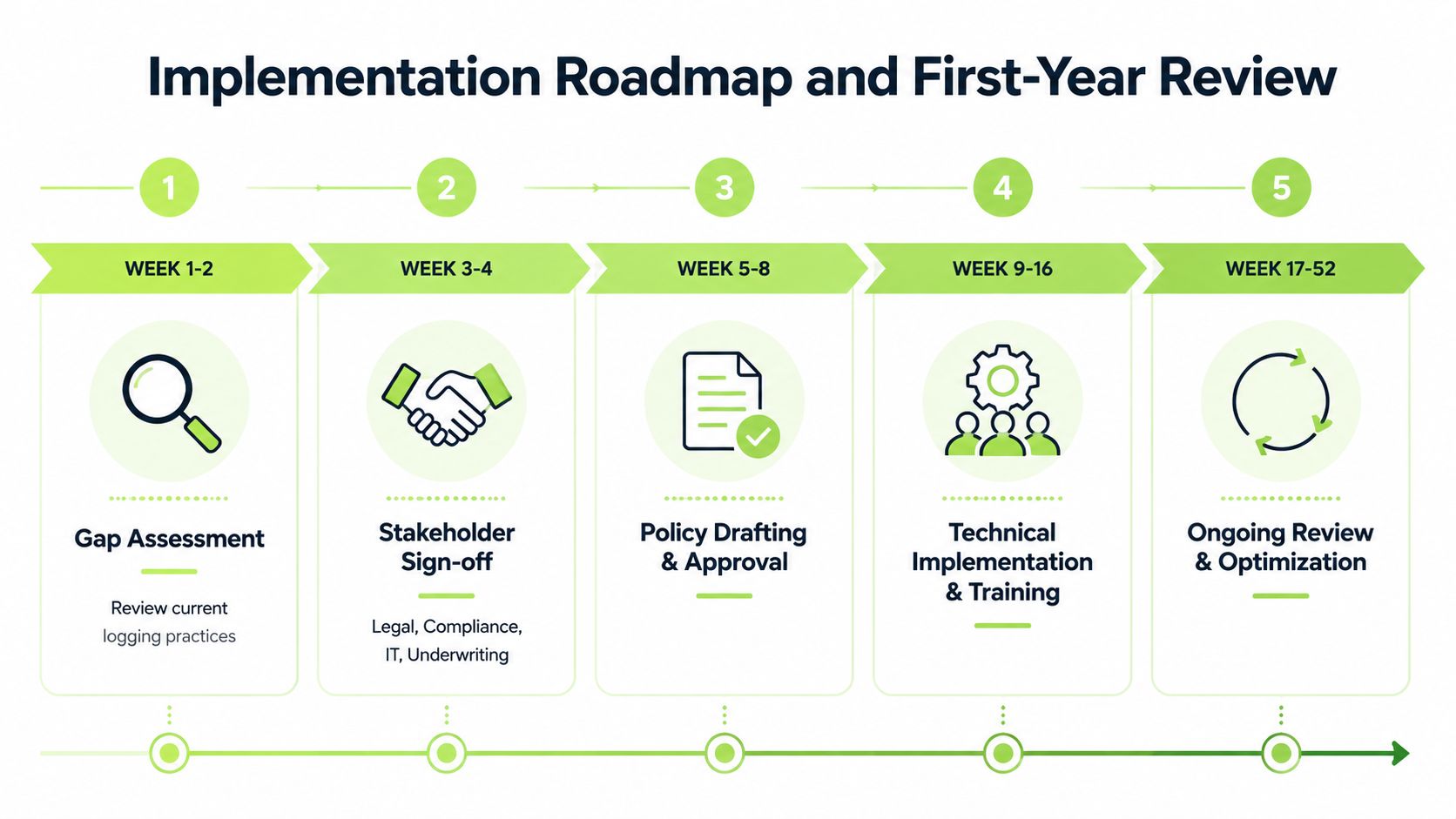
Use the rollout path below as the operating sequence:
- Week 1 to 2, gap assessment. Owner, control owner. Evidence, current-state log inventory and gap register.
- Week 3 to 4, stakeholder sign-off. Owner, Legal, Compliance, IT, and Underwriting leadership. Evidence, approval memo and issue log.
- Week 5 to 8, policy drafting and technical setup. Owner, log custodian with policy owner review. Evidence, draft policy, configuration notes, and testing results.
- Week 9 to 16, training and go-live. Owner, business and technology leads. Evidence, training completion, go-live checklist, and first sample review.
- Week 17 to 52, ongoing review and optimization. Owner, control owner with compliance oversight. Evidence, sampling results, remediation tracking, and management reporting.
At month 12, the policy owner should re-test scope, retention, and access controls, then refresh the clauses if new regulations, systems, or AI underwriting tools have been introduced. The annual attestation pack should include the current policy version, the retention matrix, the access recertification record, the latest evidence samples, and the open-issues log. For an implementation hub that supports this kind of control discipline, FigTrig is one platform teams can review when they want underwriting checks and audit-ready recordkeeping to sit alongside existing systems.
Quick Reference Checklist and Common Pitfalls
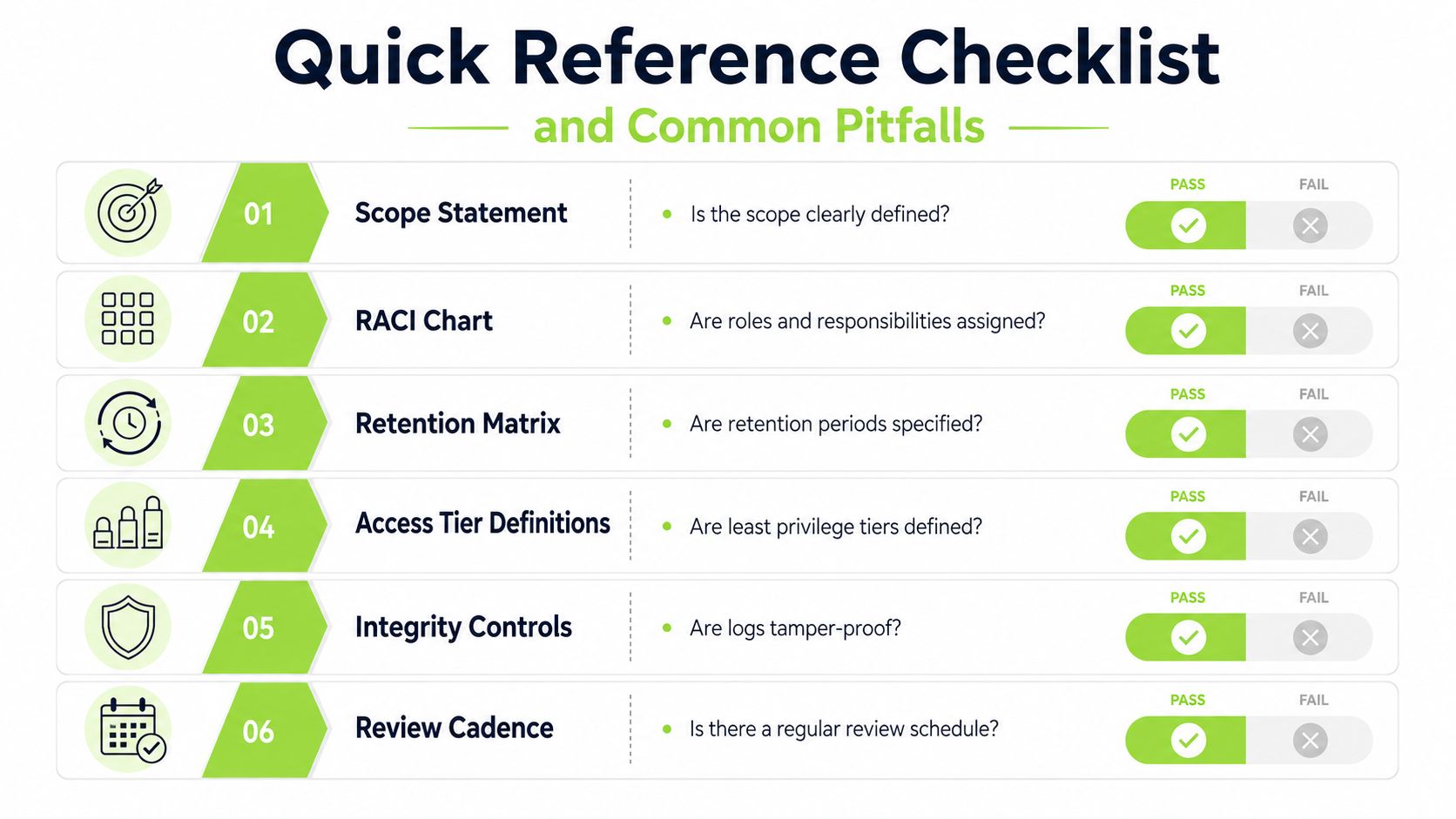
Use this checklist before go-live. If any answer is “no,” the policy isn't ready.
- Scope Statement: Is the scope clearly defined?
- RACI Chart: Are roles and responsibilities assigned?
- Retention Matrix: Are retention periods specified by log class?
- Access Tier Definitions: Are least privilege tiers defined?
- Integrity Controls: Are logs tamper-proof?
- Review Cadence: Is there a regular review schedule?
The failures repeat. Teams capture logs but never review them. They set retention to an operational convenience instead of a regulatory minimum. They leave shared admin accounts on the logging platform. They forget to store model version and prompt metadata for AI-assisted decisions. They declare legal hold rights in the policy but never test the trigger.
A few questions come up often.
Does this apply to delegated authority partners? Yes, if their decisions affect your underwriting outcome or evidence chain.
Do soft-deleted records count? Yes, if they are part of the reconstructable decision history or can still alter the file's meaning.
Should every system event be captured? No, only events tied to decisions, evidence, control execution, or privileged access.
What happens if local law conflicts with the policy? The stricter preservation or access rule should govern until legal says otherwise.
If you want a policy that holds up under internal audit, claims dispute, and regulatory review, build it on reconstruction, not retention slogans. FigTrig helps underwriting teams review notes against their own guidelines and maintain an audit-ready record that links each flag to the relevant rule section. Visit FigTrig to see how that control layer can sit beside your underwriting process and strengthen the evidence chain.


