
Underwriting Risk Management Guide for Modern Insurers
The surprising part of underwriting risk management is that the biggest exposure usually isn't one dramatic bad file, it's the steady drift of thousands of ordinary decisions. That's why a carrier can end up with an underwriting loss even when most files look fine on their own, as shown by the U.S. P&C industry's $18.4 billion underwriting loss in 2023 and 76.2% net loss ratio reported by the NAIC in the cited industry materials NAIC-referenced filing. The job, then, is not to sample a few files and hope for the best. It's to govern every binding decision so appetite, authority, quality checks, and remediation all work as one control loop.
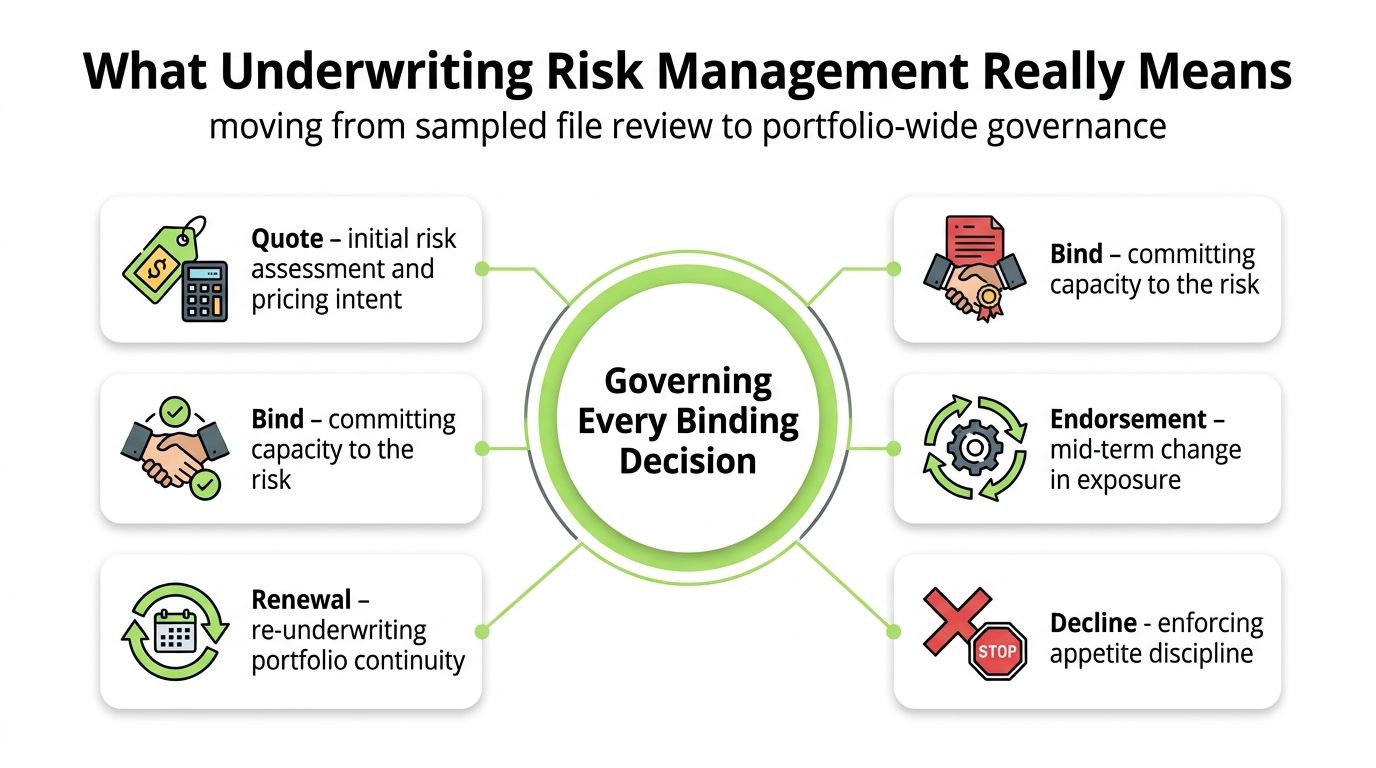
Table of Contents
- What Underwriting Risk Management Really Means
- Setting Risk Appetite and Limits That Hold
- Governance, Authority and Oversight Structures
- Why Manual QA Sampling Falls Short
- Building Full-Population Underwriting Checks
- Decision-Centric Governance with Explainable Flags
- Monitoring, Remediation and Continuous Improvement
- Putting the Underwriting Risk Management Loop Into Practice
What Underwriting Risk Management Really Means
Underwriting risk management is the discipline of controlling each quote, bind, endorsement, renewal, and decline so the portfolio stays inside appetite and the decisions can be defended later. It isn't just a compliance review after the fact. It's a live operating model that tells underwriters what they may accept, what they must escalate, and what evidence has to exist before a policy goes out the door.
The practical unit of control is the decision
Every binding action creates risk, even when the file looks routine. A small wording miss, a missed loss history issue, or an exception that never got logged can be enough to move a policy outside the intended rule set. That's why the decision itself, not just the file, has to be traceable.
Practical rule: if a decision can't be reconstructed from the note, the rulebook, and the authority limit, it wasn't governed well enough.
The cleanest way to think about the process is as a loop. A written appetite defines what belongs in the book. Limits turn that appetite into something an underwriter can apply quickly. QA checks whether the decision matched the rule. Monitoring shows where leakage is forming. Remediation feeds the fix back into appetite, rules, or authority.
That loop matters because underwriting loss is cumulative. The combined ratio is the core measure here, and a ratio of 100% means break-even on underwriting, while 150% means an insurer pays out $1.50 for every $1 of premium NAIC-referenced filing. Small slippage repeated at scale becomes expensive fast.
Where teams usually go wrong
Separating appetite, QA, and remediation into different meetings and different owners creates delay. An underwriter may follow the rules as written, but if the rule is vague, the limit is missing, or the exception path is unclear, the book drifts anyway.
The better model is simple. Define the rule. Measure the decision. Flag the breach. Fix the cause. Then update the rule or limit so the same mistake doesn't recur.

Setting Risk Appetite and Limits That Hold
Risk appetite is the starting line. If leadership can't say which classes, geographies, exposures, and referral conditions are in or out, every downstream control has to guess. That guesswork is where underwriters start making local decisions that don't add up to the portfolio intent.
Turn appetite into fast decision rules
A good appetite statement is written for action, not for ceremony. It should tell an underwriter what belongs in the book, what needs a referral, and what is off limits. Then it should be translated into limits that can be applied in seconds, not after a committee meeting.
The point is scale. The combined ratio data above shows why even small misses matter across a whole portfolio. If the carrier is already operating near breakeven, a loose limit on one class or one territory can spread into a measurable underwriting problem before anyone notices.
| Core Risk Appetite Limits and Their Operational Triggers | ||
|---|---|---|
| Limit Type | Example Threshold | Operational Trigger |
| Authority tier | Below a named bound level | Auto-refer to senior underwriter |
| Line size | Above approved single-risk size | Pause bind until approval |
| Aggregate exposure | Near concentration ceiling | Open portfolio review |
| Geography | Outside approved territory | Reject or escalate |
| Risk type | Outside stated appetite | Decline or document exception |
| Documentation quality | Missing required evidence | Hold until file is complete |
A limit only works if someone owns it. If no one is accountable for changing the threshold after a catastrophe year, a regulatory shift, or a material portfolio change, the limit becomes stale. Leadership should review appetite often enough that underwriters trust it, because they'll stop using rules that don't match reality.
Make the limit visible at the point of quote
Underwriters shouldn't have to hunt for the rule. The workflow should show the applicable appetite, the relevant limit, and the referral path in the same place where the quote is being built. If the system makes it hard to see the limit, the team will treat the limit as optional.
A limit that only exists in a binder or slide deck isn't a limit. It's a memory aid.
Governance, Authority and Oversight Structures
Governance is where appetite becomes permission. It answers who can bind what, under which conditions, and who watches the pattern afterward. Without that structure, even a strong rulebook can fail because nobody knows where authority ends.
Start with a readable authority matrix
An authority matrix should name the role, the class of business, the line size, and the geography. That makes a decision legible to the underwriter making it, the manager reviewing it, and the auditor checking it later. Delegated authority for MGAs, brokers, and digital channels should sit on top of that matrix, not beside it.
Every delegation should have an expiry date, a class restriction, and a QA condition tied to the delegate's performance. If a partner's quality slips, the authority should tighten. If a digital channel starts generating repeated referrals or overrides, the issue belongs in governance, not in an individual file.
Put human review where the risk changes
Not every decision needs the same level of review. The moments that matter are the ones where the risk meaningfully changes, such as large-line referrals, exception requests, boundary cases flagged by controls, and any override of the normal rule path. Human-in-the-loop review belongs there because those are the places where judgment and accountability matter most.
Oversight committees should also review portfolio concentration, rate adequacy, and emerging risk on a fixed cadence. Waiting for a loss event is too late. A stable oversight rhythm gives the team a place to spot drift before it hardens into a book problem.
The test is simple. For any bound risk, you should be able to answer who accepted it, under which limit, against which evidence, and with what oversight.
That question set works because it forces every layer of governance to connect. Authority without evidence is weak. Evidence without review is incomplete. Review without a limit is just commentary.

Why Manual QA Sampling Falls Short
Manual sampling still has a place, but it's a blunt instrument for modern underwriting volume. The NAIC notes that exam testing is typically performed by applying various tests to sampled files rather than the full population, and that sampling design matters enough that personal lines should generally not be combined with commercial lines in sample selection sampling guidance discussion. That alone tells you the problem. If the sample shape changes the result, then the result is only as good as the sample design.
Sampling misses the long tail
A sampled review can tell you whether a few files were handled well. It can't reliably tell you whether the whole portfolio is controlled. The blind spot grows as volume rises, because unreviewed decisions keep moving through quote, bind, and renewal while the QA team is still working through yesterday's files.
The failure mode is usually boring, not dramatic. A peril exclusion gets missed. Prior losses aren't verified. A hazard is described too loosely. Catastrophe exposure is priced as if it were ordinary exposure. Any one of those misses may look small in isolation, but the portfolio feels them later.
Random review can also miss clustered problems
Risk doesn't always spread evenly. It can cluster by segment, workflow, or authority tier, which is exactly why a random file sample can miss the bad pocket entirely. A blended sample may look clean while one channel, one region, or one product line is leaking.
That's why post-bind QA is so frustrating. Once a policy is bound, the corrective action window is narrow. Underwriters can't always rewrite the decision, and compliance teams are left documenting a miss that the business can no longer undo.
Full-population review changes the logic. Instead of asking whether the sample was representative, the team checks every decision and searches for the specific breaches that matter. That turns QA from a retrospective audit into a live control.
Building Full-Population Underwriting Checks
Full-population review starts with one basic move, turning the underwriting rulebook into a structured control set. Manuals, bulletins, authority letters, and product rules have to become machine-readable enough that the system can test each quote and bind against them consistently. That doesn't remove underwriter judgment. It removes the mechanical part of checking.
Ingest the rules once, then keep them current
The first step is guideline ingestion. The system needs to understand what counts as required documentation, what blocks a bind, what requires referral, and what policy form fit looks like for that class. When products change, the rules have to change too, or the controls go stale.
Next comes data capture. Each quote and bound policy should flow into the QA layer automatically, including the note, the key risk fields, and the evidence attached to the file. If the team has to rekey information, it's already too late for clean governance.
Check the decision, not just the file
The QA engine should compare the application against appetite, coverage eligibility, pricing inputs, prior claims history, and the policy form being proposed. It should also check whether the underwriter's note supports the decision that was made. A clean file with a weak note is still a governance issue.
Useful standard: every alert should point to a specific rule, a specific field, and a specific reason the decision drifted.
That explainability matters because underwriters need to fix the issue fast. Auditors need to see why the flag was raised. Managers need to know whether the problem is a one-off or a pattern.
A good workflow also preserves the resolution path. The audit trail should show the original decision, the reviewer, the override rationale if one was used, and the final disposition. That gives operations a defensible record without forcing the team into separate systems for every step.
FigTrig is one example of this kind of workflow support. It reviews underwriting notes against insurer guidelines, raises explainable flags tied to rulebook sections, and keeps an audit-ready record alongside existing underwriting systems.
Decision-Centric Governance with Explainable Flags
The biggest value of a critic layer is that it treats each decision as a governance object. That matters because leakage often starts as a small contradiction between the note, the rule, and the authority path. Once that contradiction is repeated across a portfolio, it stops being a single mistake and becomes operating drift.
Why contradictions matter more than speed
Independent industry coverage has pointed to a 2026 commercial insurance underwriting study that reported 98.5% guideline compliance when an AI system used a critic layer, versus about 5% compliance slips for an agent-only approach industry coverage. The number itself is less important than the lesson. When rule conflicts scale across thousands of decisions, tiny misses turn into systemic leakage.
A critic layer is useful because it reviews the decision against the full rule set before the policy goes out. It isn't replacing the underwriter. It's checking whether the underwriter's rationale, the guideline, and the authority line all agree.
| Decision-Centric Governance | ||
|---|---|---|
| Metric | Without Critic Layer | With Critic Layer |
| Rule conflicts | Discovered later in sample review | Flagged before binding |
| Decision traceability | Often fragmented across systems | Linked to the relevant rule and note |
| Exception handling | Manual follow-up after the fact | Routed with context immediately |
| Override support | Hard to reconstruct | Recorded with rationale |
| Governance visibility | Portfolio issues appear late | Patterns surface as decisions are made |
What explainable flags should do
A good flag gives the underwriter something usable. It should say what rule was tested, what input caused the mismatch, and what action would bring the decision back inside appetite. That's faster to remediate than a generic exception report and easier to defend if a regulator asks for the reasoning chain.
Governance committees can then use those flags as live evidence. Recurring patterns tell leaders whether the issue is training, a rulebook gap, a vendor workflow problem, or an authority problem. That's the difference between a noisy alert and a useful control.
Monitoring, Remediation and Continuous Improvement
Monitoring only matters if someone acts on it. Dashboards should show which decisions are drifting, where the drift is concentrated, and whether the fix is working. If the team sees a problem and just files the report away, the control has failed.
Use dashboards to drive intervention
The most useful views are the ones that help an underwriting lead act today. Track guideline hit rates, decline ratios, exception rates, and signs of premium leakage by line, region, and underwriter tier. That segmentation shows whether the issue is isolated or structural.
A remediation workflow should route low-severity flags back to the originating underwriter with structured feedback. Recurring breaches should go to the underwriting lead. If a pattern keeps repeating, binding authority should tighten until the team fixes the cause.
Feed the fixes back into the control loop
The remediation record should do more than close a ticket. It should tell the next guideline refresh what changed, tell model retraining what error pattern was found, and tell the authority matrix whether the current limits still make sense. That way, the next round of decisions starts cleaner than the last one.
If the same breach appears three times and the rulebook never changes, the business is choosing to accept the drift.
That's why continuous improvement has to be operational, not theoretical. The feedback loop should move in days for urgent issues, not quarters. A slow loop means the same mistake keeps passing through bound policies while everyone waits for the next review cycle.
Putting the Underwriting Risk Management Loop Into Practice
The most durable programs treat appetite, authority, QA, monitoring, and remediation as one chain. Appetite sets the guardrails. Authority enforces them. Full-population checks measure what really happened. Explainable flags show where decisions slipped. Monitoring turns those slips into action. Remediation updates the rules and limits so the next file is easier to govern.
A simple maturity check helps leaders see where they stand. A strong program usually has:
- Documented appetite with quantified loss targets so underwriters know the intended book shape.
- A board-level reporting cadence so exposure drift gets visible before it becomes a loss story.
- Full-population QA on bound and in-flight risks so sample bias doesn't hide the pattern.
- A feedback loop measured in days, not quarters so fixes reach the desk while the issue is still active.
- An authority matrix reviewed at least annually so delegated power doesn't outrun the rulebook.
- A named owner for each remediation action so exceptions don't disappear into shared inboxes.
If one of those pieces is missing, the loop has a gap. That gap is usually where leakage starts, because someone has to guess at the right action instead of following a controlled path.
Underwriting risk management works best when it feels boring. The rules are clear, the checks are fast, the exceptions are visible, and the fixes are owned. That's what lets a carrier govern every decision instead of hoping a small sample tells the truth.
If you're trying to move from sample-based QA to full-decision governance, FigTrig can help you review underwriting notes against your own rulebook, surface explainable flags, and keep an audit-ready trail without forcing a workflow rebuild. Visit FigTrig to see how that fits into your underwriting operations.