
7 Top Financial Services Compliance Software Tools for 2026
Financial institutions are no longer treating compliance as a periodic review exercise. The BFSI sector accounted for the largest share of compliance-software revenue in 2025, at 23.89% in one market estimate and 26.3% of compliance-automation software value in another, according to Grand View Research's compliance software market analysis and related market data. That concentration reflects a practical reality: banks, insurers, lenders, and investment firms need systems that monitor activity continuously, capture evidence automatically, and make control ownership visible.
Manually checking every underwriting decision, onboarding file, transaction, message, and regulatory update isn't sustainable. The strongest financial services compliance software tools don't all solve the same problem, though. Some are underwriting quality layers, some manage AML investigations, and others handle communications surveillance or regulatory change.
This list groups seven leading platforms by their core compliance function, so you can move directly from a specific operational pain point to the tool category that addresses it.
Table of Contents
- 1. FigTrig for underwriting quality assurance
- 2. NICE Actimize for enterprise AML and financial crime coverage
- 3. Fenergo for client lifecycle management and global KYC
- 4. ComplyAdvantage for API-first screening and monitoring
- 5. Hummingbird for AML investigations and case management
- 6. Ascent RegTech for regulatory change management
- 7. Smarsh for communications surveillance and records
- Top 7 Financial Compliance Software Comparison
- Choosing your compliance technology partner
1. FigTrig for underwriting quality assurance
Underwriting QA is often where financial institutions accept unnecessary exposure. Teams may have strong guidelines, delegated-authority matrices, and pricing standards, but manual review usually covers only a small sample of decisions. That leaves a gap between the rulebook and the bound policy.
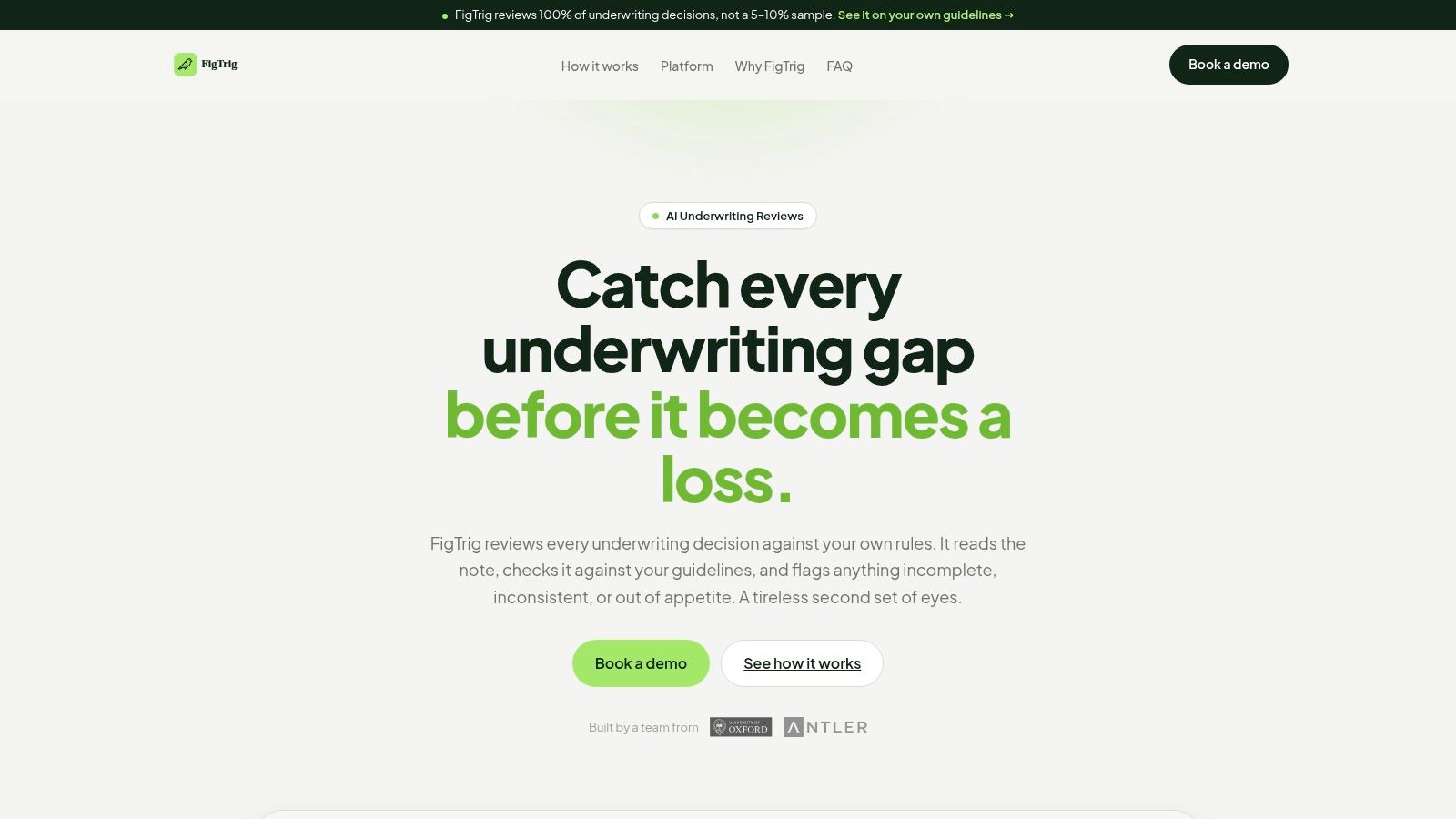
FigTrig closes that gap by reviewing 100% of underwriting notes against the insurer's own guidelines. Teams upload PDFs, Word documents, or internal manuals, and FigTrig applies those rules to each note as it arrives. The platform checks areas such as risk identification, pricing rationale, authority compliance, loss history, documentation quality, policy-term fit, and custom standards.
The useful distinction is timing. FigTrig raises plain-language flags within seconds, before binding, and links each issue to the exact guideline section involved. Underwriters retain the final decision, while compliance, claims, risk, and audit teams get a maintained record of what was flagged and why.
Why FigTrig stands out
FigTrig works as a behind-the-scenes quality layer rather than a replacement for an underwriting system. It supports REST API, webhooks, CSV, and SFTP connections, so teams can add continuous QA alongside existing workflows.
Practical rule: Automation should surface a decision problem early, explain the relevant rule, and leave accountable judgment with the underwriter.
The governance design matters as much as the review engine. FigTrig provides GDPR-aligned data controls, tenant isolation, data-residency options, explicit processing agreements, and an audit trail that connects each flag to the applicable rulebook section. Customer data isn't shared with other customers or used to train models.
Trade-offs and best fit
Pros
- Full-coverage QA: Every underwriting note is checked, rather than relying on a limited manual sample.
- Explainable findings: Flags use plain language and cite the exact guideline section.
- Rapid deployment: Users can typically review live notes within about one week.
- Low workflow disruption: Existing underwriting platforms can remain in place.
- Strong governance controls: Tenant isolation, retention arrangements, and data-residency choices support regulated deployments.
Cons
- Not a substitute for judgment: Underwriters still decide whether to accept, amend, or decline a risk.
- Rulebook quality affects results: Initial tuning may be needed to reduce unnecessary flags as standards are calibrated.
- No public pricing: Buyers need to book a demo or arrange a pilot.
The platform site highlights customer and product proof points, including £4.2M+ flagged before binding, and invites teams to bring their own guidelines and notes to a no-commitment demonstration. For insurers, MGAs, delegated-authority operations, and underwriting leaders, FigTrig is the most direct choice when the core problem is missed guidance, weak pricing rationale, or insufficient evidence before binding.
2. NICE Actimize for enterprise AML and financial crime coverage
NICE Actimize is built for institutions that need broad financial-crime coverage across products, channels, and business lines. Its scope includes AML screening, customer risk rating, transaction monitoring, investigations, suspicious activity reporting, KYC, fraud, and capital-markets compliance.
That breadth is its primary advantage. A large bank may not want separate tools for every control if it can standardize detection, investigation, and reporting across a wider operating model. NICE Actimize also positions AI and machine learning across its workflows, with cloud options and an AML Essentials package aimed at mid-market and community institutions. Details are available from the NICE Actimize financial crime compliance platform.

Where it works best
NICE Actimize makes sense when compliance leaders need an enterprise-grade platform with established financial-services coverage and a mature vendor footprint. It can support institutions with complex operating structures, multiple products, and significant investigation volumes.
The trade-off is implementation weight. Broad functionality can introduce more configuration, governance, training, and integration work than a focused point solution. Some practitioners also view the platform as more traditional and complex than newer, narrowly targeted alternatives. That doesn't make it unsuitable, but it means buyers should test investigator workflows and administrative usability, not just review the feature catalogue.
Best fit: Large or complex financial institutions seeking AML, KYC, fraud, and capital-markets compliance in a unified environment.
Watch closely: Implementation ownership, total cost of ownership, data migration, scenario tuning, and the practical experience of investigators using the system every day.
3. Fenergo for client lifecycle management and global KYC
Fenergo addresses the operational side of KYC and client lifecycle compliance. It brings client data, policy rules, onboarding activity, reviews, and governance into a connected process, which is valuable for banks and financial institutions managing corporate, investment, commercial, wealth, or fintech relationships.
The platform's global rules engine supports KYC and AML requirements across 100+ jurisdictions, as described in Fenergo's client lifecycle management platform information. That international orientation is important for institutions that struggle to apply consistent standards across legal entities and regions. A central record can also reduce the risk that relationship data, documentation, and review decisions become scattered across business units.
The operational value
Fenergo is strongest when the problem isn't just collecting identity documents. The bigger challenge is coordinating onboarding, approvals, periodic reviews, policy decisions, remediation, and audit evidence throughout the relationship lifecycle.
Its system-of-record approach gives compliance teams a clearer connection between data, policy, and execution. That can help management see where work sits, which requirements apply, and whether a client's record remains complete as circumstances change.
A KYC platform should make ownership obvious. If nobody can tell who owns the next review or remediation task, centralizing documents won't fix the control failure.
Fenergo is generally better suited to mid-sized and large institutions than to small teams seeking a lightweight onboarding tool. Implementations can be resource-intensive, especially where existing client data is inconsistent or business units follow different processes. Practitioner experiences with change management and user experience also vary, so demonstrations should include real onboarding and review scenarios rather than a scripted presentation.
Pros
- Cross-border standardization: Useful for applying lifecycle controls across jurisdictions.
- End-to-end governance: Connects onboarding, reviews, data, policy, and execution.
- Broad segment coverage: Supports corporate and investment banking, commercial banking, asset and wealth management, and fintech use cases.
Cons
- Implementation effort: Data, process, and ownership alignment can take substantial internal work.
- Institutional fit: Smaller organizations may find the platform heavier than required.
- Change-management demands: Adoption depends on consistent processes and clear accountability.
Best fit: Financial institutions that need a controlled, auditable way to manage complex onboarding and ongoing KYC relationships across regions.
4. ComplyAdvantage for API-first screening and monitoring
ComplyAdvantage is a strong candidate for fintechs, digital banks, and financial institutions that prioritize fast integration. Its platform combines AML risk data with sanctions, politically exposed person, and adverse-media screening, plus continuous monitoring and configurable transaction-monitoring scenarios.
The developer experience is central to the product's appeal. API-based services can fit into onboarding, payment, account-opening, and risk workflows without forcing a business to replace every surrounding system. ComplyAdvantage also promotes agentic AI capabilities and a Starter Plan, giving smaller or fast-growing teams a path to begin with focused screening and expand as their needs develop. See the ComplyAdvantage AML screening and monitoring platform for product details.

What buyers should test
Real-time screening and continuous monitoring only help if teams can manage the resulting alerts. Buyers should test entity resolution, matching logic, adverse-media relevance, disposition workflows, and the quality of explanations available to investigators.
ComplyAdvantage can be a practical choice when speed and integration matter more than buying a broad, all-in-one compliance suite. It also works well for organizations that want screening and monitoring data from a focused specialist while keeping case management or other controls elsewhere.
The main commercial and operational caveats are tier-specific entitlements, volume-based contracts, and variation in practitioner experience around alert quality. Ask the vendor to demonstrate false-positive handling with your own sample data. Don't evaluate only the number of records in the underlying data set. Evaluate whether investigators can reach a defensible decision without excessive manual research.
Pros
- Developer-friendly integration: Suitable for API-first operating models.
- Broad screening coverage: Sanctions, PEP, and adverse-media screening sit alongside monitoring.
- Continuous oversight: Supports ongoing screening rather than a single onboarding event.
- Flexible entry point: A Starter Plan and expanded capabilities can support staged adoption.
Cons
- Commercial complexity: Pricing and data entitlements vary by tier and volume.
- Alert-quality risk: Your team should validate matching and false-positive performance before deployment.
- Narrower than a full suite: Additional platforms may still be needed for investigations, governance, or other compliance functions.
Best fit: High-growth fintechs and banks that need modern screening, monitoring, and integration without committing immediately to a large enterprise suite.
5. Hummingbird for AML investigations and case management
Hummingbird focuses on the work that starts after a monitoring or screening system produces an alert. It gives investigators a structured environment to triage activity, organize evidence, document decisions, prepare cases, and produce SAR or STR reports.
That focus makes Hummingbird different from a full AML platform. It isn't intended to replace upstream transaction monitoring or screening. Instead, it acts as the investigations and case-management layer that helps compliance teams turn alerts into consistent, reviewable outcomes. The Hummingbird compliance case management platform describes AI agents that can assist with repetitive tasks such as triage and case-review preparation.

The case-layer decision
Hummingbird is attractive when investigators spend too much time assembling information, moving between systems, and preparing repetitive documentation. Its user experience is designed around investigation work, which can be more important than adding another detection engine.
The platform's extensible integrations allow it to sit alongside existing AML monitoring and screening vendors. That architecture supports a best-of-breed strategy, but it also creates a dependency on clean upstream data. If alerts arrive without useful context, investigators will still spend time collecting it manually.
Don't buy a case-management layer expecting it to improve detection. Buy it when your bottleneck is triage, investigation quality, evidence organization, or time to disposition.
Pros
- Investigator-focused design: Workflows are built around case review and disposition.
- Automation of repetitive work: AI assistance can help with triage and preparation.
- Stack compatibility: Integrates with upstream monitoring and screening tools.
- Structured reporting: Supports SAR and STR preparation within documented workflows.
Cons
- Not a complete AML suite: Detection and screening sources are required.
- Integration dependence: The value depends on the quality and context of incoming alerts.
- Sales-led pricing: Detailed commercial terms aren't widely published.
Best fit: Compliance teams with capable monitoring tools but inefficient investigations, inconsistent case files, or excessive manual preparation.
6. Ascent RegTech for regulatory change management
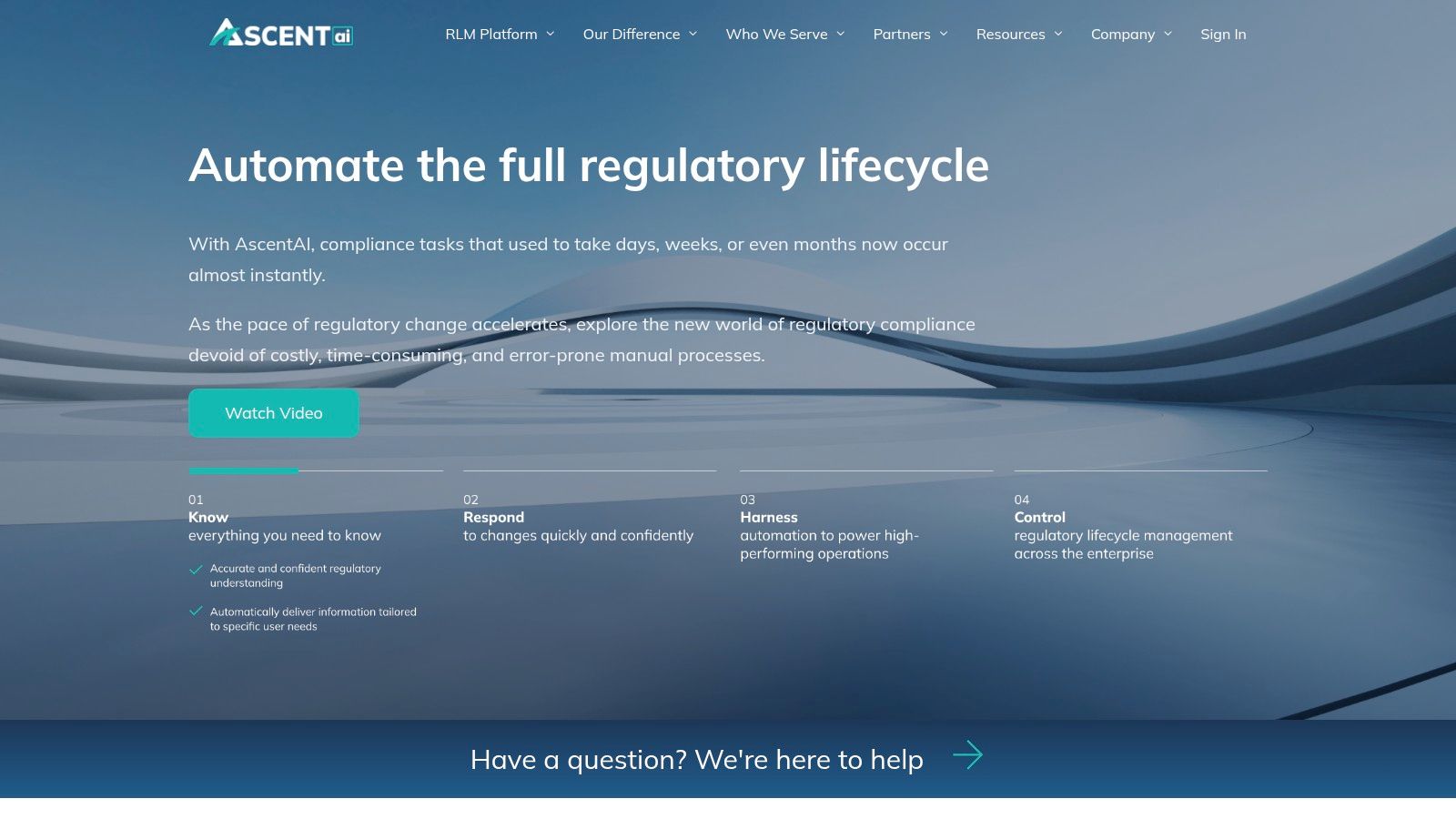
Regulatory change becomes dangerous when teams can't connect a new rule to the obligations, policies, controls, owners, and evidence that should follow. Ascent RegTech addresses that chain through regulatory lifecycle management.
The platform uses AI to support horizon scanning, applicability analysis, obligations inventories, regulatory summaries, and mapping from obligations to policies and controls. It can also propagate changes into GRC tools, giving compliance teams a clearer lineage from a regulatory development to the control response. The Ascent RegTech regulatory lifecycle management platform provides further detail on this approach.
Where Ascent adds value
Ascent is most useful for institutions with large regulatory footprints and a change-management process spread across documents, spreadsheets, email, and disconnected GRC records. A structured obligations inventory helps teams distinguish rules that apply to their business from developments that are merely informative.
The audit benefit is equally important. A reviewer should be able to follow the path from source obligation to internal policy, assigned control, implementation status, and evidence. That lineage is stronger than a folder of regulatory alerts with no clear record of decisions.
This isn't a transaction-monitoring tool, a screening engine, or an investigations platform. Buyers should position Ascent as the regulatory-change layer and plan integration work carefully. Existing GRC systems may use different taxonomies, ownership models, and data structures, so alignment should be designed before configuration begins.
Pros
- Reduced manual tracking: Automates much of the effort involved in monitoring and assessing regulatory change.
- Explicit lineage: Connects rules, obligations, policies, and controls.
- Applicability analysis: Helps teams focus on requirements relevant to their profile.
- GRC connectivity: Supports change propagation into established governance systems.
Cons
- Focused scope: It won't replace AML, KYC, surveillance, or underwriting QA tools.
- Integration work: Data-model alignment can require substantial preparation.
- Governance still matters: Automation can't decide ownership responsibly if the operating model is unclear.
Best fit: Banks, insurers, and financial groups that need defensible regulatory-change processes with traceability from external rule to internal control.
7. Smarsh for communications surveillance and records
Smarsh is designed for communications compliance. It captures and archives email, chat, mobile, voice, and social communications, then supports supervision, surveillance, e-discovery, and records retention. That makes it relevant to firms whose risk sits in employee communications rather than transaction or underwriting decisions.
The platform provides broad multi-channel capture through a cloud archive, with AI-assisted supervision and surveillance capabilities. It also supports communications compliance and retention requirements associated with FINRA and the SEC. The Smarsh communications compliance platform outlines its coverage across voice, mobile, and digital channels.
The coverage trade-off
Smarsh's strength is defensible capture. If staff communicate across approved and emerging channels, a platform that preserves records, supports search, and creates audit trails can give supervision teams a more complete evidence base.
The limitation is scope. Smarsh isn't an AML/KYC platform, and it won't manage underwriting authority or regulatory obligations inventories. It belongs in a communications-control architecture, usually alongside financial-crime and broader GRC tools.
Pricing depends on the channels and volume a firm needs to capture, and broad coverage can increase the overall cost. Buyers should map actual communication channels, retention requirements, supervision policies, reviewer capacity, and e-discovery needs before selecting a package.
Pros
- Multi-channel capture: Covers email, chat, mobile, voice, and social communications.
- Defensible records: Supports retention, audit trails, supervision, and e-discovery.
- AI-assisted review: Helps teams prioritize communications for supervision.
- Established market presence: Longstanding coverage has expanded through acquisitions.
Cons
- Narrow functional focus: Separate systems are needed for AML, KYC, and other financial-crime controls.
- Channel-dependent pricing: Costs vary with the breadth of capture.
- Operational review burden: More captured data still requires clear supervision policies and reviewer capacity.
Best fit: Broker-dealers, banks, insurers, and investment firms that need broad communications capture and defensible records for supervision or regulatory retention.
Top 7 Financial Compliance Software Comparison
| Product | Implementation Complexity 🔄 | Resource & Time Investment ⚡ | Expected Outcomes 📊 | Ideal Use Cases 💡 | Key Advantages ⭐ |
|---|---|---|---|---|---|
| FigTrig | Low, API/webhook integration; deploys alongside systems | Low, rapid time‑to‑value (~1 week); initial rule tuning needed | Continuous 100% underwriting QA; explainable flags and audit trail | Underwriting governance, claims readiness, regulator audits | Full‑coverage checks, explainability, strong data controls |
| NICE Actimize | High, enterprise scope across multiple products | High, longer implementations and higher TCO | Enterprise‑grade AML/KYC/fraud coverage across channels | Large banks and institutions requiring end‑to‑end financial crime controls | Very comprehensive suite, mature vendor and references |
| Fenergo | High, CLM integration and global rules engine | High, resource‑intensive implementations and change mgmt | Standardized onboarding and auditable lifecycle controls | Cross‑border KYC/onboarding for mid‑to‑large institutions | Strong onboarding governance and multi‑jurisdiction rules |
| ComplyAdvantage | Medium, API‑first, developer‑friendly integrations | Low–Medium, fast deployment; costs scale by tier/volume | Real‑time screening and continuous monitoring; faster screening | Fintechs and growth banks needing quick screening and monitoring | Proprietary risk data, API ecosystem, quick time‑to‑market |
| Hummingbird | Medium, integrates as investigations/case layer | Medium, improves investigator productivity; needs upstream feeds | Faster triage and reduced time‑to‑disposition for cases | AML investigators needing case management and automation | Investigator‑focused UX, AI agents for triage and prep |
| Ascent RegTech | Medium, integrates with GRC; data/model alignment required | Medium, reduces ongoing manual regulatory work | Automated obligations inventory and rule‑to‑control traceability | Regulatory change management and control mapping | Granular obligations mapping, AI‑driven change tracking |
| Smarsh | Medium–High, multi‑channel capture and archive integrations | Medium–High, costs scale with channels/volume | Defensible multi‑channel records for supervision and e‑discovery | Communications compliance, records retention for SEC/FINRA | Broad channel coverage, legal defensibility and audit trails |
Choosing your compliance technology partner
The right financial services compliance software depends on the control failure you need to address first. FigTrig is designed for underwriting QA before binding. NICE Actimize is the broader enterprise option for AML, KYC, fraud, and capital-markets compliance. Fenergo fits complex client onboarding and lifecycle governance, while ComplyAdvantage suits API-first screening and continuous monitoring.
Hummingbird is more focused. It makes sense when investigators need a stronger case layer rather than another detection engine. Ascent RegTech addresses regulatory change and the connection between obligations and controls. Smarsh handles communications capture, surveillance, and retention. These tools aren't interchangeable, and buying the broadest platform won't necessarily solve the most expensive operational gap.
The market is moving toward continuous oversight and integrated evidence. The HKMA's Regtech Adoption Index found that 56% of banks had applied regtech to at least two regulatory themes, as reported in market coverage of financial-crime compliance software. That matters because a tool used for one isolated check may digitize a task without improving the underlying operating model.
Buying test: Ask whether the platform can show who owned the control, what rule applied, what evidence was created, and how a reviewer can challenge the decision.
Integration should be assessed at the process level, not just through an API checklist. Identify the source systems, data owners, approval points, exception paths, retention requirements, and downstream audit consumers. Then test a realistic workflow with imperfect data, not a polished demonstration record.
Financial services software was estimated at USD 162.59 billion in 2025, with North America the largest region and Asia-Pacific the fastest-growing, according to The Business Research Company's financial services software market report. That global spread reinforces the need for region-specific controls, cloud deployment discipline, auditability, and integration with existing financial systems.
Choose the product that makes your highest-risk decision more visible and more defensible. A specialized platform that creates timely, explainable evidence can be more valuable than a broad suite that leaves ownership, data quality, and exception handling unresolved.
FigTrig gives underwriting and compliance teams a continuous quality layer that checks every commercial underwriting note against their own guidelines, then raises explainable flags with direct rulebook citations. If your priority is preventing avoidable underwriting leakage before binding while preserving an audit-ready record, visit FigTrig to book a demo and test the platform with your own rules and notes.