
10 AI Explainability Tools for Insurance in 2026
An underwriter opens a commercial note, sees a clean risk score, and still has to answer the harder questions. Did the file justify the price, stay inside authority, and reference the right guideline version? That is where ai explainability tools matter in insurance, because a local explanation for one decision only solves part of the problem. Teams also need a global view of model behavior across a portfolio, plus an audit trail that survives review by compliance, claims, or a regulator.
The useful split is simple. Local explanations explain one prediction, one flag, or one note. Global explanations show how a model behaves across many cases, which features matter most, and whether the system is drifting, biased, or unstable over time. In insurance, both matter, but they serve different jobs. Underwriting teams need note-level traceability and pricing rationale. Fairness teams need portfolio-level pattern review. Audit teams need evidence that the explanation matched the policy in force at decision time.
The comparison below focuses on model-agnostic flexibility, cloud integration, monitoring, governance depth, and fit for underwriting, pricing, fairness review, and audit preparation. Explainability helps humans document and defend decisions, but it doesn't replace validation, oversight, or the underwriter's final call. NIST's 2021 framing of explainability as evidence, meaningfulness, fidelity, and limits is the right standard to keep in mind when choosing among tools NISTIR 8312.
Table of Contents
- 1. FigTrig
- 2. Fiddler AI
- 3. Arthur
- 4. TruEra
- 5. Amazon SageMaker Clarify
- 6. Google Cloud Vertex Explainable AI
- 7. Azure Machine Learning Responsible AI Dashboard
- 8. IBM watsonx.governance
- 9. DataRobot
- 10. H2O Driverless AI MLI
- Top 10 AI Explainability Tools, Feature Comparison
- Choose the Explanation That Matches the Decision
1. FigTrig
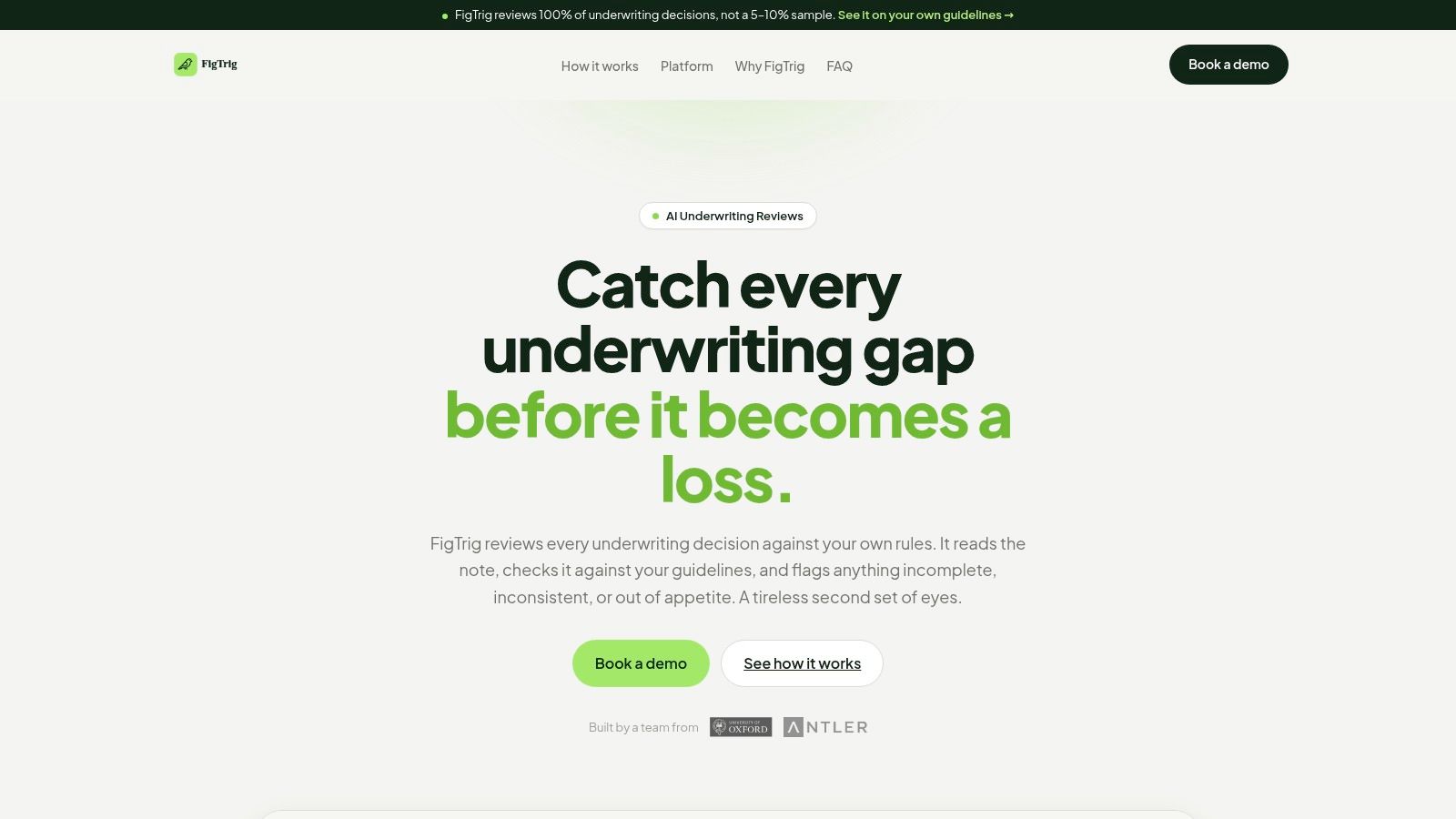
FigTrig is the most insurance-native option on this list because it doesn't start with a model. It starts with the underwriting note and the insurer's own rulebook. That makes it a good fit when the problem is not “why did the model score this case this way?” but “did this submission follow the guideline section that governs it?”
Why it fits commercial underwriting QA
FigTrig reviews 100% of underwriting notes in seconds, which is a very different posture from sample-based QA. It checks risk identification, pricing rationale, authority compliance, loss history, documentation quality, policy-terms fit, and custom rules against the insurer's guidelines. The practical value is traceability, because each flag cites the exact guideline section, so the explanation is written for underwriting managers, audit teams, and regulators instead of data scientists.
Practical rule: if the review has to stand up in a file audit, the explanation should point to the rulebook, not just to a generic feature-importance chart.
That makes FigTrig especially strong for delegated authority operations, MGA oversight, and pricing review, where the question is often whether a note supported the action taken. The product also sits alongside existing systems through REST API, webhooks, CSV, and SFTP, which helps teams avoid a disruptive platform swap. FigTrig's published positioning also emphasizes GDPR alignment, tenant isolation, data residency choices, and explicit processing agreements, which matters in regulated workflows where data handling is part of the control story FigTrig.
Trade-offs to validate before buying
The biggest trade-off is that FigTrig depends on the quality of the insurer's written standards and note hygiene. If guidelines are vague, outdated, or inconsistent across lines of business, the flags will mirror that ambiguity. Teams should also be ready to tune workflows so reviewers distinguish a helpful exception from a real breach.
One other point is commercial. FigTrig doesn't publish list pricing, so it's a demo-led enterprise discussion. The upside is that teams can bring their own guidelines and notes and see exactly what would be flagged, which is a much better buying motion than reading about abstract explanation methods.
2. Fiddler AI

Fiddler AI is a strong fit for teams that want monitoring plus explainability in one place. It is useful when the insurance stack already has predictive models in production and the team needs a way to investigate drift, compare runs, and explain individual predictions without stitching together separate tools.
Best use in insurance workflows
For underwriting and pricing models, Fiddler's combination of feature attributions, Integrated Gradients, and Fiddler SHAP helps data science teams debug why a model behaved a certain way. That matters most when the workflow includes a model owner, a compliance reviewer, and a business lead who all need to see the same evidence from different angles. Its monitoring for data quality, drift, and performance also makes it relevant for portfolio models that need ongoing oversight.
The platform is also relevant for LLM and agent observability, which matters as insurers start using generative workflows for summarization, intake, and document handling. That broad scope is useful, but it can also pull attention away from the narrow question insurance teams care about most, whether a specific decision is defensible.
What to watch
Fiddler is not a lightweight add-on. Teams should expect implementation effort to get full value from dashboards, root-cause analysis, and monitoring workflows. Pricing is enterprise-led, so the main evaluation question is not cost transparency, it's whether the operational overhead is justified by the depth of model oversight you need.
If your insurance team already runs a strong ML program and wants a unified layer for explanation, monitoring, and investigations, Fiddler is compelling. If you mainly need rulebook-based underwriting QA, a more workflow-specific control layer will usually be easier to operationalize. For teams comparing broader governance stacks, the same implementation discipline that helps Fiddler land well also applies to FigTrig's underwriting review approach, especially when you need plain-language flags tied to policy language.
3. Arthur
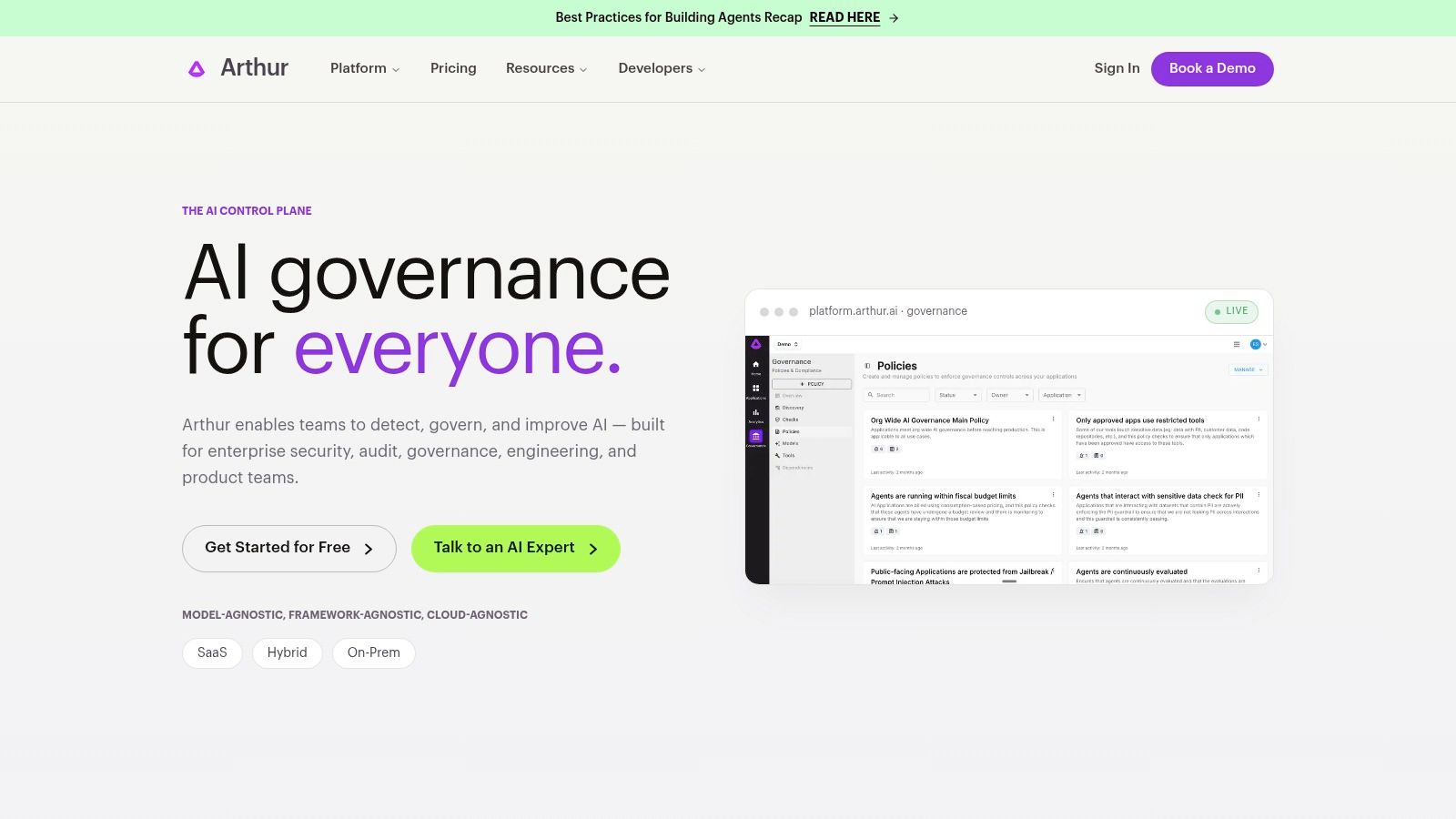
Arthur is best understood as a governance-forward observability platform. It's aimed at teams that want explanations inside a wider control environment, especially where traditional ML and generative AI both sit in scope. That makes it useful for insurers that are trying to standardize oversight across underwriting models, document workflows, and emerging agentic use cases.
Where it helps
Arthur's value is the way it connects dashboards, trace drill-downs, and policy-level views. That matters because governance leaders rarely want only a local feature attribution. They want to know whether a model, a workflow, or a whole team is staying inside policy boundaries over time. The platform's multi-modal support, including tabular, NLP, CV, and LLMs or agents, also makes it easier for a carrier to keep one governance language across different AI programs.
For insurance workflows, Arthur is strongest in governance reporting, model oversight, and cross-functional review. It can support the conversations that happen between data science, compliance, and risk management when a model needs justification beyond raw performance.
Trade-offs
Arthur's method-level detail is less front-and-center in public documentation than the governance story. That means buyers will need a hands-on trial to verify how explanations are generated, how well they map to their workflows, and how much setup is needed to make the dashboards useful for non-technical stakeholders.
Pricing is also enterprise-oriented. That is normal for a platform at this layer, but it means teams should ask early about packaging, implementation support, and the effort required to connect it to existing monitoring and approval processes.
4. TruEra
TruEra focuses on AI quality, which makes its positioning especially relevant for insurers that care about explanation, drift, fairness, and stability across the full model lifecycle. It's a better fit for teams that want one place to test a model before deployment, then keep monitoring it after launch.
What practitioners get
The combination of a web app and Python SDK is practical. Data scientists can work where they already work, while governance teams can review results in a UI that is easier to share. That matters in insurance, because the explanation usually has to move between technical review, model governance, and business sign-off.
TruEra is useful for fairness review and production monitoring when a model's behavior needs to stay consistent enough for policy and compliance teams to trust it. In underwriting and pricing, that means the platform is more useful when the key question is whether the model remains stable and reviewable over time, rather than whether a single note breached a line-by-line underwriting guideline.
Limits to keep in mind
Public documentation gives less detail on pricing and packaging than teams usually want during a shortlisting process. That does not make it weak, but it does mean procurement and technical validation take on extra importance. Insurers should also compare the depth of its explainability outputs with the specific evidence needed for audit files, because not every explanation that looks good in a dashboard is easy to defend in a review meeting.
For teams building lifecycle controls, TruEra sits closer to the model-governance end of the spectrum than the note-review end. If your main pain point is note-by-note underwriting QA, a workflow-native reviewer will usually be easier to adopt. If your main pain point is model trust across development and production, TruEra is a serious contender.
5. Amazon SageMaker Clarify

SageMaker Clarify is the clearest choice for insurers already committed to AWS. It lives inside the SageMaker stack, which means explanation, bias analysis, and monitoring can sit close to model deployment instead of living in a separate governance tool.
Why AWS teams use it
Clarify offers SHAP-based local and global explanations, bias detection workflows, partial dependence plots, and integration with SageMaker Model Monitor. That makes it useful when the insurance workflow is already built around AWS endpoints and managed ML services. It can support pricing models, underwriting scores, and fair lending style review where analysts want explainability to sit in the same environment as training and inference.
The big practical advantage is integration depth. If your team already uses AWS for feature stores, endpoints, and monitoring, Clarify reduces the number of moving parts. That makes implementation more straightforward than wiring together a standalone XAI library and a separate production monitor.
What can go wrong
Explanations can become compute-heavy, which matters when teams try to scale them across many decisions. Clarify is also best inside the AWS ecosystem, so cross-cloud or hybrid setups require extra work. For insurers with legacy systems spread across multiple environments, that can turn a neat technical feature into a slow integration project.
If the business already lives in AWS, Clarify is worth serious evaluation. If your governance team needs a tool that can sit directly on top of insurer-specific guidelines and produce plain-language flags for reviewers, a purpose-built control layer will usually feel more operationally direct. For organizations balancing technical and privacy requirements, it's also sensible to check internal policies alongside the platform itself, including the kind of governance language found in FigTrig's privacy approach.
6. Google Cloud Vertex Explainable AI

Vertex Explainable AI is the natural fit for teams already working in Vertex AI. It gives insurers multiple attribution methods and keeps explanation close to the broader model lifecycle, which is useful when models move from training to deployment inside the same cloud.
Strengths for insurance teams
The platform supports Sampled Shapley, Integrated Gradients, and XRAI, plus example-based explanations for tabular, image, and text models. That breadth matters when an insurer is not just scoring policy risk, but also working with document classification, image-heavy workflows, or text models tied to intake and triage. It also includes attribution-drift monitoring, which helps teams notice when the reasons behind predictions start changing.
For use cases like pricing review and portfolio monitoring, Vertex is appealing because it stays tightly integrated with pipelines, registry, and monitoring. That reduces friction for teams that want explanation generated as part of the model lifecycle rather than as a separate post-processing step.
Boundaries to validate
Like AWS, the best experience is inside its own cloud ecosystem. Cross-cloud use is possible, but it's not the path of least resistance. Teams should also understand the pricing mechanics across Vertex services and explanation compute before they standardize on it for high-volume workflows.
Vertex is a strong answer when the question is “how do we explain what is already running in Google Cloud?” It is a weaker answer when the question is “how do we enforce our insurer's own rulebook against every submitted underwriting note?” That difference matters, because explainability inside the stack is not the same thing as operational QA on top of the stack.
7. Azure Machine Learning Responsible AI Dashboard
Azure's Responsible AI Dashboard is a practical choice for insurers that already standardize on Microsoft tooling. It consolidates interpretability, counterfactual analysis, fairness assessment, and error analysis into a governed workflow that business stakeholders can consume.
What stands out
The dashboard offers global and local feature importance, what-if analysis, fairness metrics, and error analysis in one place. That makes it useful for fairness review, model review committees, and business sign-off meetings where the audience needs a scorecard rather than a notebook. The combination of SDK, CLI, and Studio UI also supports repeatable governance workflows, which matters when multiple teams need the same evidence.
For insurance, the counterfactual piece is especially handy. Pricing and underwriting teams often need to understand what would have changed the outcome, not just which features influenced it. That makes the dashboard useful for internal challenge sessions and adverse-action style review conversations.
Trade-offs
Azure's full capability set is most effective inside Azure ML, so hybrid environments take more effort. Pricing is consumption-based and varies by pipeline usage, which can make forecasting harder when explanation workloads scale unevenly. Teams should also confirm that the UI outputs align with the documentation standards their compliance team expects.
This is a solid option for organizations that want a consolidated Responsible AI workflow in a cloud they already trust. It is less compelling if the core business problem is continuous underwriting note QA against insurer-specific rules. In that case, the platform can help with model review, but it won't replace a rulebook-aware review layer.
8. IBM watsonx.governance

IBM watsonx.governance is built for enterprise governance programs that need explanation, monitoring, and documentation to live together. Its combination of OpenScale, AI Factsheets, and OpenPages makes it especially relevant for regulated insurers with formal model risk processes.
Why governance teams like it
The platform supports transaction-level explanations, what-if analysis, drift and bias monitoring, and documentation artifacts that can feed model risk governance. That's exactly the kind of structure enterprise risk teams need when they have to evidence how a model was reviewed, by whom, and under what control framework. AI Factsheets are particularly useful for audit trails, because they help turn model metadata into something governance teams can inspect and archive.
For insurance decisioning, the platform fits best when the organization has already committed to a broader enterprise governance program. It can support review of underwriting models, pricing logic, and portfolio monitoring, especially where documentation quality matters as much as raw explanation output.
Where it can be awkward
IBM's packaging can be complex because it bundles multiple services. That is often the price of governance depth, but it also means buyers need a clear implementation plan before procurement. Pricing is enterprise-led and not transparent, so shortlisting should focus on control coverage, evidence quality, and integration effort.
This is one of the best answers for teams asking, “how do we govern models across the enterprise?” It is not the cleanest answer for teams asking, “how do we review every commercial underwriting note against our own rulebook?” The former is governance software. The latter is workflow control.
9. DataRobot

DataRobot is a mature choice for teams that want AutoML plus explainability without building a separate interpretation layer. Its Understand tooling makes it useful for insurance programs that want development, explanation, and production monitoring to live in one platform.
How it behaves in practice
DataRobot provides global and per-prediction explanations, feature impact, partial dependence and ICE plots, and insights reporting. It also includes production monitoring with alerts and diagnostics. For insurance, that makes it a good fit for pricing models, risk scoring, and text projects where the team needs a repeatable interpretability workflow and a solid production story.
The UI is one of its strongest assets. Data scientists can move through explainability views quickly, and business users can inspect the outputs without digging through notebooks. That makes the platform useful for stakeholder communication, especially when model review needs to happen fast.
Main downside
The advanced features generally reward full platform adoption. If a team wants only a lightweight explanation module, DataRobot may feel bigger than necessary. Pricing and SKU structure are also enterprise-oriented, so buyers should be ready for a sales-led process.
DataRobot works well when the organization wants a broad AI platform with explainability as a core feature. It is less specialized than a rulebook-aware underwriting reviewer, but stronger than many point tools when the problem is broader model lifecycle management.
10. H2O Driverless AI MLI
H2O Driverless AI's Machine Learning Interpretability module is built for teams that want a deep toolbox of explanation methods inside a commercial AutoML environment. It is especially attractive when the insurance team wants reason codes, reports, and audit-friendly artifacts without assembling everything manually.
What it offers
The module includes K-LIME, Shapley values, surrogate trees, PDPs, and LOCO, plus disparate-impact analysis and support for NLP or text token explanation. That breadth matters when a model owner wants to compare explanation styles, not just accept one default view. It also generates MLI artifacts and reports in the UI and notebooks, which makes it easier to hand evidence to governance or audit teams.
For regulated decisioning, that mix can be powerful. It gives model developers enough depth to inspect behavior, while also providing outputs that can be packaged for review. Insurance teams working on underwriting, claims triage, or document-heavy models will find the reporting layer especially useful.
Trade-offs
The downside is that it's a commercial AutoML stack, so the best value often comes when a team adopts the platform more broadly. GPU and compute demands can also be material on larger problems. That means H2O is a better fit for organizations ready to standardize around the platform than for teams wanting a narrow explanation add-on.
H2O is strongest when you want a method-rich explainability toolkit attached to broader model building and reporting. It is less focused on insurer-specific governance workflows than a dedicated underwriting QA layer, but it is a serious choice for teams that want interpretability and automation together.
Top 10 AI Explainability Tools, Feature Comparison
| Solution | Core capability ✨ | Explainability & Audit ★ | Integrations & Deployment | Best for 👥 | Price & Value 💰 |
|---|---|---|---|---|---|
| FigTrig 🏆 | 100% automated underwriting QA; guideline ingestion; real‑time note checks | ★★★★★, plain‑language flags citing exact rulebook; audit trail; GDPR & tenant isolation | REST API, webhooks, CSV, SFTP; most teams live ~1 week | 👥 Insurers, MGAs, delegated authority ops | 💰 Enterprise/quote, high ROI (pilot flagged £4.2M+) |
| Fiddler AI | Model & LLM observability + attribution (SHAP, IG, proprietary) | ★★★★, feature attributions, root‑cause analysis | Integrates with ML/LLM pipelines; requires instrumentation | 👥 ML/ops teams needing debugging & auditability | 💰 Enterprise pricing; sales engagement |
| Arthur | Governance + observability across predictive & generative AI | ★★★★, org dashboards, trace drill‑downs for governance | Built for org pipelines; UI workflows for scopes | 👥 Compliance & AI governance teams | 💰 Tiered/enterprise; contact sales |
| TruEra | AI Quality: explanations, diagnostics, drift & monitoring | ★★★★, lifecycle explainability (dev → prod) | SDK + web UI for iterative analysis & monitoring | 👥 Teams needing end‑to‑end model quality coverage | 💰 Enterprise; contact sales |
| Amazon SageMaker Clarify | SHAP-based explainability + bias detection & PDPs | ★★★★, global/local SHAP, bias workflows | Native SageMaker integration & Model Monitor | 👥 Teams on AWS ML stack | 💰 Consumption/compute costs; cost‑sensitive at scale |
| Google Vertex Explainable AI | Multiple attribution methods (Sampled Shapley, IG, XRAI) | ★★★★, example‑based & attribution drift monitoring | Tight Vertex AI integration & APIs | 👥 Vertex AI users seeking multi‑method attributions | 💰 Cloud/compute pricing for explanations |
| Azure Responsible AI Dashboard | Interpretability, counterfactuals, fairness & error analysis | ★★★★, what‑if, fairness scorecards for stakeholders | Seamless in Azure ML Studio/SDK | 👥 Azure teams needing repeatable Responsible AI workflows | 💰 Consumption-based Azure billing |
| IBM watsonx.governance | Enterprise governance: OpenScale + Factsheets + OpenPages | ★★★★, transaction‑level explanations & audit artifacts | Bundled IBM services; complex packaging | 👥 Large regulated enterprises & audit teams | 💰 Enterprise licensing; procurement model |
| DataRobot | End‑to‑end AutoML + "Understand" explainability tooling | ★★★★, per‑prediction & global explanations; monitoring | Best value with full platform adoption | 👥 Teams wanting AutoML + integrated interpretability | 💰 Enterprise SKUs; contact sales |
| H2O Driverless AI | AutoML with MLI: K‑LIME, SHAP, surrogate trees, LOCO | ★★★★, rich method set + auto‑generated MLI reports | Optimal when adopting full AutoML stack; GPU needs | 👥 Finance/regulatory teams needing audit artifacts | 💰 Commercial license; compute costs |
Choose the Explanation That Matches the Decision
The right ai explainability tools choice starts with the decision you're trying to defend. If the priority is one prediction, one note, or one adverse action explanation, pick a tool that gives local explanations cleanly. If the priority is portfolio behavior, drift, and fairness patterns, prioritize global explanations and monitoring. If the priority is governance, what-if analysis, and audit preparation, choose a platform that keeps documentation and lineage attached to the model lifecycle. If the priority is continuous underwriting QA against your own rulebook, use a workflow-native control layer instead of a generic model-explanation dashboard.
Then match the tool to the stack you already run. AWS teams will usually get the fastest path with SageMaker Clarify. Google Cloud teams should look at Vertex Explainable AI. Azure shops will find the Responsible AI Dashboard easier to operationalize. Enterprise governance groups that need a broader control framework should compare IBM watsonx.governance, Arthur, TruEra, and Fiddler AI. Teams that want a deep AutoML and explanation stack can look closely at DataRobot or H2O Driverless AI.
Insurance buyers should test more than explanation quality. They should test whether the explanation is stable, whether underwriters and compliance staff can use it, whether it stays tied to the exact guideline version or model version in force, and whether it produces evidence that can survive audit. That is where the NIST standard matters, because explainability has to provide evidence, be meaningful to the intended user, reflect how the system works, and stay within its limits NISTIR 8312.
FigTrig is the most directly relevant choice when the problem is continuous, plain-language review of commercial underwriting notes against insurer-specific guidelines. The broader platforms are better when the problem is model lifecycle observability, cloud-native interpretability, or enterprise governance. The best selection process is simple, define the decision, test it on representative insurance cases, and validate governance, integration, compute, data controls, pricing, and audit readiness before you commit.
If your underwriting team needs every note checked against your own rulebook, FigTrig is built for that job. It reviews commercial underwriting decisions in seconds, surfaces explainable flags with guideline citations, and creates an audit-ready trail without replacing your current workflow. Visit FigTrig to see how it fits your underwriting, pricing, and audit process.