Audit Trail Review How to Validate Every Record
A senior underwriter approves a difficult risk late on a Friday. The note records the exposure, the price, and the final decision, but the audit trail shows only that the record changed. It doesn't show the original value, who approved the override, whether that person had the authority, or why the pricing rationale changed. When compliance asks for the decision history, the team has activity logs, but not a defensible explanation.
That gap is where audit trail review earns its value. A stored log proves that a system recorded activity. A properly designed review proves whether the decision was complete, attributable, authorized, logically sequenced, and capable of being reconstructed later. That distinction matters in underwriting, lending, financial services, clinical operations, and every regulated workflow where a record may need to withstand internal audit, a claim dispute, or regulatory scrutiny.
Table of Contents
- What Audit Trail Review Really Proves and Why It Matters
- Before You Review How to Define Scope Roles and Cadence
- Sampling vs Full Review How to Choose the Right Coverage
- Running the Review Checks That Validate Every Entry
- Red Flags That Break Traceability and How to Spot Them
- From Finding to Fix Building a Remediation Workflow That Closes the Loop
What Audit Trail Review Really Proves and Why It Matters
A useful audit trail review doesn't begin with the question, “Do we have logs?” It begins with a harder question: “Can another qualified person replay this decision and understand what happened, who acted, what changed, and why the action was permitted?”
That standard has deep regulatory roots. In 1997, the U.S. FDA published the final rule for electronic records and electronic signatures under 21 CFR Part 11, linking compliant recordkeeping to time-stamped audit trails that document record changes and operator actions. Later guidance reinforced the same principle. The EMA's 2010 reflection paper described the audit trail as beginning with the initial data entry, the FDA's 2013 guidance defined it as capturing additions, deletions, or alterations without obscuring the original record, and the MHRA's 2018 data integrity guidance described secure recording across the record's lifecycle. These milestones are summarized in the history of audit trail expectations in regulated records.
Financial services applies the same logic at scale. The SEC's Consolidated Audit Trail, created through Rule 613 and operated by CAT LLC as a joint entity of FINRA and U.S. securities exchanges, was designed to give regulators a complete view of order and trade activity across equities and options markets. Separate retention requirements also shape review operations. A financial compliance guide to audit trails summarizes broker-dealer records retention at 6 years, SOX retention at 7 years for public companies, and PCI DSS retention at 1 year, with the most recent 3 months immediately accessible. Those time horizons make evidence useful for investigations and later disputes, but retention alone doesn't make a record trustworthy.
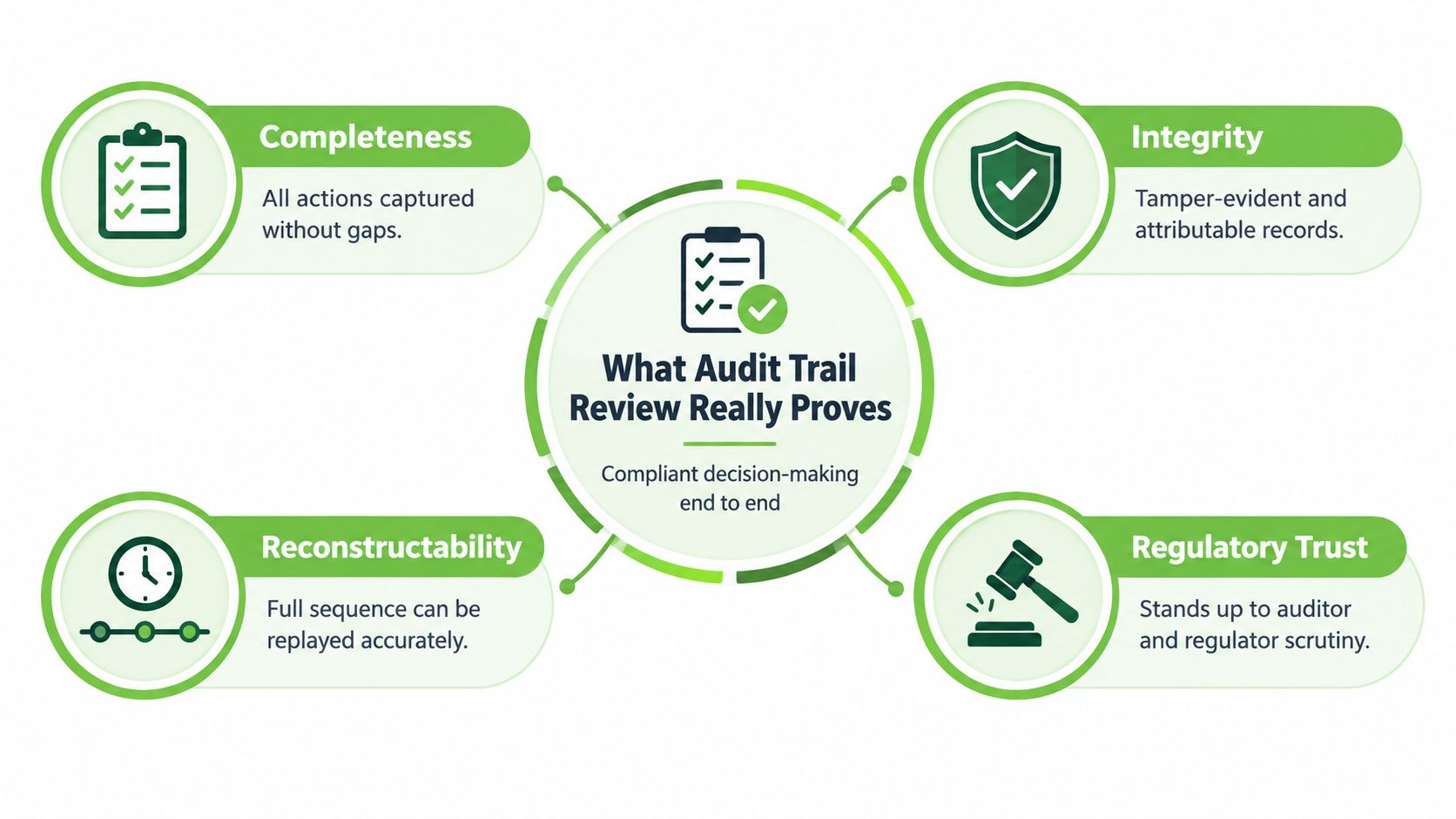
The four tests that matter
A defensible review tests four connected properties:
- Completeness: The system captures the relevant actions, including additions, deletions, edits, approvals, administrator actions, and important access events, without unexplained gaps.
- Integrity: The record is protected against undetected alteration, and each action is attributable to an authenticated user or system process.
- Reconstructability: Reviewers can follow the sequence from initial entry through amendment, approval, override, and final decision.
- Regulatory trust: The evidence can support a reasoned conclusion when an auditor, regulator, claims team, or dispute investigator asks how the decision was made.
This is why enabling an audit trail fails as a control. A trail can be active yet omit before-and-after values, allow shared credentials, record timestamps that users can adjust, or exclude the spreadsheet used to calculate the final price. It may be visible to an auditor while still being unable to prove decision intent or authority.
For high-volume underwriting, the standard becomes more demanding. A manual reviewer may find one unusual override, but that doesn't establish whether similar decisions passed unnoticed. The review process must connect each material event to the applicable rule, the responsible user, the timestamp, and the supporting rationale. Privacy and access controls matter too, so review design should sit alongside documented privacy controls for regulated information, not treat the audit record as an unrestricted data store.
Before You Review How to Define Scope Roles and Cadence
An audit trail review becomes unreliable before the first entry is opened if nobody has defined what belongs in scope. “Review periodically” isn't an operating instruction. It doesn't identify the system, the time period, the event types, the reviewer, or the evidence needed to prove completion.
Start with the decision or control risk, not the available report. Identify which records could affect customer outcomes, participant safety, financial exposure, policy terms, pricing, eligibility, delegated authority, or regulatory reporting. Then map the systems and surrounding artifacts involved. If an underwriter changes a value in the core platform, obtains approval by email, calculates a price in a spreadsheet, and uploads a final note, reviewing only the platform log leaves the decision incomplete.
Define the review boundary
Write the scope so a different reviewer could reproduce it. At minimum, specify:
- Systems and records: Name the application, data set, workflow, and related manual artifacts.
- Review period: State the start and end points, including the relevant timezone.
- Events: Identify edits, deletions, overrides, approvals, access changes, administrator actions, and other high-risk activity.
- Risk rationale: Explain why these records and events require review and which existing controls already cover adjacent risks.
- Exclusions: Record what isn't included and why the exclusion doesn't undermine the review objective.
The scope should also distinguish trial-level or business-process review from technical system review where relevant. A process reviewer may assess changes to underwriting rationale or policy terms, while a system owner examines provisioning, configuration, and administrative activity. Different owners can perform those activities, but the plan must show how the results connect.
Assign independent ownership
The person who created or approved the work shouldn't be the sole reviewer of its audit trail. Assign a reviewer who understands both the business process and the system's event model, then name the owner responsible for investigation and closure. Technical ability to export a report isn't enough. The reviewer needs enough context to decide whether an unusual action was expected, properly authorized, and adequately explained.
Set cadence according to risk, data criticality, study or workflow phase, data volume, and prior findings. Practical operating benchmarks from regulated SOPs include:
- Daily review for critical documents or events requiring rapid intervention.
- Weekly review for active documents and ongoing high-risk work.
- Monthly sampling across the broader document population.
- Quarterly system-wide review to identify structural gaps and recurring patterns.
These are operating benchmarks, not universal rules. A near-real-time exception queue may be appropriate for a high-risk authority override, while a lower-risk metadata change can wait for a scheduled review. The important point is to document the decision and avoid using one calendar for every process.
Make the review itself defensible
Before execution, confirm that the audit trail export is complete, the report filters are saved, the reviewer can see original and changed values, and the system protects records from retroactive editing. Verify that system clocks are synchronized and that timestamps clearly identify timezone. Check that user identities are unique, administrator actions are logged, and the review record will capture the reviewer, date, scope, criteria, findings, and conclusion.
Practical rule: If the review record can't show who reviewed what period, which criteria they applied, and what they found, the review is only an assertion that work happened.

Sampling vs Full Review How to Choose the Right Coverage
Sampling and full review answer different assurance questions. Sampling asks whether a controlled selection of records provides reasonable confidence that the process is operating correctly. Full review asks whether every in-scope decision or event has been tested against the applicable rules.
Random samples remain useful when the population is stable, the risk is bounded, existing controls are strong, and exhaustive review would duplicate work without adding meaningful assurance. The sample must be tied to the audit trail and selected through a documented method. A convenient sample of records chosen because they're easy to access doesn't test coverage. Nor does a sample answer whether a particular high-risk event occurred outside the selected records.
For underwriting, the trade-off is sharper. If every note can contain a pricing decision, authority judgment, loss-history interpretation, or policy-term exception, a small manual sample can miss the exact action that creates downstream exposure. Full coverage is more suitable when the decision population is high risk, the volume is substantial, the cost of a missed breach is material, or management needs an exception list before binding rather than after a later review.
Sampling vs Full Review Decision Matrix
| Coverage Model | Best For | Assurance Level | Effort |
|---|---|---|---|
| Risk-based random sampling | Lower-risk populations, stable processes, and assurance where exhaustive checking would duplicate effective controls | Confidence based on the selected population and documented method | Lower manual effort, but requires sound population definition and sample governance |
| Targeted exception review | Known risk signals, unusual overrides, missing rationale, access concerns, or prior findings | Strong assurance for the selected signals, limited assurance outside them | Moderate effort, dependent on reliable detection rules |
| Full manual review | Small, highly critical populations where every record needs human judgment | High coverage, but vulnerable to fatigue and inconsistent interpretation | High effort and difficult to sustain at scale |
| Full automated review with human exception handling | High-volume underwriting and other workflows where every decision must be checked against explicit rules | Complete automated coverage with human judgment focused on flagged cases | Higher implementation effort, lower repetitive review burden |
The most effective pattern for large programs isn't reading every raw line. Convert logs into searchable views, trend summaries, and exception reports, then direct a second-person reviewer to the entries that need judgment. The SCDM industry position paper on audit trail review also describes random samples tied to the audit trail as a practical approach for statistical or sampling-based assurance, while emphasizing verification that the work was performed correctly and wasn't falsified.
The wrong approach is to call a narrow manual sample “full QA,” especially where the business decision itself is high risk. Coverage should match the question being asked, and the review record should say exactly what the chosen model can and cannot prove.
Running the Review Checks That Validate Every Entry
A reviewer should process each filtered event through the same logical sequence, but consistency doesn't mean mechanical acceptance. The entry must make sense in the context of the record, the workflow, the user's role, and the decision that followed.
Begin with sequence. Establish the initial entry, subsequent edits, approvals, overrides, and final state. Look for an event that appears before its prerequisite, a deletion with no related explanation, or a final value that has no corresponding change event. A sequence gap is not automatically misconduct, but it is a reason to obtain context before closing the review.
Apply the core validation sequence
Check the event order. Confirm that the chronology is coherent and that related actions appear in a plausible order. Compare the audit trail with workflow status changes, approvals, notes, and supporting records.
Validate timing. Confirm that timestamps are precise, timezone-aware, and consistent with the system clock. Investigate entries created long after an expected decision point, clusters of activity at unusual times, or timestamps that appear adjustable.
Confirm identity and authority. Each action should map to an authenticated user or controlled system process. Compare the user's role and delegated authority with the action taken. Shared credentials, generic accounts, and administrator activity require particular scrutiny because they weaken attribution.
Compare original and changed values. The reviewer should see the before state, the after state, the affected field, and the reason for the change. A final price without the original price doesn't show the decision path. A changed policy term without the prior term prevents a reviewer from assessing impact.
Test justification. The reason should explain the business decision, not merely repeat that a change occurred. For an underwriting override, the note should support the departure from the guideline, identify the relevant authority, and connect the rationale to the evidence available at the time.
Assess completeness and integrity. Check for missing fields, unexplained gaps, omitted changelogs, failed exports, and any ability to edit or delete the trail without detection. Review side spreadsheets, email approvals, and manual workarounds where the process depends on them.
Raw exports are hard to review at scale. Use filters for high-risk actions, visual timelines for sequence, and exception reports for missing rationale, repeated edits, authority mismatches, and unusual user activity. A second reviewer should verify the interpretation where the finding could affect a claim, policy, regulatory response, or corrective action.

A visual workflow can help reviewers apply these checks consistently. The following video provides an additional explanation of data-entry validation in an audit trail context.
For underwriting records, the practical test is straightforward. Can the reviewer identify the risk, see how the price or terms changed, verify the underwriter's authority, understand the rationale, and connect the final decision to the governing guideline? If any answer is no, the record may still be recoverable, but it isn't yet defensible.
Red Flags That Break Traceability and How to Spot Them
Most failed reviews don't collapse because the organization lacks a logging function. They collapse because the log captures isolated activity while the business process occurs elsewhere.
A common example is an unexplained override. The core system shows that the premium or coverage term changed, but the rationale lives in an email, a spreadsheet, or a conversation that wasn't attached to the record. The final note may look complete, yet the trail can't establish whether the underwriter acted within authority or merely documented the outcome after the fact.

Patterns that deserve an exception
- Missing original values: The log records a new value but not the value it replaced. This prevents impact assessment and hides whether the change corrected an error or altered the decision.
- Uncontrolled versioning: Users overwrite documents or circulate local copies without a controlled relationship between versions. Reviewers can't establish which version supported approval.
- Shared credentials: Multiple people act under one account, making user attribution impossible. A manager may know who performed the work, but the system evidence won't prove it.
- Adjustable or inconsistent timestamps: Users can alter dates, clocks drift between systems, or exports omit timezone information. Sequence and contemporaneity become uncertain.
- Incomplete metadata: The record lacks the affected field, source application, action type, reason, role, or outcome. A timestamp alone provides little decision context.
- Unlogged administrator activity: Privileged users can change configurations, permissions, or records without appearing in the same review population as business users.
- Side-channel approvals: Email, chat, spreadsheets, and manual calculations determine the outcome but never enter the controlled record.
- Missing decision and change logs: A final status exists without evidence of the rule evaluation, approval, exception, or version used to reach it.
Exception reporting should search for these patterns directly. Flag changes without before-and-after values, approvals by users outside the authority chain, records edited after a decision was finalized, duplicate or generic accounts, and gaps between related events. For pricing, compare the documented rationale with the pricing rule and the authority level. An unsupported price isn't merely a documentation weakness. It can signal that the decision itself can't be defended.
The key is context. An unusual event may have a valid explanation, such as a system outage followed by controlled back-entry. But the explanation belongs in the review record, with supporting evidence and a clear conclusion. “No issue found” without the reason doesn't close the traceability gap.
From Finding to Fix Building a Remediation Workflow That Closes the Loop
A finding becomes useful only when the organization can connect it to a cause, an owner, an action, and evidence of closure. Recording “missing rationale” in a spreadsheet creates an inventory of problems, not a remediation process.
Start each finding with a precise evidence package. Preserve the relevant record identifier, event type, user, timestamp, original and changed values, rule or control involved, supporting documents, reviewer assessment, and impact decision. The record should let another qualified person understand what was examined and why the conclusion followed.
Use a closed-loop finding record
A practical workflow has distinct stages:
- Document the exception. Describe the observed condition without guessing at intent. Identify the exact rule, user action, and timestamp connected to it.
- Investigate context. Compare the event with approvals, source records, system incidents, authority schedules, and related communications. Separate a valid exception from an unexplained one.
- Assess impact. Determine whether the issue affects a customer decision, policy terms, pricing, claims handling, financial reporting, data reliability, or regulatory obligations.
- Assign corrective action. Name one accountable owner, define the required action, and set an acceptance condition. Possible actions include retraining, workflow redesign, permission changes, rule clarification, system configuration, or further investigation.
- Verify closure. Confirm that the action occurred and test whether the original failure mode is no longer present. Update the review scope or cadence if the finding reveals a broader risk.
Measure the process with operational indicators, including entries reviewed, exceptions per system, mean time to detect and resolve, false-positive rate, and coverage against the control library. These measures don't replace judgment, but they show whether the review is becoming more targeted and whether repeated failures are declining. For an insurer or lender, a useful exception record should also show whether the issue was tied to a specific rule, user action, and timestamp.
Keep evidence ready for later scrutiny
Store the approved scope, report parameters, reviewer identity, review date, findings, investigation notes, approvals, corrective actions, and closure evidence together. Don't rely on a personal mailbox or an editable spreadsheet as the system of record. Access should be controlled, changes should be attributable, and the retained package should remain readable when the original reviewer is unavailable.
A review SOP should explain these responsibilities plainly. It should also define how the organization handles disputes, acceptable explanations, escalation, repeat findings, and changes to the underlying rulebook. Teams often document the exception but fail to preserve the version of the guideline that applied at the time, which makes later reassessment unnecessarily difficult.
The strongest operating model treats audit trail review as a decision-quality control. It doesn't reward teams for producing more log lines. It asks whether high-risk actions can be explained, challenged, corrected, and defended from initial intent through final outcome. That mindset is consistent with disciplined governance around terms governing the use of review platforms and related services.
If your underwriting or regulated review process still depends on small manual samples and disconnected evidence, FigTrig can review every underwriting decision against your own guidelines, raise explainable flags, and link each issue to the relevant rulebook section. Use it alongside existing systems to create a clearer decision trail for underwriting, claims, compliance, and regulatory review.