7 AI Compliance Platforms for Insurance in 2026
An underwriting decision can move from a submission to binding while its reasoning remains scattered across notes, emails, spreadsheets, and system logs. When a reviewer later asks which rule justified the price, whether delegated authority was respected, or what remediation occurred, an AI registry alone can't provide a defensible answer. Insurance buyers need an AI compliance platform that connects continuous monitoring with explainability, evidence collection, policy enforcement, privacy controls, and decision-level quality assurance.
This comparison evaluates seven platforms against practical insurance needs: underwriting coverage, guideline alignment, runtime controls, observability, audit trails, integration effort, and the point at which human underwriter judgment must remain decisive. It includes broad governance suites, runtime security tools, observability platforms, and a purpose-built underwriting review layer.
Table of Contents
- 1. FigTrig
- 2. OneTrust AI Governance
- 3. Credo AI
- 4. Holistic AI
- 5. IBM watsonx.governance
- 6. CalypsoAI
- 7. Fiddler AI
- AI Compliance Platforms: 7-Tool Comparison
- Choose Coverage Before You Choose a Platform
1. FigTrig
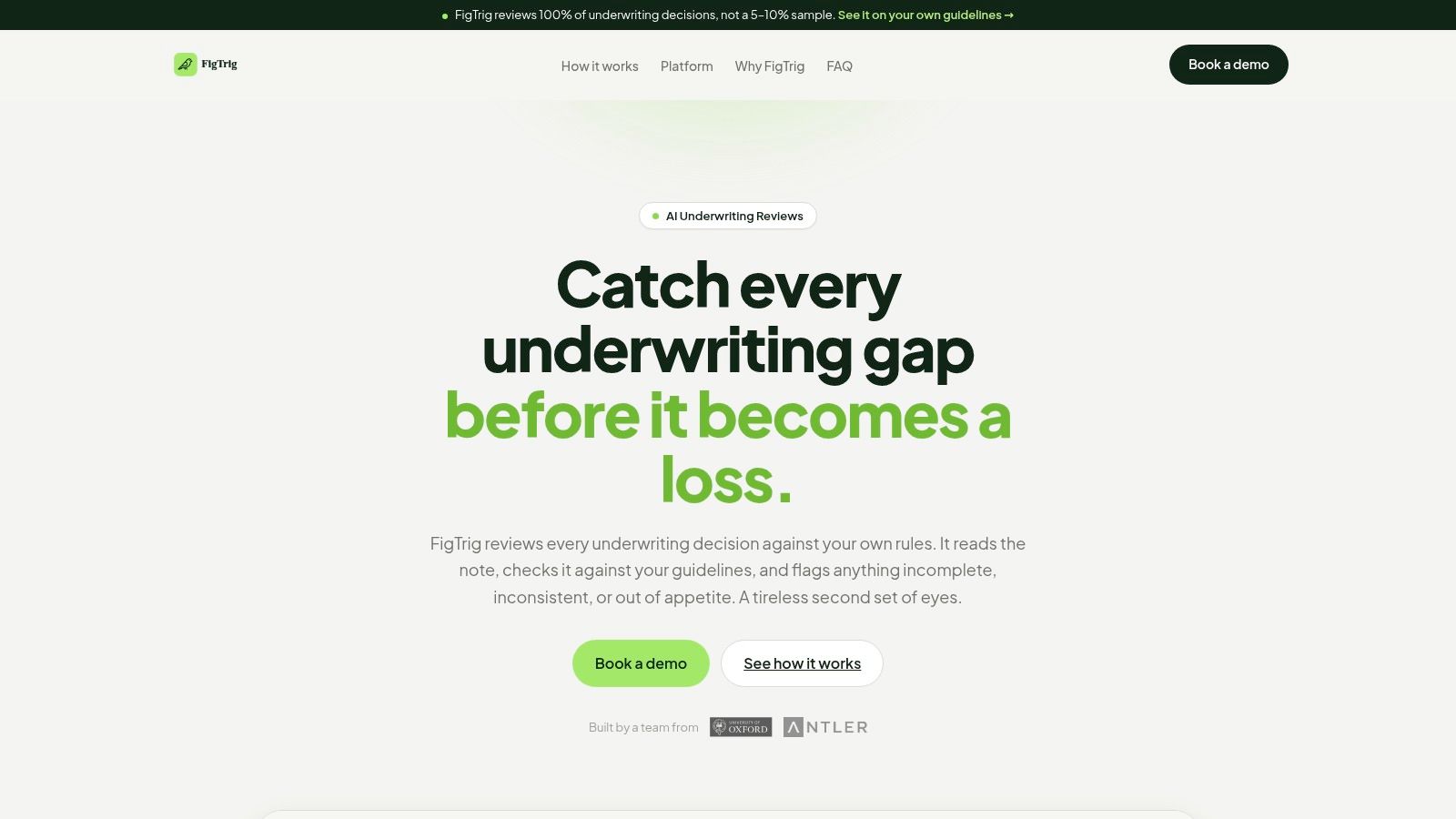
FigTrig is the most directly aligned option for insurers whose immediate problem is decision-level underwriting QA rather than enterprise AI inventory. It reviews commercial underwriting notes against an insurer's own guidelines, checking areas such as risk identification, pricing rationale, authority compliance, loss history, documentation quality, and policy-term fit. The review is designed to happen before binding, when an underwriter can still correct the record or escalate the decision.
The practical distinction is coverage. Instead of relying on a small manual sample, FigTrig is positioned to review 100% of underwriting decisions in seconds. It ingests PDF, Word, and internal manual rulebooks, then produces plain-language flags linked to the exact guideline section involved. That link matters more than a generic risk score because a CUO, compliance officer, or auditor can see both the issue and the rule used to identify it.
Where FigTrig fits best
FigTrig sits alongside existing underwriting systems through REST API, webhooks, CSV, and SFTP options. That lowers workflow disruption, although implementation still depends on the quality of source notes and the clarity of the insurer's rulebook. It flags potential breaches and documentation gaps, but it doesn't replace the underwriter's responsibility to assess risk, exercise judgment, or approve a binding decision.
Data protection is a central evaluation point for insurance buyers. FigTrig describes GDPR-aligned controls, tenant isolation, data residency choices, retention and processing controls, and a policy that customer data isn't used to train models or shared across customers. Its audit trail is intended to preserve the reasoning path for claims and regulatory review. Details about FigTrig's privacy approach should still be tested during procurement against the insurer's own requirements.
Practical rule: Ask the vendor to review representative underwriting notes against your current rulebook, then inspect whether every flag is understandable, actionable, and traceable to a precise guideline section.
Pricing isn't published, so buyers need a demo or pilot to assess cost and portfolio fit. For insurers prioritizing continuous, explainable review before binding, FigTrig offers the clearest operational match in this group.
2. OneTrust AI Governance
OneTrust is a strong candidate for insurers that already use an enterprise privacy, third-party risk, or GRC environment and want AI oversight in the same operating model. Its AI Governance offering supports discovery and inventory across models, agents, and AI-enabled software, including potential shadow AI. That gives governance teams a centralized record of where AI is used, who owns it, and which assessments or documentation apply.
The platform also supports framework-oriented work involving the EU AI Act, NIST AI RMF, and ISO/IEC 42001. For an insurer, that can help coordinate legal, privacy, procurement, model risk, security, and internal audit evidence. It addresses the governance layer more directly than the individual underwriting note, so buyers should test whether it can capture the rationale and rule citation behind a specific commercial insurance decision.
Governance strength, runtime qualification
OneTrust's AI Guard SDK adds a runtime dimension by classifying and blocking sensitive data in prompts and responses. That can be valuable where underwriting teams use generative AI with customer or policy information. It shouldn't be confused with underwriting guideline QA, however. A tool that blocks sensitive content may protect data without determining whether a price is supported by the insurer's appetite rules or whether an authority limit was exceeded.
Integration effort is likely to depend on the insurer's existing OneTrust deployment, identity model, AI estate, and application architecture. SDK-based controls can be effective, but they require technical ownership and careful placement in production workflows. Buyers should also clarify how inventory growth and administrator access affect commercial terms, since pricing isn't publicly standardized.
For insurers seeking an enterprise system of record for AI governance, OneTrust is a credible fit. For continuous review of every underwriting note, it may need to be paired with a specialized decision-review layer. Its AI governance offering is best assessed through a workflow demonstration, not only a registry tour.
3. Credo AI
Credo AI is purpose-built for AI governance, risk, and compliance. Its platform combines AI and vendor registries, evidence collection, control mapping, and policy workflows, with support for frameworks including the EU AI Act, NIST AI RMF, and ISO/IEC 42001. That structure suits regulated insurers that need to demonstrate ownership, assessment status, control performance, and evidence across a growing AI estate.
Its Agent Governor is the most relevant differentiator for teams moving beyond static model inventories. The concept translates organizational policies and regulatory expectations into controls for LLMs and agents, with runtime governance and observability. This matters in financial workflows where an agent may retrieve information, call another system, or influence an action through delegated permissions. Governance must answer not only what the system produced, but what it was allowed to do and who remained accountable.
The underwriting evidence question
Credo AI can help establish the governance context around an underwriting model or assistant. It may support policy mapping, vendor oversight, and evidence preparation, but insurers should separately test whether it can evaluate the content of underwriting notes against detailed internal manuals. Registry and framework conformity aren't the same as decision-level review.
Enterprise orientation also affects deployment planning. Wiring runtime controls into underwriting applications, identity systems, model endpoints, and logging infrastructure may require meaningful integration work. Pricing isn't public, so procurement teams should request a configuration-specific proposal rather than relying on generic platform comparisons.
Credo AI is a strong fit when the central requirement is policy-to-control governance across models, vendors, and agents. It becomes less directly comparable to FigTrig when the buyer's primary pain is missed pricing rationale, authority overruns, or incomplete underwriting documentation before a policy binds. Explore the platform through the Credo AI website and ask for an insurance workflow proof of concept.
4. Holistic AI
AI compliance platforms treat regulation as a lifecycle spanning discovery, risk assessment, testing, assurance, and enforcement. Their platform maps controls to the EU AI Act, NIST AI RMF, ISO/IEC 42001, and local requirements such as New York City Local Law 144. For insurers operating across jurisdictions, this mapping can reduce the manual work of aligning internal controls with external obligations.
The workflow is organized around identify, protect, and enforce stages. It supports risk scoring, recommended remediation, pre-assessment activities, and audit evidence packs. These functions suit model risk, compliance, and internal audit teams that need a documented readiness process with assigned owners, tests, and remediation records.
Strong framework coverage, less underwriting specificity
The platform's main strength is linking AI risk management with compliance evidence. An insurer can document a model's intended use, risk classification, controls, owners, testing status, and remediation progress. That record improves auditability, but it does not by itself confirm that an underwriting note follows a particular appetite, authority, or eligibility rule. Framework conformity and decision-level underwriting review remain separate evaluation questions.
Runtime enforcement appears less central than in products designed around security gateways or agent controls. Buyers may need additional infrastructure for prompt inspection, sensitive-data handling, prohibited interactions, or policy blocking. The result is a potentially broader integration plan across underwriting applications, model endpoints, identity systems, and logging services.
This vendor is most compelling for compliance-first organizations building an enterprise AI assurance program. Smaller underwriting teams may find the scope broader than their immediate needs, especially without a dedicated model-governance owner. Underwriters still need to assess the commercial context, exceptions, documentation quality, and judgment that a control framework cannot resolve automatically.
Evaluate custom pricing alongside integration work, framework maintenance, evidence administration, privacy requirements, and any runtime tooling. Start with the vendor governance platform, then test the full path from model discovery through an auditable underwriting decision.
5. IBM watsonx.governance
IBM watsonx.governance provides a broad governance layer for traditional machine learning and generative AI assets. It supports model and catalog management, documentation, risk controls, monitoring, and reporting across hybrid environments. That breadth makes it suitable for insurers with complex technology estates, established IBM relationships, or governance requirements spanning cloud, on-premises, and multiple business units.
For a carrier, the value lies in creating a common assurance process around models used in underwriting, claims, fraud detection, pricing, and customer operations. A centralized catalog can give model risk and compliance teams visibility into ownership, intended use, documentation, monitoring status, and evidence. Its availability through the IBM Cloud catalog can also align procurement with existing enterprise service processes.
Enterprise control plane, not automatic underwriting review
watsonx.governance should be evaluated as an assurance and governance layer, not assumed to be a specialized reviewer of underwriting notes. It can help insurers document model behavior and operational controls, but the buyer must confirm how internal rulebooks, decision rationale, authority checks, and remediation records would be represented.
Hybrid deployment is a practical advantage for insurers with data residency, legacy integration, or strict architecture requirements. It can also create complexity. IBM environments often involve structured procurement, security review, architecture decisions, and coordination among several teams. That may be appropriate for an enterprise transformation, but it can feel heavyweight if the immediate goal is a focused control over commercial underwriting quality.
Insurers should ask for a demonstration using their own governance artifacts and a representative decision flow. The relevant test isn't just whether a model appears in the catalog. It's whether the resulting evidence can explain what happened, identify the responsible owner, preserve relevant records, and support human review. Further product information is available from IBM watsonx.governance.
6. CalypsoAI
CalypsoAI focuses on runtime security, policy enforcement, and compliance for generative AI and agentic systems. Its controls can inspect prompts and outputs, flag or block policy-violating content, and address risks such as prompt injection and data leakage. For insurers deploying internal copilots, claims assistants, or underwriting agents, that runtime position fills a gap left by governance tools that mainly document systems after deployment.
The model-agnostic approach is useful where an insurer operates several LLM providers or changes models over time. A security and compliance layer that sits across those environments can provide more consistent controls than application teams implementing separate protections for each model. Testing and adversarial assessment also help teams examine how systems behave under misuse or hostile inputs.
Runtime protection versus rulebook alignment
CalypsoAI is strongest when the question is whether an AI interaction should be allowed to proceed. It isn't automatically the answer to whether a commercial underwriting decision complies with an insurer's internal appetite, pricing, documentation, or delegated-authority requirements. A runtime scanner may detect sensitive information or unsafe content while missing an unsupported premium rationale that is perfectly safe from a data-security perspective.
That distinction is central to insurance evaluation. CalypsoAI can complement a decision-review tool, particularly where AI agents can access policy systems or trigger downstream actions. Buyers should ask how enforcement records connect to user identity, agent permissions, application context, and remediation ownership.
Framework mapping may require integrations or additional governance processes, and public pricing is limited. Procurement teams should also confirm deployment options, retention settings, tenant separation, and the effect of controls on underwriter workflow latency. Review the vendor's GenAI security and compliance platform alongside your privacy and retention requirements, including the FigTrig terms of service when comparing data-handling expectations across vendors.
7. Fiddler AI
Fiddler AI combines observability, explainability, fairness monitoring, guardrails, and governance workflows. Its scope covers machine learning, LLMs, and agents, which makes it relevant to insurers managing models across underwriting, pricing, claims, fraud, and service operations. Continuous monitoring can help teams identify drift, fairness concerns, anomalous behavior, and changes in production performance that a one-time model approval won't reveal.
The explainability and fairness capabilities are particularly relevant to insurance. A model can perform as designed while still creating questions about disparate impact, feature influence, or decision consistency. Fiddler's control-plane approach gives model risk teams a place to connect monitoring signals with governance records and reporting.
Observability must meet the underwriting record
Fiddler's guardrails add runtime policy enforcement, while its GRC features support evidence generation and framework-oriented reporting. That combination is broader than a simple model registry and may suit larger insurers that want one operational view across AI assets. It can also be more capability than a team needs if the primary requirement is inventory and periodic assessment.
The key insurance test is whether observability connects to the evidence an underwriter and auditor need. Monitoring drift or fairness metrics doesn't, by itself, prove that a note followed the current rulebook or that an authority decision was properly documented. Buyers should examine the platform's handling of decision context, explanations, reviewer actions, linked investigations, retention, and exportable audit records.
Fiddler's security posture, including references to SOC 2 Type II and HIPAA support, may assist enterprise procurement, but insurers should validate the controls against their own security review. Pricing isn't public and is typically handled through a demonstration-led process. Visit Fiddler AI to assess whether its observability layer can integrate with underwriting systems without obscuring the human judgment that remains essential.
AI Compliance Platforms: 7-Tool Comparison
| Product | Implementation Complexity 🔄 | Resource Requirements | Speed / Efficiency ⚡ | Expected Outcomes ⭐ | Ideal Use Cases 📊 | Key Advantages / Tips 💡 |
|---|---|---|---|---|---|---|
| FigTrig | Low, rapid, API/webhook/CSV integration; most teams live ≈1 week | Underwriting rulebooks, clean notes, stakeholder review; pilot recommended | Very fast, sub-second to seconds; 100% notes reviewed | High, continuous, explainable QA; traceable flags (pilot: £4.2M flagged) | Underwriting teams, CUOs, MGAs, compliance & audit | Strong audit trail & privacy-first; pricing via demo; surfaces issues, not replace judgment |
| OneTrust – AI Governance | Medium, fits into existing OneTrust stacks; SDK for runtime guardrails | Enterprise GRC admin, inventory effort; SDK engineering for runtime | Moderate, discovery automated; runtime depends on SDK integration | High, centralized registry and audit‑ready evidence | Enterprises already using OneTrust for privacy/GRC | Rich templates for EU AI Act/NIST; guardrails SDK may need complementary tools |
| Credo AI | Medium–High, enterprise integrations to enforce controls at runtime | GRC teams + engineering to wire Agent Governor into apps | Moderate, rapid policy mapping; runtime enforcement requires integration | High, structured readiness for EU AI Act and NIST | Regulated industries needing policy→runtime enforcement | Agent Governor translates policies to enforceable runtime controls; sales-led pricing |
| Holistic AI | Medium, end-to-end compliance workflows; often paired with gateways for runtime | Compliance teams for assessments and evidence collection | Moderate, lifecycle coverage but less runtime emphasis | High, audit-ready assessments and remediations mapped to frameworks | Organizations prioritizing EU AI Act readiness and local laws | Clear control-to-framework mapping; may require additional runtime security tools |
| IBM watsonx.governance | High, enterprise/hybrid deployment with IBM Cloud integration | Significant IT, GRC teams, and procurement involvement | Moderate, enterprise monitoring and reporting; heavyweight for small use cases | High, governance across ML & generative assets with monitoring | Large enterprises with hybrid estates and existing IBM footprint | Hybrid deployment options, extensive documentation and enterprise support |
| CalypsoAI | Medium, model-agnostic runtime layer; deploys around production LLMs/agents | Security/ops teams for runtime enforcement and testing | High, real-time scanners and runtime protection | High, demonstrable runtime controls, logs for compliance | Production LLM/agent deployments needing runtime security | Strong runtime enforcement and adversarial testing; framework mapping via integrations |
| Fiddler AI | Medium–High, observability plus guardrails and GRC workflows | MLOps + compliance teams; instrumentation for continuous monitoring | High, sub-100ms guardrails claimed; continuous monitoring | High, explainability, fairness, drift detection, audit evidence | Regulated ML/LLM use cases requiring fairness, explainability, and monitoring | Robust fairness/explainability tooling; enterprise security certifications (SOC2/HIPAA) |
Choose Coverage Before You Choose a Platform
The right AI compliance platform depends on the failure you're trying to prevent. Start by mapping the insurer's critical workflows, including commercial underwriting, delegated authority, pricing, claims, fraud, customer service, and internal model governance. For each workflow, identify whether the primary gap is inventory, framework evidence, runtime enforcement, observability, or underwriting QA.
That classification prevents a common buying mistake. An enterprise registry can document that a model exists, but it may not review every underwriting note. A runtime gateway can block sensitive prompts, but it may not understand a pricing rule. An observability platform can surface drift or fairness concerns, but it may not preserve the exact guideline section that justified a decision.
Test evidence, not presentation quality
Use representative cases during evaluation. Ask each vendor to show what a reviewer receives when a decision raises a concern, which source rule supports the flag, who can resolve it, how remediation is recorded, and what an auditor can export later. The strongest demonstration will make the difference between a system log and human-readable, decision-level evidence obvious.
Then examine the operating model around the technology:
- Coverage: Does the tool evaluate every relevant underwriting note, or only registered models and selected samples?
- Guideline maintenance: Can the insurer update manuals and policies without rebuilding the workflow?
- Runtime controls: Can the platform block, flag, or escalate activity before an AI action affects a customer or policy?
- Integration effort: Does it work alongside existing systems, or require substantial application changes?
- Privacy controls: Are tenant isolation, data residency, retention, processing terms, and training-use policies clear?
- Human accountability: Can the platform support underwriter judgment rather than replacing it?
- Auditability: Does each event connect the decision, rationale, reviewer, rule, and remediation path?
Regulatory pressure makes this operational distinction increasingly important. Stanford HAI reported that U.S. AI-related federal regulations rose from 25 in 2023 to 59 in 2024, while the number of agencies involved increased from 21 to 42 in the same period. AI-related laws passed in the United States also rose from 30 to 40, as documented in the Stanford AI Index report. In the European Union, the AI Act entered into force on 1 August 2024, with staged obligations and the majority of the framework applying from 2 August 2026, according to the European Commission's AI Act announcement.
The market direction reinforces the need to separate categories carefully. The global AI governance and compliance platform market was valued at $440.0 million in 2025 and is projected to reach about $5.84 billion by 2034, representing a projected 35.7% CAGR from 2026 to 2034, according to Market IntelO's market analysis. That projection signals growing investment, but it doesn't tell an insurer which layer is missing from its own workflow.
For a carrier whose priority is continuous, explainable review of commercial underwriting notes before binding, FigTrig is the most directly relevant choice in this list. OneTrust, Credo AI, Holistic AI, and IBM watsonx.governance are better suited to broader governance estates, while CalypsoAI and Fiddler AI address runtime protection and observability needs. Some insurers will need more than one layer. The defensible decision comes from testing each platform against real notes, real rulebooks, real integrations, and the point where a qualified underwriter must still make the final call.
FigTrig reviews commercial underwriting notes against your own guidelines, raises plain-language flags tied to exact rulebook sections, and preserves an audit-ready record before policies are bound. Visit FigTrig to request a focused demonstration or pilot using your underwriting workflow and see whether continuous decision-level QA closes the compliance gap your current AI stack leaves open.