
Insurance Model Risk Management: A Practical Guide
You can feel a model problem before anyone names it. An underwriter trusts the rate, the binder goes out, the book looks fine in the monthly dashboard, and only later do the losses show that something inside the pricing or referral logic was off. That's the part many teams miss, insurance model risk management isn't about catching dramatic failures after the fact, it's about finding the quiet drift before it turns into a decision problem.
For underwriting managers, the hard truth is that the risk usually lives in the gap between a model's output and the business action that follows it. A model can be technically “working” and still be unsafe for the portfolio if its assumptions no longer fit the market, the data shifted, or the review process sampled the wrong transactions. That's why this discipline matters, it gives you a way to judge which model-driven decisions deserve trust, which ones need challenge, and which ones need continuous QA.
Table of Contents
- When a Quiet Model Drift Becomes a Seven-Figure Loss
- What Insurance Model Risk Management Actually Means
- The Three Pillars of Model Governance
- Building the Model Inventory That Anchors Everything Else
- Validation and Monitoring Across the Model Lifecycle
- Why Decision Criticality Beats Model Counting
- Governing AI, Third-Party and Delegated Authority Models
- From Program to Operating Discipline in 90 Days
When a Quiet Model Drift Becomes a Seven-Figure Loss
A mid-sized commercial property insurer refreshes its catastrophe pricing model during routine maintenance. The update is meant to improve the regional frequency factor, but a coding issue subtly compresses a severity weighting for coastal mid-layer accounts. Nothing crashes. No red error message appears. The underwriting team keeps accepting the outputs because the rates still look consistent inside the system.
The failure is usually slow, not spectacular
Over two quarters, the book grows on the strength of those lower rates. The binder system mirrors the pricing output, so the decision path looks clean from the outside. Then a moderate season brings a cluster of claims, and the cohort's loss experience jumps because the account segment was underpriced from the start.
Practical rule: if a model change affects pricing, reserving, or capital decisions, treat it like a control change, not a routine IT refresh.
The miss is usually in the control chain. Validation may have been completed last year, monitoring may have focused on portfolio-level indicators, and underwriting QA may have sampled the wrong transactions, so the exact segment where the compression lived never got checked. That is how model risk behaves in insurance, it usually compounds through ordinary workflow.
Regulators have been pushing in exactly this direction. Supervisory expectations now point to ongoing model governance, where the board sets the framework, management identifies the risks, and the program keeps watching for drift as the business uses the model. Australia's Prudential Standard CPS 230 adds to that pressure by requiring stronger operational risk management for model-dependent processes. The lesson is simple, if a model influences reserving, pricing, valuation, or capital management, weak governance can turn into financial, strategic, or reputational loss.
What Insurance Model Risk Management Actually Means
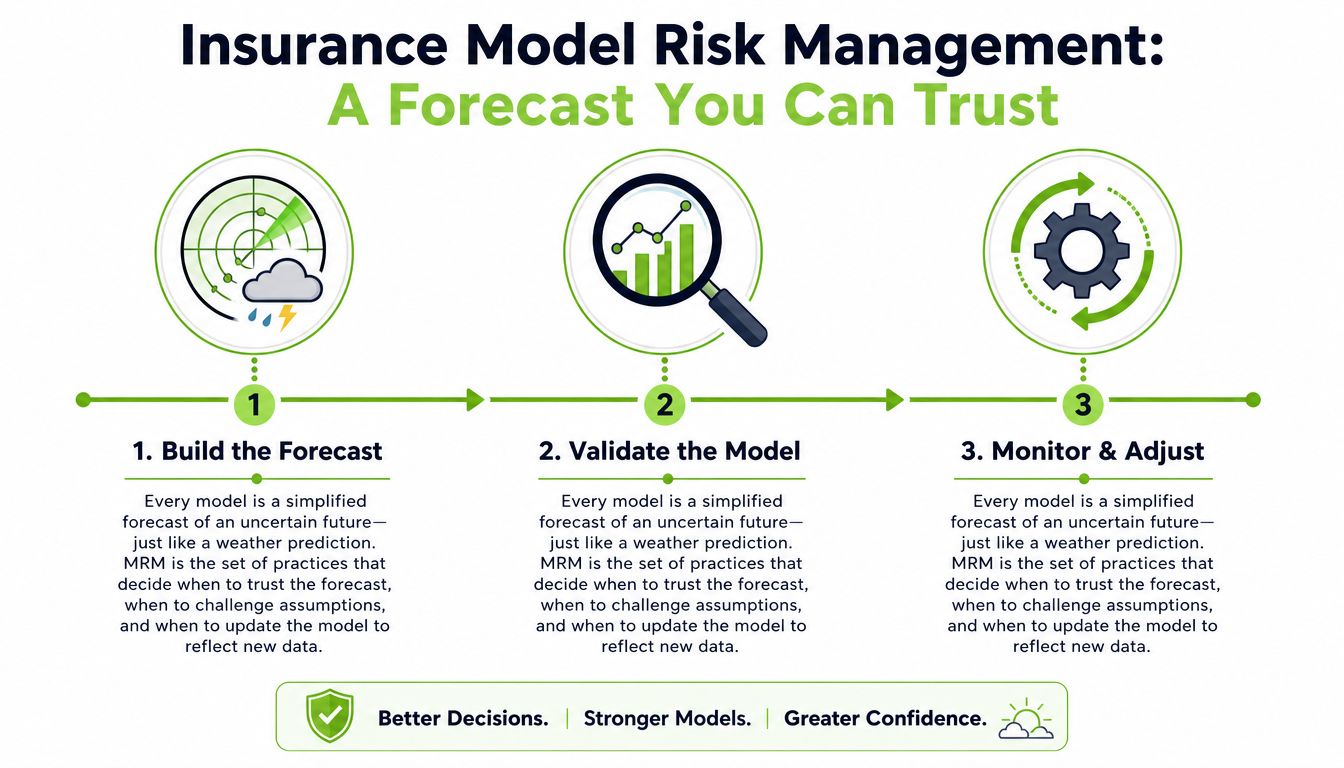
Think of every model as a weather forecast. It's a simplified picture of an uncertain future, and insurance model risk management is the discipline that decides when the forecast is good enough to use, when it needs a second set of eyes, and when the assumptions have drifted far enough that the business should stop relying on it.
The lifecycle is the backbone
A model doesn't enter the world fully formed. It gets developed, independently validated, implemented, monitored in use, revalidated when conditions change, and eventually retired. That lifecycle matters because risk doesn't stop after sign-off, it follows the model into production, into overrides, and into the business decisions built from its outputs.
A reserving model is a good example. During development, actuaries choose assumptions and methods. Before implementation, an independent reviewer checks whether the design makes sense, whether the data supports the method, and whether the outputs are reasonable. During use, the team watches for drift, unexpected patterns, or changes in claims emergence. When the portfolio shifts or a method changes materially, the model needs revalidation rather than another casual look.
A lapse model in life insurance follows the same logic, even if the business context is different. The model can be acceptable at launch, then less reliable after product changes, policyholder behavior shifts, or economic conditions move. The lifecycle gives you a control map for those moments.
Short version: development creates the model, validation tests whether it deserves trust, and monitoring tells you when trust needs to be revisited.
That's also where model risk management differs from adjacent disciplines. Data quality focuses on whether inputs are accurate. Actuarial standards focus on professional work product and assumptions. Operational risk looks at process failure more broadly. MRM is the overlay that connects all of those to the specific decisions a model influences, which is why underwriting managers need it, not just quants.
The Three Pillars of Model Governance
A model may be technically sound and still fail the business if no one can say who owns it, who can challenge it, and what evidence exists when it is put into use. The International Association of Insurance Supervisors expects insurers to put a clear risk management framework in place, and the International Actuarial Association describes model governance through three parts, a governance owner, a governance structure, and a governance policy. IAIS Insurance Core Principles, IAA governance of models guidance
Ownership is business accountability
Every material model needs a named business owner, usually someone close to the decision, such as a chief underwriting officer, claims head, or capital lead. That owner should not be the developer. The separation matters because the person using the model should also be accountable for its limitations and for the decisions built from its output.
The weak pattern is easy to spot. A model sits in actuarial, underwriting uses it, and no single leader owns the outcome when it drifts. Losses appear, and each team assumes someone else is tracking the risk. Ownership closes that gap by putting one business leader on the hook for use, change, and result.
Structure is the challenge path
The second pillar is the structure that makes challenge real. That usually means an independent validation function, a second-line model risk function, a committee that can escalate findings, and board reporting when the model is significant. Bermuda's updated expectations, as summarized by Milliman, also call for board approval before significant models and major changes are used, along with policies for model risk management and data quality, and validation reports reviewed at committee level (Milliman on Bermuda model validation governance).
Policy turns intent into repeatable control
A policy should spell out what counts as material, how often models are validated, what triggers escalation, and what evidence an examiner can review. Many insurers have a policy on paper. The failure is usually age and drift, not absence. A policy written for an earlier operating model, then left unchanged while the model estate expands, will not protect the business for long.
A committee meeting without challenge-ready documentation is just a status update.
That is the test of governance. The program needs to show who owns the model, who challenged it, and what changed because of that challenge.

Building the Model Inventory That Anchors Everything Else
A model inventory is not a spreadsheet of names. It's the control spine of the program, the place where the insurer records what the model is, who owns it, how important it is, and whether it's fit to stay in production. Industry guidance treats the centralized inventory as the backbone for managing interdependencies, prioritizing validation effort, and spotting unresolved issues before they affect capital, pricing, or reserving decisions (IAA governance of models guidance).
What belongs in the record
Each inventory entry should capture the model's type, materiality or risk tier, owner, intended use, key assumptions, data sources, last review date, and validation status. Those fields aren't admin clutter. They're the minimum set needed to decide how much scrutiny a model deserves and whether its current use matches its approved purpose.
A good inventory also helps you see interdependencies. A pricing model might feed a referral rule, a reserving workflow, and a management dashboard. If the shared input changes, the inventory should make it obvious which decisions could be affected.
Materiality tiers drive effort
Not every model deserves the same depth of review. A high-tier model used to price catastrophe-exposed accounts should receive deeper validation, stronger sign-off, and more frequent monitoring than a low-tier operational tool. The point of tiering is to concentrate scarce review capacity where the decision impact is highest.
| Required Fields in a Material Model Inventory Record | Purpose | Example |
|---|---|---|
| Model ID | Creates a unique control reference | PRC-COAST-014 |
| Business owner | Shows who is accountable for use | Head of Commercial Underwriting |
| Development team | Identifies who built or maintains it | Pricing Actuarial Team |
| Intended use | Defines the decision it supports | Coastal property rate setting |
| Data inputs | Documents core dependencies | Loss history, exposure, catastrophe view |
| Frequency of use | Indicates operating cadence | Daily at quote time |
| Governance committee | Shows escalation path | Model Risk Committee |
| Last validation date | Confirms recency of review | Most recent approved validation cycle |
| Known limitations | Records boundaries and caveats | Not suitable for new construction accounts |
| Exit criteria | States when use should stop | Retire after portfolio redesign |
Duplicate entries, missing assumptions, and no retirement date are common flaws. So is the “orphan model” that appears in pricing but not in risk or finance. Examiners tend to ask for the inventory first because it shows whether the insurer understands its model footprint.
Validation and Monitoring Across the Model Lifecycle
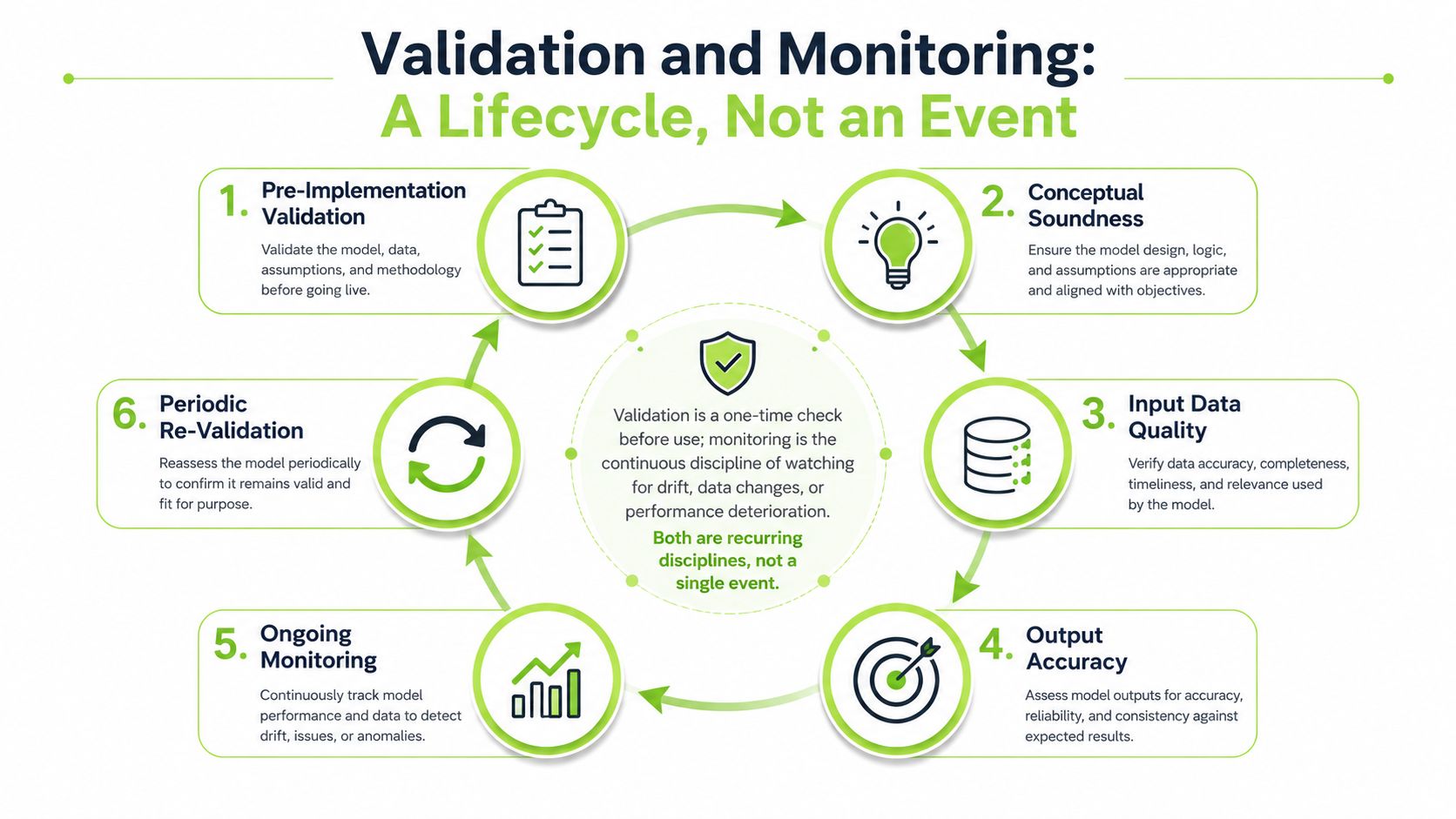
Validation and monitoring do different jobs. Validation checks whether the model is built on sound logic and fits its intended use. Monitoring checks whether it still behaves as expected once it enters real underwriting flow, where data shifts, overrides happen, and market conditions move.
Pre-implementation validation needs independence
Before a model goes live, the reviewer should test conceptual soundness, input data quality, output reasonableness, sensitivity to key assumptions, and benchmarking against alternatives. That review should be independent, not a self-check by the same team that built the model.
Canadian regulators have also pushed toward fuller lifecycle discipline in model and data use. The point is the same whether the model supports pricing, reserving, or portfolio oversight, examiners want evidence that review starts before launch and continues after launch, with clear ownership for what happens when issues appear.
Monitoring needs triggers, not just dashboards
Once the model is live, monitoring has to look for drift, calibration issues, and changes in performance. That can include backtesting, override patterns, and scenario or stress analysis tied to the way the model is used. The important question is not which metric is displayed, it is whether someone can act when the metric moves out of range.
For insurers, validation should also reach beyond normal conditions. Frameworks should require stress and scenario testing across model components, data, methods, assumptions, calculations, and outputs, and ORSA or internal model processes should include a wide enough range of plausible stress tests, including reverse stress testing, to show how solvency changes before and after management actions (CAS ERM session paper on validation and stress testing).
A monitoring report that sits unread is just paperwork.
Monitoring without remediation is only observation. The loop closes when findings change model behavior, model use, or approval status. That is the evidence examiners look for, because it shows the insurer is managing the model as a living control, not filing away a one-time sign-off.
Why Decision Criticality Beats Model Counting
A model inventory can lull teams into the wrong question. Counting models tells you how many objects exist, but not which decisions are at risk. A model that helps draft marketing copy doesn't deserve the same control intensity as one that prices catastrophe-exposed business or drives claims triage, even if both sit in the same inventory.
Underwriting is where sampling breaks first
Manual sampling works poorly in high-volume underwriting flows because the decisions are frequent, the inputs are soft, and the overrides are uneven. A quarterly spot check can miss the exact segment where a weak assumption is compounding across hundreds of small decisions. By the time someone notices, the issue has already been translated into bound business.
That's why the newer U.S. guidance is more useful when it is read as a decision-risk framework rather than a checklist. It shifts attention toward enterprise-critical decisions where models materially influence financial results, customer outcomes, risk profile, regulatory reporting, or strategy. In that view, the question isn't “Do we have a model inventory?” It's “Which decisions need continuous scrutiny?”
Tier the decision, not just the model
A practical tiering method weighs four things, financial impact, regulatory exposure, customer fairness, and reversibility. If an underwriting decision is hard to unwind, has clear pricing impact, or affects protected customer treatment, it deserves tighter monitoring and deeper independent review. If the decision is low impact and easy to reverse, lighter oversight may be enough.
That tiering should drive monitoring frequency, challenger model use, and the depth of review evidence. A high-criticality underwriting model should be treated like a live control, not a periodic project artifact.
Decision first, model second: if the business consequence is severe, the control plan should follow the consequence, not the model headcount.
Many programs still fall short. They focus on cataloging every tool, then spread review effort evenly, which makes the highest-risk decisions the least continuously observed. Decision-criticality reverses that pattern and puts the effort where the loss exposure sits.
Governing AI, Third-Party and Delegated Authority Models
Most insurers don't run a single model universe anymore. They run a mix of internal pricing tools, vendor scorecards, AI-supported underwriting systems, and delegated authority or MGA pricing engines, and each one creates a different governance problem. The common mistake is assuming the same control depth works for all of them.
The regulatory anchors are converging, not identical
The EU AI Act can classify certain insurance AI use as high-risk, which brings documentation, human oversight, and post-market monitoring into the picture by August 2026 as noted in the available industry guidance (AIPMO on AI in insurance underwriting). At the same time, U.S., APRA, and UK expectations are moving toward written AI programs, bias testing, vendor oversight, and operational resilience. The details vary, but the direction is the same, more evidence, more traceability, and more accountability.
Controls should follow the source
A vendor model needs documentation on development purpose, intended use, limitations, and any customizations the insurer applies. A delegated authority model needs clear evidence of who is responsible for thresholds, exceptions, and oversight. An AI-assisted underwriting engine needs testing around explainability, unfair-discrimination review, and post-deployment monitoring that can be audited after the fact.
That's also where continuous evidence trails matter. Audit-ready logs, documented thresholds, and a record of exceptions are starting to replace point-in-time review packets. If the model changes often, the governance record has to change with it.
| Governance obligations by model source | Key Regulatory Anchor | Minimum Evidence |
|---|---|---|
| Internal statistical model | IAIS and actuarial governance expectations | Inventory record, validation report, monitoring results |
| Vendor underwriting model | UK, APRA, and general third-party oversight expectations | Vendor documentation, challenger review, usage limits |
| AI-supported decision tool | EU AI Act high-risk concepts where applicable | Human oversight, post-market monitoring, explainability record |
| MGA-delegated pricing engine | Delegated authority and oversight controls | Threshold logs, exception tracking, audit trail |
FigTrig is one option that sits in this control space. It reviews underwriting notes against an insurer's own guidelines, raises explainable flags, and keeps an audit-ready record that links each flag to specific rulebook sections.
The point is not that every insurer needs the same tool. The point is that every model source still needs traceability, challenge, and monitoring, regardless of who built it or where it runs.
From Program to Operating Discipline in 90 Days
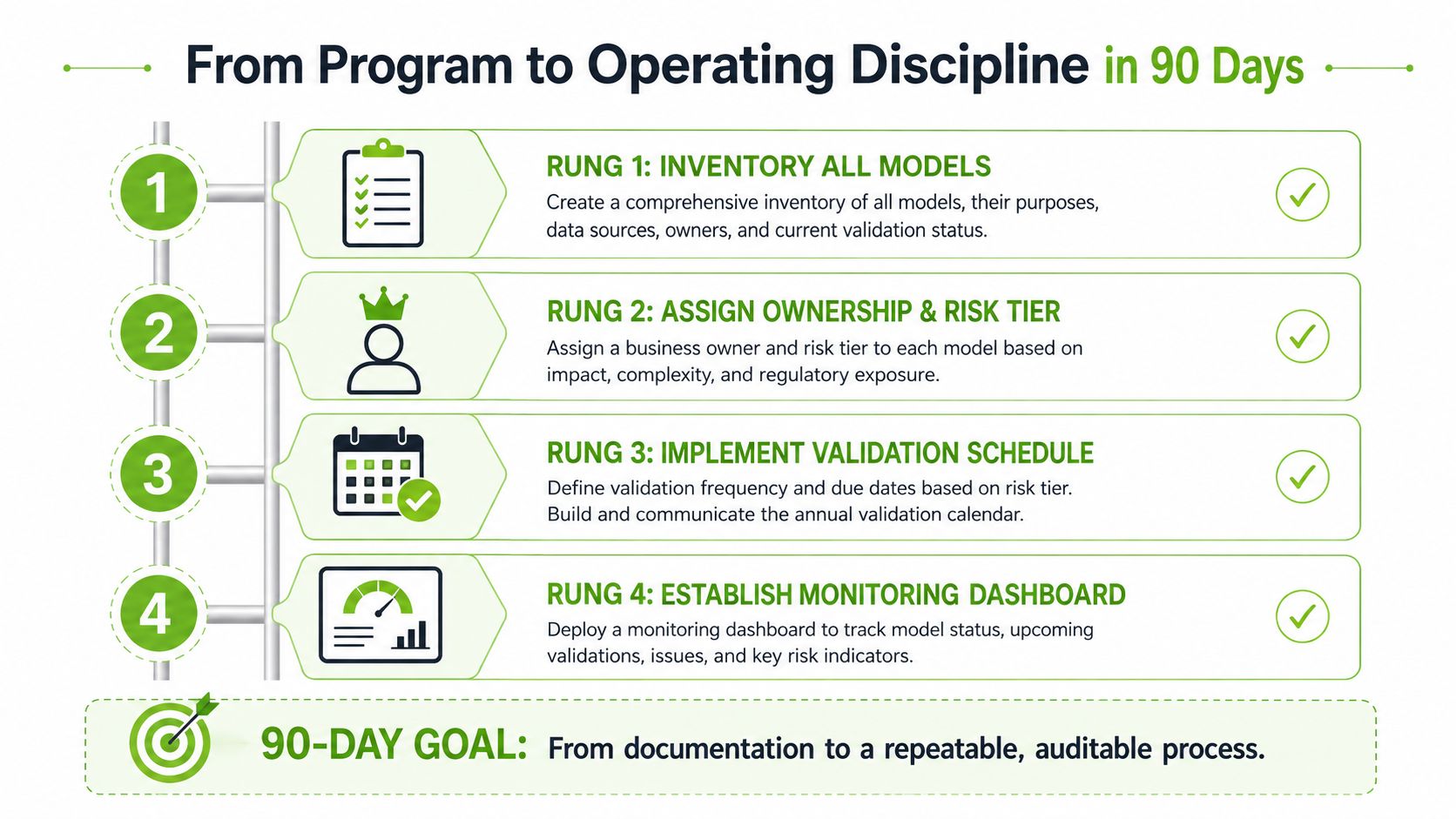
A lot of model risk programs stall because they stay trapped in project mode. The team builds the inventory, drafts the policy, presents the slides, and then discovers that the hard part is turning all of it into daily underwriting behavior. The shift is from documentation to routine.
A simple maturity ladder helps teams see where they are
At the ad hoc stage, model use is mostly local and undocumented. At the inventory-led stage, the firm can at least name its models and owners. At the decision-critical stage, tiering aligns review effort with the decisions that matter most. At the continuous stage, monitoring and exception handling are part of the workflow, not a separate spreadsheet exercise.
The self-check is straightforward. Are material model owners named? Do high-tier models have independent validation? Does monitoring trigger action? Can the team produce examiner-ready evidence without rebuilding the story from email threads?
A 90-day plan can move the needle
- Weeks 1 to 2, inventory and ownership: List every material model, assign one accountable business owner, and mark the intended use and last validation date.
- Weeks 3 to 6, tier and validate: Rank by decision criticality, focus the deepest review on the highest-risk underwriting and reserving models, and document the challenge trail.
- Weeks 7 to 10, wire monitoring into workflow: Embed exceptions and drift alerts into underwriting and claims processes so findings don't sit outside the daily operating rhythm.
- Weeks 11 to 12, package evidence: Assemble board-ready and examiner-ready records showing ownership, validation, monitoring, remediation, and change control in one place.
The candid part is this, most programs don't fail because the policy is wrong. They fail because the work moves from a visible project team to the less glamorous routines that sit inside underwriting, claims, finance, and risk. That's where insurance model risk management becomes real.
If your underwriting team needs a practical way to move from sample-based QA to continuous, decision-level oversight, FigTrig can help by reviewing underwriting notes against your own guidelines, flagging issues in plain language, and keeping an audit-ready trail tied to the relevant rulebook sections. Visit FigTrig to see how that kind of control layer fits alongside your existing underwriting process.


