10 Commercial Underwriting Software Options
Most buying guides treat commercial underwriting software as one product category, then rank policy systems, submission tools, data platforms, pricing engines, and quality controls as if they were interchangeable. They aren't. A carrier replacing its policy administration system has a different problem from an MGA trying to triage broker submissions, and neither problem is solved by a faster document reader alone.
The market is also splitting into distinct layers. The underwriting automation market is projected to grow from $6.2 billion in 2025 to $16.8 billion by 2034, with software estimated as the largest segment in the 2025 snapshot at $3.86 billion. Carrier Management's market coverage also identifies cloud deployment as the fastest-growing model, which reinforces the shift toward configurable, connected infrastructure.
This comparison therefore evaluates each option by the underwriting job it performs and the system layer it occupies. The criteria are workflow fit, deployment model, integration burden, guideline governance, explainability, implementation effort, and suitability for carriers, specialty insurers, or MGAs. Public pricing isn't compared where vendors don't publish it. The useful question isn't “Which platform is best?” It's “Which decision or operating constraint does this platform improve?”
Table of Contents
- 1. FigTrig
- 2. Guidewire PolicyCenter
- 3. Duck Creek Policy
- 4. Appian Connected Underwriting
- 5. Send Underwriting Workbench
- 6. AdvantageGo Underwriting Workbench
- 7. Cytora
- 8. Federato RiskOps Underwriting Platform
- 9. hyperexponential hx
- 10. Planck
- Top 10 Commercial Underwriting Software, Feature Comparison
- Match the Platform to the Decision You Need to Improve
1. FigTrig
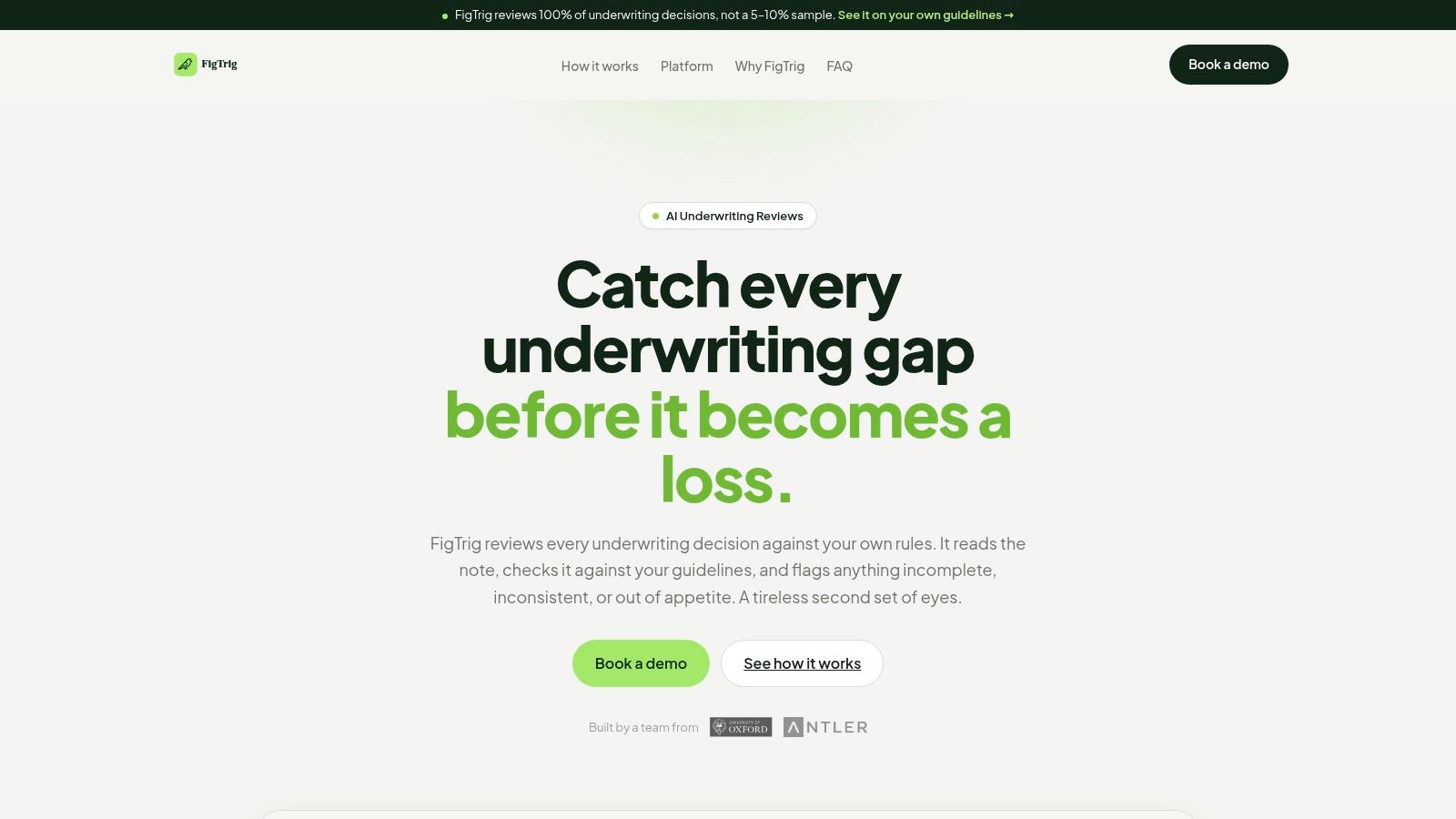
FigTrig occupies a layer most underwriting stacks leave exposed: independent quality assurance after the underwriting note is written and before the policy is bound. Its AI platform reviews 100% of underwriting notes against the insurer's own guidelines, rather than relying on a small manual sample. It checks risk identification, pricing rationale, authority compliance, loss history, documentation quality, policy terms, and custom rules.
The important distinction is explainability. FigTrig doesn't merely return a risk score or a generic exception. It raises a plain-language flag and links it to the specific section of the uploaded rulebook that appears to have been breached. That creates a review record a manager, claims team, auditor, or regulator can understand later.
Practical rule: Faster intake improves throughput. Note-level QA tests whether the resulting decision can be defended.
Teams upload guideline documents in formats such as PDF, Word, or internal manuals, then connect FigTrig alongside existing systems through REST API, webhooks, CSV, or SFTP. Teams can review live notes within about one week, according to the supplied product information. Its tenant isolation, data residency choices, GDPR-aligned processing controls, and policy that customer data isn't used to train shared models make it suited to organizations with strict data-governance requirements.
The trade-off is equally clear. Coverage depends on the quality of the insurer's rulebook. Ambiguous or incomplete guidelines can produce limited coverage or more false positives, so implementation still requires underwriting ownership. Pricing isn't published, and prospects need to visit FigTrig to discuss a demonstration, commercial terms, and testing against their own rules.
FigTrig is best for carriers, specialty insurers, and delegated-authority MGAs that already have core systems but can't confidently review every decision before binding. It complements policy administration, workbenches, enrichment, and pricing tools rather than replacing them.
2. Guidewire PolicyCenter
Guidewire PolicyCenter belongs in the core policy administration and underwriting platform category. It supports the policy lifecycle for P&C carriers, including product configuration, rating, underwriting rules, quoting, binding, endorsements, and renewals. Through Guidewire Cloud and the wider InsuranceSuite ecosystem, it can connect policy operations with billing and claims processes.
That makes PolicyCenter a plausible foundation for a carrier modernizing a fragmented core. Its value isn't that underwriters get another screen. The system can encode products and underwriting rules into the transaction flow, allowing the carrier to connect eligibility, rating, authority, and policy servicing rather than treating each as a separate application.

The fit is strongest for large P&C carriers with complex commercial products, multiple jurisdictions, mature operations, and a long-term platform strategy. The ecosystem and market content can reduce the need to assemble every capability independently, while cloud delivery can simplify upgrades and infrastructure management.
The cost of that breadth is implementation effort. Product configuration, data migration, integration design, operating-model changes, and governance all become major workstreams. A smaller MGA that needs a focused submission workbench may find PolicyCenter too broad, especially if policy issuance remains with a capacity partner.
Guidewire also shouldn't be confused with an independent QA layer. Its embedded rules can govern transactions, but a carrier may still want a separate control that reviews the completed underwriting rationale against the current rulebook. That separation matters when management wants evidence of what the underwriter documented, not only whether the core system accepted the transaction. Buyers should also review FigTrig's terms when considering how an external review layer could sit alongside a core platform.
Best fit: enterprise P&C carriers replacing or consolidating policy administration.
3. Duck Creek Policy
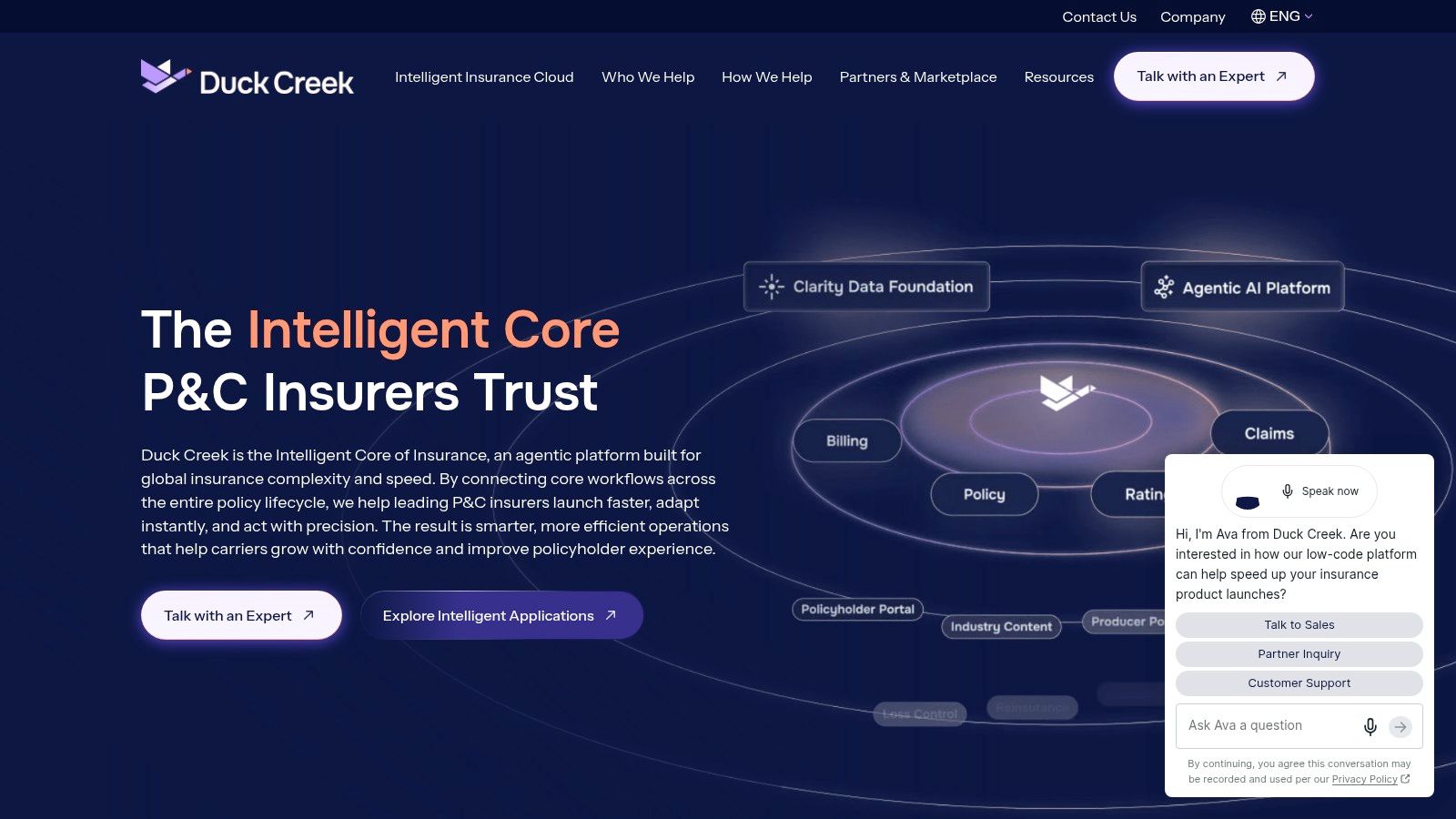
Duck Creek Policy is another cloud policy administration platform, but its buying logic centers on commercial content, configurable rating, APIs, and SaaS delivery. The platform supports P&C products and can be paired with an Underwriting Workbench when the carrier wants a more unified workspace for submissions and portfolio context.
For carriers launching or changing commercial products, prebuilt content can reduce the amount of foundational configuration required. The platform's rating and pricing controls also place product logic closer to policy transactions, which helps organizations that need a governed path from product design through quote and issuance.
The workbench option changes the comparison. Policy is the core layer, while the workbench addresses how underwriters receive, organize, and act on risk information. That can make Duck Creek attractive to a carrier seeking a connected suite instead of a standalone policy engine plus a separate workspace.
The limitations are typical of enterprise core platforms. Configuration still requires disciplined change management, testing, ownership of rules, and integration governance. The platform won't automatically resolve inconsistent broker submissions or prove that every narrative decision matched the insurer's guideline. Those are adjacent problems.
Pricing isn't public, and content packs and workbench capabilities may be licensed separately. Buyers should therefore define the intended footprint before comparing commercial terms. A carrier looking only for a policy engine may not need the same package as one seeking policy, underwriting workflow, content, rating, and integration services together.
Best fit: commercial P&C carriers that want cloud policy administration with configurable content and an optional underwriting workspace.
4. Appian Connected Underwriting
Appian Connected Underwriting is a workflow and orchestration layer, not a replacement for the policy administration or rating core. Built on the Appian Platform, it focuses on submission intake, triage, collaboration, document handling, validation, and task management. Separate P&C and Life variants allow the operating model to reflect different underwriting processes.
The practical appeal is adaptability. A carrier or specialty insurer can configure workflows as requirements change, route referrals to the right people, and preserve an audit trail across tasks. The “My Workbench” experience is designed to help underwriters prioritize cases and collaborate without forcing every operational change into a core-system release cycle.
Its document and data extraction capabilities can help turn incoming material into structured tasks, but extraction isn't the same as judgment. Appian can organize missing information, validation, approvals, and handoffs. The carrier still needs external systems for policy administration, rating, and often specialized decisioning.
A workbench can make the process visible. It doesn't automatically make the underwriting rationale correct.
That distinction makes Appian a strong candidate for organizations with several legacy systems and a need for a configurable front door. It can orchestrate activity across those systems while preserving who did what and when. The trade-off is commercial and architectural: buyers need an Appian Platform subscription as well as the Connected Underwriting license, and the core transaction systems remain part of the design.
A separate QA layer can add another control point by checking the completed note against insurer rules rather than only recording workflow progression. Privacy requirements should be reviewed alongside the broader FigTrig privacy policy when evaluating data movement between platforms.
Best fit: carriers and specialty operations that need rapid workflow tailoring around existing policy and rating systems.
5. Send Underwriting Workbench
Send is a focused underwriting workbench for carriers, MGAs, and reinsurers that want to centralize submissions without replacing the policy administration stack. Its API-first architecture, ACORD support, data-provider connections, and portfolio context are designed around the underwriter's daily casework rather than the full policy lifecycle.
That positioning matters for MGAs operating across multiple carrier or capacity-provider environments. A workbench can give the team one place to manage broker interactions, triage, referrals, and portfolio information even when issuance occurs in external systems. It also supports a minimize-the-rip-and-replace strategy, which is often more realistic than replacing every core component at once.
Send's prebuilt workflows and data models across numerous lines of business can shorten the distance between implementation and operational use. The buyer still needs to map data fields, establish integration ownership, and decide which system remains authoritative for quote, bind, issuance, and servicing.
The platform isn't a full policy administration or rating engine. That limitation is a feature for some buyers and a gap for others. An MGA that needs a workspace around several carrier portals may value the separation. A carrier seeking one system for product configuration, rating, policy servicing, and claims integration will need a broader platform.
Portfolio visibility also doesn't equal continuous quality review. Send can help an underwriter see context while working a submission. FigTrig can complement that workflow by checking the resulting underwriting note against the insurer's own authority, documentation, and pricing rules.
Best fit: MGAs, delegated-authority teams, and carriers that need a modern workspace over an existing core stack.
6. AdvantageGo Underwriting Workbench
AdvantageGo is oriented toward commercial, specialty, London Market, and reinsurance underwriting workflows. Its workbench brings submissions, referrals, endorsements, wordings, exposure information, and portfolio views into a connected operating environment.
The strongest reason to consider it is the document and wording problem. Specialty underwriters don't work only from clean application fields. They handle broker submissions, negotiated terms, endorsements, clauses, and exposure information that must remain connected to the risk decision. A platform that centralizes those artifacts can reduce rekeying and make the file easier to manage across the lifecycle.
The modular approach also lets organizations select capabilities across underwriting, exposure, and policy administration rather than committing to one monolithic replacement. That can suit a specialty insurer or London Market operation with established systems that still needs stronger pre-bind control.
Implementation depends heavily on information quality. If documents are inconsistent, integrations are poorly mapped, or ownership of portfolio data is unclear, the workbench may centralize confusion rather than remove it. Buyers should test representative specialty submissions, not just clean sample records.
AdvantageGo also isn't an independent proof layer. A workbench can make the wording and exposure context accessible, while a QA platform can verify whether the written rationale aligns with the applicable guideline and authority. Those controls address different points in the operating model.
Best fit: specialty insurers, London Market teams, and reinsurers with complex submissions, wordings, and exposure workflows.
7. Cytora
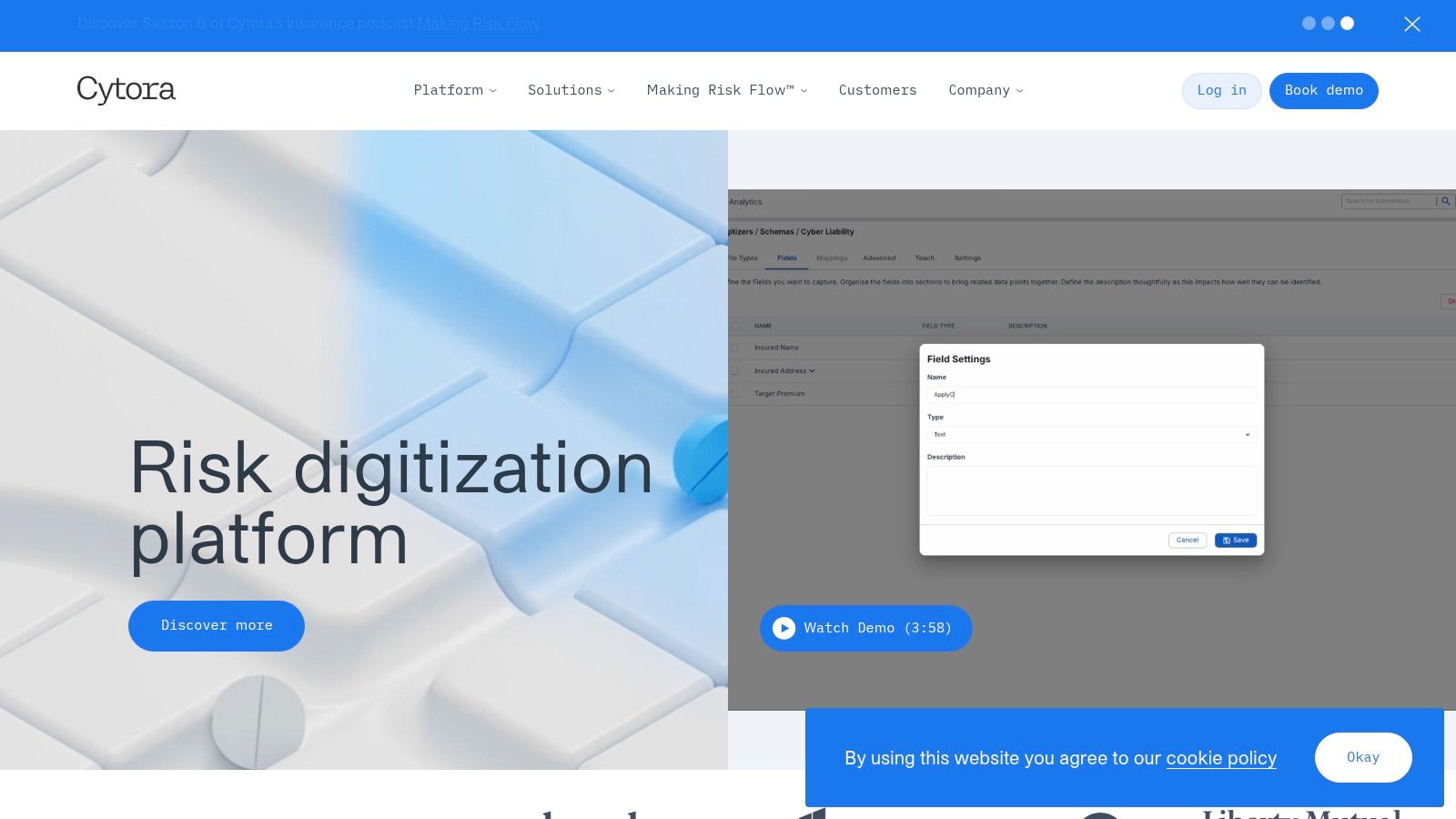
Cytora sits in the risk digitization and pre-bind decisioning layer. Its job is to turn incoming submissions into normalized data, apply appetite and routing logic, enrich the risk, and prioritize work for underwriters. That makes it materially different from PolicyCenter or Duck Creek Policy, which own more of the policy transaction.
This is particularly relevant because commercial submissions arrive through mixed formats and channels. A digitization platform can classify and structure those inputs before an underwriter spends time deciding whether the risk is worth pursuing. Routing can then send in-appetite risks toward the right queue and move unsuitable or incomplete risks out of the main flow.
The buyer's real dependency is rule clarity. Cytora can only prioritize effectively when the appetite, referral conditions, and decision logic are defined well enough to operationalize. Data-provider choices also affect the quality of enrichment and the confidence an underwriter can place in the resulting file.
That creates a useful division of labor. Cytora helps answer, “Which submissions should we work, and what information can we assemble before review?” A quality layer helps answer, “Did the final underwriting note follow the applicable rules and document the reasoning?” Treating both as the same function risks leaving the second question unanswered.
Cytora is therefore best evaluated by intake quality, routing precision, integration fit, and the carrier's ability to maintain appetite rules. It isn't a policy administration system, and buyers shouldn't assess it on issuance capabilities it wasn't designed to own.
Best fit: commercial insurers and MGAs prioritizing submission digitization, triage, and pre-bind throughput.
8. Federato RiskOps Underwriting Platform
Federato RiskOps focuses on the connection between portfolio strategy and front-line underwriting action. It prioritizes submissions using appetite, guideline logic, and winnability signals, while exposing portfolio controls intended to help teams manage accumulation and capacity concerns.
That makes it a natural fit for insurers and MGAs that don't only need to process cases faster. They need underwriters to select risks in a way that reflects the current book, available capacity, and strategic appetite. A submission can look attractive in isolation and still be undesirable when it creates concentration or conflicts with portfolio objectives.
Federato's operating model is therefore closer to appetite governance and portfolio optimization than to policy administration. Its agentic features are intended to accelerate the assembly of decision-ready files, while real-time adjustments help reflect changes in appetite.
The trade-off is integration and governance. Federato operates alongside policy and rating engines, so teams must define how appetite rules are changed, who approves them, and how decisions flow into downstream systems. Enterprise sales also handle pricing and commercial details, which means budgeting requires direct vendor engagement.
A platform that recommends priority doesn't necessarily verify every completed decision. Buyers should ask whether the system preserves the evidence behind a recommendation and whether another control will inspect the final underwriting note. That distinction is especially important where senior judgment must remain visible rather than being replaced by an opaque score.
Best fit: carriers and MGAs that want underwriter-level appetite governance, portfolio awareness, and submission prioritization.

9. hyperexponential hx
hyperexponential, or hx, occupies the pricing and underwriting decision-intelligence layer. Its products connect advanced pricing, risk assessment, portfolio intelligence, renewals, reinsurance workflows, and decision traceability. The key buyer is less interested in a generic work queue and more concerned with how pricing decisions are built, governed, explained, and monitored.
The platform's pricing lineage is central to its value. Underwriters and pricing teams need to understand the factors behind a recommendation, especially when models use sparse or limited data. Embedding portfolio intelligence at the point of pricing can also help teams assess a risk in relation to the wider book rather than treating price as a standalone calculation.
hx Renew and its workbench capabilities extend that logic into renewal and reinsurance workflows. An emerging agentic layer is intended to advance submissions, but the core distinction remains decision intelligence, not policy issuance.
That means the platform is best suited to specialty P&C and reinsurance organizations with mature pricing functions and the discipline to govern models. It won't replace a policy administration system. It also won't remove the need to define underwriting rules, document authority, and preserve human accountability.
Buyers should separate pricing explainability from underwriting-note QA. A price can be traceable to a model and still be poorly justified in the written file. Combining a pricing platform with independent review can test both the numerical decision process and the documentation that supports it.
Best fit: specialty and reinsurance organizations prioritizing pricing sophistication, portfolio intelligence, and decision traceability.

10. Planck
Planck is an external-data enrichment and risk-intelligence platform for commercial underwriting. It gathers and synthesizes external and proprietary information to identify risk factors, support eligibility and appetite checks, monitor exposures, and surface changes over time.
That addresses a specific underwriting failure: the submission doesn't contain enough reliable context to answer important questions. Planck can complement a workbench, policy system, or rating engine by supplying additional risk information rather than attempting to own the policy lifecycle.
The platform is particularly relevant to SMB and mid-market workflows where underwriters need consistent enrichment across classes such as BOP, general liability, and property. Continuous monitoring also changes the role of data. The buyer isn't only enriching a submission once. The organization can use alerts to identify changes that may affect exposure or appetite later.
The limitation is data coverage. External data varies by class, geography, source, and risk complexity. A carrier should test the exact segments it writes rather than assuming that a strong result in one line transfers to another.
Planck also doesn't replace decision governance. Better data can improve the basis for a decision, but it doesn't prove that the underwriter followed the applicable authority or documented the rationale adequately. That is why enrichment and QA should be evaluated as complementary layers.
Best fit: commercial insurers and MGAs seeking automated risk discovery, eligibility checks, and exposure monitoring around an existing underwriting stack.
Top 10 Commercial Underwriting Software, Feature Comparison
| Solution | Core capabilities | UX & Quality (★) | Value & Pricing (💰) | Target audience (👥) | Unique strengths (✨) |
|---|---|---|---|---|---|
| FigTrig 🏆 | 100% automated note reviews; guideline ingestion; explainable flags & audit trail; API/webhooks | ★★★★★, seconds-level flags; audit-ready citations | Custom / demo required 💰; fast ROI (pilot value shown) | 👥 Insurers, MGAs, London market underwriters | ✨ Explainable, guideline-cited flags; tenant isolation; ~1‑week live reviews |
| Guidewire PolicyCenter | Enterprise PAS: product config, rating, STP, large integrations | ★★★★, proven at scale | Enterprise licensing 💰, significant TCO | 👥 Large carriers, multi-state programs | ✨ Deep PAS + ecosystem; strong analytics & market content |
| Duck Creek Policy | Cloud PAS with prebuilt commercial content, 2k+ APIs, rating controls | ★★★★, SaaS delivery | Enterprise / module pricing 💰 (content/workbench extra) | 👥 Carriers seeking cloud PAS & content packs | ✨ ISO/industry packs; extensive API surface |
| Appian Connected Underwriting | Low-code workbench for intake, triage, orchestration, audit | ★★★★, rapid tailoring & orchestration | Platform + license 💰, modular cost | 👥 Teams needing orchestration/intake & fast config | ✨ Low-code workflows; strong audit trails |
| Send Underwriting Workbench | API-first workbench, ACORD support, real-time portfolio insights | ★★★★, focused underwriter UX | Enterprise / subscription 💰 | 👥 MGAs, carriers needing focused workspace | ✨ Real-time portfolio context; minimizes rip‑and‑replace |
| AdvantageGo Underwriting Workbench | Submissions, wordings, exposure insights; specialty & reinsurance focus | ★★★★, London Market pedigree | Regional/module pricing 💰 | 👥 London Market, specialty & reinsurance teams | ✨ Wordings management; exposure & portfolio intelligence |
| Cytora | Submission digitization, enrichment, decisioning & triage | ★★★★, improves intake throughput | SaaS / enterprise 💰 | 👥 Teams automating intake & triage | ✨ Strong intake automation; modern cloud stack |
| Federato RiskOps | Appetite-driven triage, winnability scoring, portfolio optimization | ★★★★, underwriter-centric signals | Enterprise / contact sales 💰 | 👥 Underwriters focused on appetite & portfolio controls | ✨ Winnability scoring; portfolio governance tools |
| hyperexponential (hx) | Advanced pricing + underwriting intelligence; decision traceability | ★★★★, pricing explainability | Enterprise / model governance 💰 | 👥 Pricing-led teams, reinsurance & specialty | ✨ Pricing-first decision intelligence; audit trail |
| Planck | Automated enrichment, eligibility checks, continuous monitoring | ★★★★, reduces unanswered questions | SaaS / API pricing 💰 | 👥 SMB–mid‑market underwriting teams | ✨ Continuous data enrichment & monitoring |
Match the Platform to the Decision You Need to Improve
Start with the operational failure, not the vendor shortlist. If the carrier needs product configuration, rating, issuance, endorsements, and renewals, evaluate policy administration platforms such as Guidewire PolicyCenter or Duck Creek Policy. If the problem is fragmented intake and manual coordination across systems, compare workbenches such as Appian Connected Underwriting, Send, and AdvantageGo. If appetite and portfolio alignment are the concern, Federato is closer to the problem than a core PAS.
The same logic applies to data and pricing. Cytora addresses submission digitization and pre-bind routing. Planck addresses external-data enrichment and monitoring. hx addresses pricing and decision intelligence. FigTrig addresses a different control question, whether the completed underwriting note complies with the insurer's own guidelines and remains defensible.
Industry adoption supports this layered view. Insurers expect AI adoption in underwriting to rise from 14% today to 70% within three years, while 81% of underwriting executives believe AI and generative AI will create new roles and meaningful efficiency gains, according to BizTech Magazine's coverage of the industry survey. The same research describes modern policy platforms as a growing underwriting enabler, but adoption doesn't mean every AI tool belongs in the same layer.
Use a practical selection sequence:
- Define the decision: decide whether the priority is policy administration, submission orchestration, appetite control, pricing intelligence, external enrichment, or independent QA.
- Map the stack: document integrations with the existing PAS, rating engine, broker channels, document repositories, claims systems, and data providers.
- Test real material: use representative submissions, messy documents, referral cases, renewals, and the insurer's current guidelines.
- Assign rule ownership: identify who can change appetite, authority, pricing, documentation, and referral rules, and how those changes are versioned.
- Confirm governance: review audit trails, explainability, human oversight, privacy, data residency, deployment, retention, and security requirements.
- Model implementation effort: compare configuration, migration, integration, testing, training, and ongoing operating ownership, not only license scope.
The evidence on underwriting platforms also points to a recurring trade-off. Celent's survey of 38 respondents evaluating 11 solutions found generally positive feedback on configurability and scalability, while lower scores clustered around data-model flexibility, upgradeability, and integration ease. Celent's underwriting system survey reinforces why a polished feature list isn't enough. The platform must fit the organization's data model and change process.
A buyer may combine several layers rather than replace the entire stack. A carrier might pair Duck Creek or Guidewire with Cytora for intake, Planck for enrichment, hx for pricing, and FigTrig for note-level QA. An MGA might retain carrier policy systems, use Send for the workspace, Federato for appetite visibility, and FigTrig to review every decision against delegated authority and underwriting guidelines.
That final layer matters because faster decisions aren't automatically better decisions. Industry reporting identifies inconsistent submission data, pressure to bind quickly, and limited context on similar prior risks as significant underwriting drags, while also highlighting concern about losing senior judgment. Insurance Business Magazine's reporting captures the central buyer question: does the system improve decision quality, or only accelerate the workflow?
For teams that need an answer before binding, FigTrig is the most direct fit in this list. It sits behind the core systems, reviews each underwriting note against the insurer's own rulebook, explains the exact issue, and preserves an audit-ready record without asking the carrier to replace its operating stack.
FigTrig provides an independent quality layer for commercial underwriting, reviewing every underwriting note against your own guidelines and raising explainable flags before binding. If your priority is defensible decisions, clearer management oversight, and rule-level auditability alongside existing systems, visit FigTrig to see how it can be tested against your underwriting rulebook.