
Regtech Insurance
A Monday morning bind report can turn a routine underwriting review into a compliance investigation. A commercial property quote may have been booked below the carrier's minimum premium guideline, while a separate policy missed a required jurisdictional endorsement deadline. By the time someone notices, the broker may already have been notified, the policy may be active, and the underwriting team may be trying to reconstruct a decision from emails, screenshots, and memory.
That situation explains why regtech insurance is moving beyond filing calendars and regulatory reporting. The more difficult question is often whether a carrier can prove that each underwriting decision followed the right rule, authority level, pricing rationale, and approval path. Modern regulatory technology brings those checks closer to the point of decision, where teams can correct issues before binding and preserve evidence automatically.
Table of Contents
- Why Insurance Compliance Is Under Pressure Right Now
- What Regtech in Insurance Actually Means
- The Regulatory Pain Points Driving Adoption
- Core Regtech Capabilities Reshaping Insurance Workflows
- How Automated Underwriting QA Fits Into the Picture
- What Audit-Ready Evidence Really Requires
- Why Full-Coverage Review Changes the Governance Equation
- Choosing Regtech Tools That Hold Up Under Scrutiny
Why Insurance Compliance Is Under Pressure Right Now
An underwriting manager opens the bind report and finds a policy below the minimum premium guideline. The immediate breach is clear. The harder question is whether it is one mistake or evidence of similar decisions that escaped review.
The cause could be a data-entry error, an outdated underwriting rule, or an exception that no one approved. A missed state endorsement deadline could signal a failing filing workflow rather than an isolated oversight. In either case, the final policy record is not enough. Compliance needs to establish who made the decision, which information they used, which rule applied, and whether anyone approved an exception.
Insurance supervision is becoming more digitally enabled. Deloitte's analysis of insurance regtech describes technology use by state regulators as part of a broader regulatory toolkit. The OECD and IAIS discussion of digitalisation in insurance describes an early but advancing stage of digital development, including sandboxes, digital filing, and technology-enabled oversight.
Manual review creates a timing problem
Traditional quality assurance usually begins after binding. Reviewers select files, compare documents by hand, and send findings through separate email or spreadsheet processes. The method can find defects, but it offers limited visibility into decision quality while corrections are still practical.
The burden is structural. Paper-based documentation requirements and complex rating models make insurance oversight harder to evaluate efficiently. As regulators modernize their own review processes, carriers need evidence that can withstand detailed questioning.
Practical rule: If a control only confirms that a policy exists, it is not enough. A defensible control should show how the policy came into existence.
Product filings, producer appointments, delegated authority, consumer protection requirements, reinsurance documentation, and incident reporting all place demands on workflows built around human judgment and disconnected systems. Automated decision review addresses the gap between checking selected files and examining underwriting quality across the decisions being made. It moves compliance checks closer to the point of underwriting, so teams can identify exceptions, correct them, and retain the reasoning behind each action.
What Regtech in Insurance Actually Means
Regtech in insurance means applying technology to the operational work required to interpret, apply, monitor, and prove compliance. It isn't limited to a reporting portal. A useful way to understand it is as an operational stack that connects raw insurance data to an examiner-ready record.

The four layers of the stack
At the foundation sits data capture and normalization. The system gathers quote, bind, endorsement, claims, producer, and regulatory information from existing platforms, then gives those records a consistent structure. Without this layer, a rule engine may receive incomplete or conflicting inputs.
The next layer is rule logic and monitoring. Statutes, filing obligations, underwriting guidelines, authority matrices, and internal procedures become executable checks. The technology can compare an underwriting note or policy transaction with the applicable requirements instead of waiting for a person to find the issue during a later review.
The third layer is workflow automation. A flagged decision can trigger an approval gate, request additional documentation, route an exception to a supervisor, or create a task for compliance. Automation doesn't have to replace the underwriter. It can support judgment by making the relevant rule and evidence visible at the right time.
The final layer is audit evidence. A reconstructive record connects the decision to its inputs, rule version, user, timestamp, outcome, and any override. That evidence lets an insurer explain a decision without rebuilding the narrative from disconnected files.
Two sides of the same modernization
Regtech serves regulators as well as insurers. Regulator-side tools include digital filing platforms, supervisory analytics, and dashboards used by insurance departments. Insurer-side tools operate inside carrier, MGA, reinsurer, or broker workflows to help those organizations meet supervisory expectations.
Automated underwriting QA belongs on the insurer side. It sits between human decisioning and the bound policy, checking pricing, appetite, authority, documentation, and policy-term fit. That distinction matters when evaluating vendors. A dashboard that summarizes compliance activity may be useful, but it won't necessarily review the decision population or preserve the evidence behind each result.
The Regulatory Pain Points Driving Adoption
An underwriter binds a policy, and the record shows the premium, form, and final terms. Months later, a reviewer asks why the risk received that treatment. The file contains several documents, but no clear link between the source data, applied guideline, approval, and exception. That gap is the day-to-day compliance problem regtech must address.
Legacy policy administration and underwriting platforms often preserve the outcome more reliably than the decision context. The result is a control problem inside ordinary work: teams must determine whether a pricing choice, coverage term, authority decision, or missing document reflects an isolated mistake or a repeatable process failure.
| Pain Point | Operational Impact |
|---|---|
| Modernization pressure | Compliance teams translate changing expectations into workable controls across products, jurisdictions, and distribution channels. |
| Manual compliance expense | Staff reconcile records, prepare audit support, investigate exceptions, and correct preventable errors after the transaction is complete. |
| Inconsistent underwriting decisions | Similar risks may receive different treatment, creating governance concerns and difficult examination questions. |
| Producer and delegated authority oversight | Carriers need evidence that appointed producers and delegated teams acted within the authority granted to them. |
| Reconstructive audit requirements | Teams rebuild the rationale for pricing, coverage, or exceptions from scattered documents and communications. |
The hidden cost sits after the decision
A manual review commonly begins with a sample of completed files. If the reviewer finds a problem, the team searches related records, decides whether the issue is isolated, and identifies the control owner. The policy has already entered the portfolio, so correction may require remediation, outreach, or a later endorsement.
A single file can make a defect look clerical. Across a portfolio, a minimum premium issue, authority breach, or missing form may reveal that a guideline was not updated, a system rule is misconfigured, or an approval process is not operating as intended. Automated decision review changes the question from “Which files should we inspect?” to “Which decisions failed the control, and what pattern do they form?”
Why legacy records fall short
A final premium and policy form show what happened. They do not necessarily show why. An examiner may need the source data, applied rule, user identity, approval history, and evidence supporting an exception. If those elements sit in separate systems or email threads, the insurer must reconstruct the decision manually.
The right regtech starting point depends on the largest evidence gap. A carrier struggling with regulatory change may begin with policy intelligence. One facing underwriting drift may need automated decision review across completed transactions. A delegated authority operation may prioritize approval controls and authority monitoring. This focus connects compliance technology to underwriting quality assurance, rather than limiting regtech to reporting and filing work.
Core Regtech Capabilities Reshaping Insurance Workflows
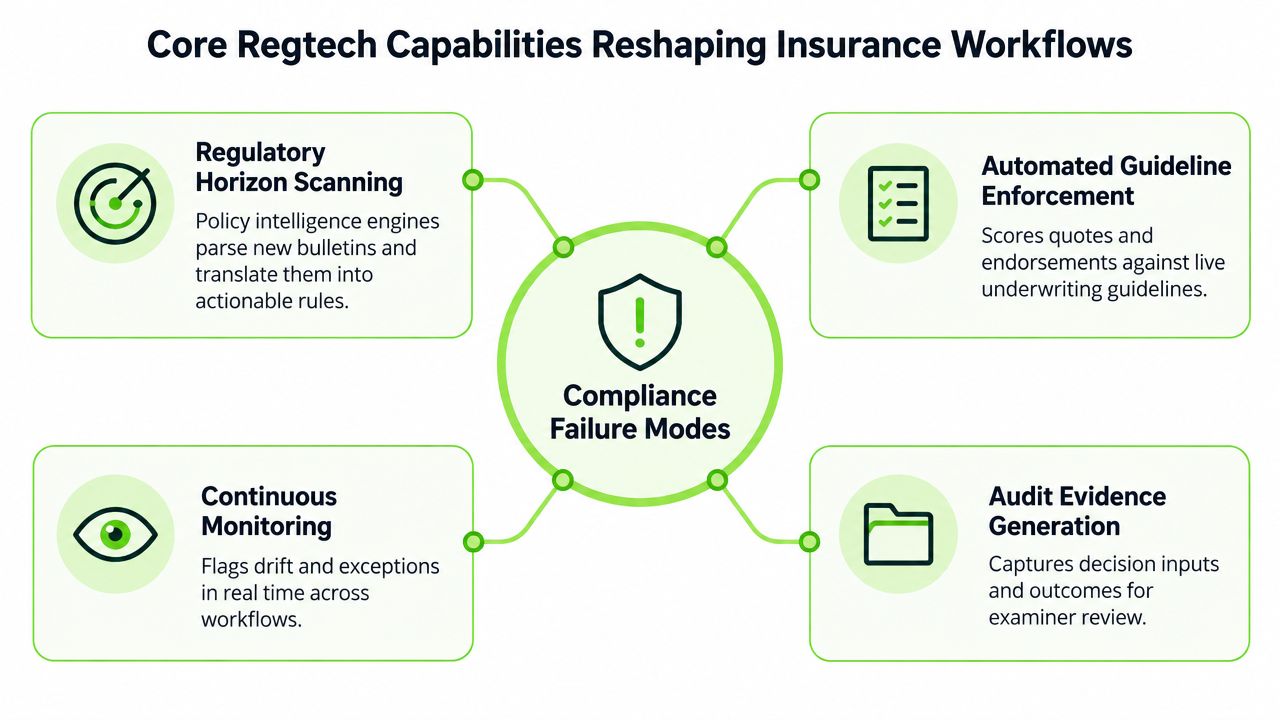
The strongest regtech architectures map each recurring failure mode to a control that operates inside the workflow. They don't treat compliance as a separate dashboard that someone checks after the business has finished its work.
Regulatory intelligence turns change into action
A policy intelligence engine monitors regulatory bulletins, filing updates, and supervisory communications. Its value comes from translating those changes into internal obligations, affected products, jurisdictional tasks, and control updates.
That translation step is important. A bulletin may change an endorsement requirement, but an underwriting manager needs to know which product, state, form, workflow, or approval rule is affected. The system should create an actionable change record rather than display new text.
Guideline enforcement checks the decision itself
Automated guideline enforcement compares quotes, underwriting notes, endorsements, and other transactions with the carrier's live rules. It can identify an out-of-appetite risk, an unsupported pricing rationale, a missing document, or an authority conflict.
The check should return an explanation, not just a pass or fail result. The underwriter needs to see the relevant rule, the data that triggered the flag, and the next action. That design keeps human judgment in the workflow while making deviations easier to resolve.
Continuous monitoring finds drift
A monitoring layer looks across transactions rather than treating each file as a separate event. It can surface repeated exceptions, unusual override patterns, inconsistent treatment of similar risks, or deterioration in documentation quality.
This layer supports both first-line managers and second-line compliance. Underwriting leaders can address coaching or process issues, while compliance teams can investigate patterns that require formal remediation.
Audit evidence preserves the story
Evidence generation records decision inputs, rules, outcomes, approvals, overrides, and supporting files. The result is an audit trail that can be searched and replayed instead of assembled manually during an examination.
Watch the embedded walkthrough for a practical view of how workflow automation can support review and oversight.
These capabilities work best as a connected stack. Horizon scanning identifies a change, guideline enforcement applies it, monitoring detects exceptions, and evidence generation proves what happened. Removing any layer can leave the carrier with a control that detects risk but cannot explain it, or evidence that documents a decision only after the opportunity to correct it has passed.
How Automated Underwriting QA Fits Into the Picture
At the start of the underwriting day, an underwriter may move between submissions, renewal reviews, endorsements, broker messages, and authority questions. Each action carries compliance context, but that context is often distributed across manuals, policy systems, emails, and local team knowledge.
Automated QA adds a review layer to the existing process. As the underwriter records a decision, the engine compares the note and supporting data with the active guideline library, jurisdictional requirements, and authority matrix.

What the underwriter sees
Suppose an underwriter binds a dwelling outside the carrier's preferred appetite using preferred terms. A useful system doesn't merely display “exception detected.” It produces an explainable flag connected to the precise rule, the relevant input, and the time of the review.
The side panel might identify the appetite condition, show the property characteristic that caused the conflict, and recommend a remediation path, such as obtaining approval, changing the terms, or adding supporting documentation. The underwriter can then decide whether the flag reflects a genuine issue, a permitted exception, or an incomplete record.
A good QA flag explains the concern without pretending to make the underwriting decision.
The final decision remains with the authorized human user. The technology provides consistency, speed, and evidence. It also creates a structured record of how the user responded to the flag.
What compliance and management see
The same review produces an exception queue for compliance and underwriting management. Clerical issues can be separated from judgment calls, while repeated deviations can be grouped by product, team, broker, authority level, or guideline.
That distinction helps leaders focus attention. A missing document may require workflow redesign. Repeated pricing exceptions may require a guideline review. A delegated authority breach may require escalation and control testing.
The QA layer therefore connects frontline decisioning with the broader regtech stack. It doesn't replace policy intelligence, workflow controls, or audit storage. It makes those capabilities relevant to the individual underwriting action, where the carrier can still correct the record before binding.
What Audit-Ready Evidence Really Requires
An audit-ready underwriting record should let an examiner reconstruct a decision from the original inputs to the final outcome. A summary report may show that a policy passed review. A reconstructive trail shows why it passed, what rules were active, who acted, and what happened when the system identified an exception.
The Finantrix explanation of underwriting audit trails identifies the types of records examiners commonly want, including timestamped login and logout activity, field-level before-and-after changes, rule execution logs with inputs and outputs, supervisor-approved overrides, and external data query logs.

The evidence chain
A complete trail should preserve:
- Inputs: Application data, source documents, third-party data, and user-entered information.
- Rules: The guideline or model version active when the decision occurred.
- Authority: The user's role, delegated authority, approval level, and any segregation-of-duties control.
- Outcome: The decision, pricing rationale, coverage terms, and disposition.
- Exceptions: Overrides, escalations, comments, supporting files, and final approval.
The automated underwriting system analysis from Jinba describes full decision tracing at the workflow layer as capturing who triggered a run, what data entered, which rules fired, which rule or model version was used, and what human review followed. That level of lineage makes the record useful for both internal audits and external examinations.
Durability matters as much as completeness
Evidence should be time-stamped, tamper-evident, searchable, and exportable in a format an examiner can understand. Version control also matters. If a guideline changes later, the historical record must continue to show the version that governed the original decision.
Privacy controls belong in the design from the start. Teams should review retention, access, tenant isolation, data residency, and processing arrangements, including the provider's privacy terms, before connecting underwriting data.
Audit readiness isn't a quarter-end documentation exercise. It is the result of capturing decision lineage as work happens, with enough context to replay the reasoning later.
Why Full-Coverage Review Changes the Governance Equation
Many quality programs rely on manual sampling because reviewers have limited time. Sampling can provide useful signals, but it can't establish what happened across the entire underwriting population. A repeated error may never appear in the selected files, while an isolated issue may receive disproportionate attention.
Full-coverage review changes the question from “Did we inspect enough files?” to “What did the system identify across all decisions?” That is a governance shift, not merely a software feature.
Sampling creates blind spots
A small manual sample can miss guideline drift, recurring documentation defects, pricing exceptions, and authority misuse. It also makes trend interpretation difficult. Management may know that reviewers found issues, but not whether those issues represent a narrow anomaly or a broader pattern.
Continuous monitoring gives leaders a complete exception population to analyze. It can show which issues were resolved before binding, which required approval, and which indicate a weakness in the underlying rule or workflow.
Oversight becomes more transparent
Boards, audit committees, chief compliance officers, and chief underwriting officers need visibility into control performance. A full-coverage approach can provide that visibility without asking reviewers to read every file manually. The system performs the initial comparison, while people investigate the decisions that require judgment.
The FigTrig terms page should also be reviewed alongside any technology evaluation, especially where teams need clarity about service conditions and operating responsibilities.
Full coverage doesn't eliminate human review. It changes where human review is spent. Instead of selecting a handful of files and hoping they reveal the right problem, leaders can focus on explainable exceptions across the whole population.
Choosing Regtech Tools That Hold Up Under Scrutiny
A generic compliance dashboard may display open tasks, overdue reviews, and high-level risk indicators. Those features can help with administration, but underwriting leaders need to test whether a platform can explain the decision behind a specific policy.
Start with the data. Ask whether the tool can ingest quote records, underwriting notes, bound policies, endorsements, authority information, and relevant external data. Confirm how it handles missing fields, conflicting records, document versions, and changes made after the original decision.
Questions to ask during a vendor demonstration
- Can the tool review the actual decision? Ask the vendor to process a real or representative underwriting note and show the checks applied.
- Can a user understand every flag? Require the system to identify the exact rule, source data, reason for the exception, and recommended action.
- Does it fit the underwriting workflow? A parallel screen creates friction. Look for integration with the underwriting workbench, existing systems, or an appropriate API.
- Is the trail reconstructive? Test whether the record includes inputs, rule versions, user identity, timestamps, overrides, approvals, and outcomes.
- Can an examiner replay it? Ask the vendor to export a complete decision record in a readable format, not just a dashboard screenshot.
- How are governance controls managed? Review rule changes, versioning, access rights, retention, privacy, and model oversight.
A practical demonstration should begin with a flagged decision, not a polished overview page. The vendor should show the rule citation, source information, reviewer response, and resulting audit record.
One option in this category is FigTrig, which reviews commercial underwriting notes against an insurer's own guidelines, raises explainable flags, and maintains an audit-ready record linking each flag to the relevant rulebook section. The important evaluation standard is broader than any single product. Choose technology that helps your team correct decisions early and prove what happened later.
FigTrig provides automated review of commercial underwriting notes against insurer-specific guidelines, with explainable flags and decision-level audit evidence. If your team wants to replace limited manual sampling with continuous underwriting QA, visit FigTrig to see how the platform can fit alongside existing systems.