What Is Delegated Underwriting and How It Works
Delegated underwriting is a formal arrangement where an insurer or Lloyd's managing agent gives a third party limited authority to quote, bind, and sometimes issue policies on its behalf. It's already a mainstream channel, driving over 40% of Lloyd's premium income and roughly 10% of the UK general insurance market.
That changes how you should think about the topic. This isn't a niche mechanism for odd specialist risks. It's one of the main ways insurance gets written, especially where carriers want local reach, specialist knowledge, or faster handling than a central underwriting team can provide.
A look at the org chart shows the usual hierarchy: carrier on top, MGA in the middle, broker at the front. Useful, but incomplete. The harder question is operational: once a carrier delegates the decision, how does it prove that every bound risk stayed within appetite, pricing rules, and authority limits?
That's where junior underwriters usually get stuck. They understand who holds the pen. They're less clear on who owns the risk, who checks the file after binding, what bordereaux are really for, and why regulators care whether oversight was active every day rather than assembled later for an audit.
Table of Contents
- What Delegated Underwriting Actually Means
- The Core Model and How Authority Moves
- Roles of the Carrier, MGA and Coverholder
- A Delegated Decision From Quote to Bordereaux
- Where Delegated Underwriting Goes Wrong
- Controls and Oversight That Actually Work
- Why Governance Matters More Than Growth
- Three Shifts Reshaping Delegated Underwriting
What Delegated Underwriting Actually Means
Delegated underwriting is a contractual model where a carrier hands a defined set of underwriting and policy administration decisions to a third party that acts on the carrier's paper.
The key word is delegated, not transferred. The carrier hasn't handed away the risk. It has handed away part of the day-to-day decision-making process, within written limits. The policy is still issued on the insurer's or syndicate's paper, and the carrier still carries the risk and accountability.
At Lloyd's, this is a major operating model rather than a side channel. Lloyd's says delegated underwriting accounts for approximately 45% of its premium income, with about 250+ territories, $26.2bn in annual premium, 2,800+ coverholder global branches, and 400+ service companies in the ecosystem, according to Lloyd's delegated underwriting guidance.
A broader market view says much the same. Deloitte wrote that delegated business represented over 40% of Lloyd's volumes and over 10% of the UK general insurance market, written by more than 300 MGAs or coverholders, in Deloitte's discussion of delegated underwriting.
What the arrangement includes
In practice, the carrier may delegate some or all of these tasks:
- Quoting risks: The delegate can assess submissions and offer terms within agreed rules.
- Binding cover: The delegate can accept the risk on the carrier's behalf if it fits the written authority.
- Issuing documents: Policies, endorsements, and renewals may be produced by the delegate.
- Limited discretion: The delegate may adjust within pre-set pricing or wording parameters, but only inside the written grant.
If you're new to the model, the cleanest way to understand it is this: the carrier sets the box, the delegate works inside the box, and anything outside the box must go back for referral.
Practical rule: If you can't point to the clause in the authority agreement that permits the action, assume the action needs referral.
The confusion usually starts when people treat delegated underwriting as if it were only a distribution decision. It isn't. It's also a control design problem. Speed at the front end has to be matched by evidence at the back end.
That's why teams building delegated oversight often end up spending as much time on workflow discipline as on underwriting judgment. Tools used in that work can range from bordereaux controls and authority logs to specialist review platforms such as FigTrig, depending on how the carrier monitors delegated files.
The Core Model and How Authority Moves
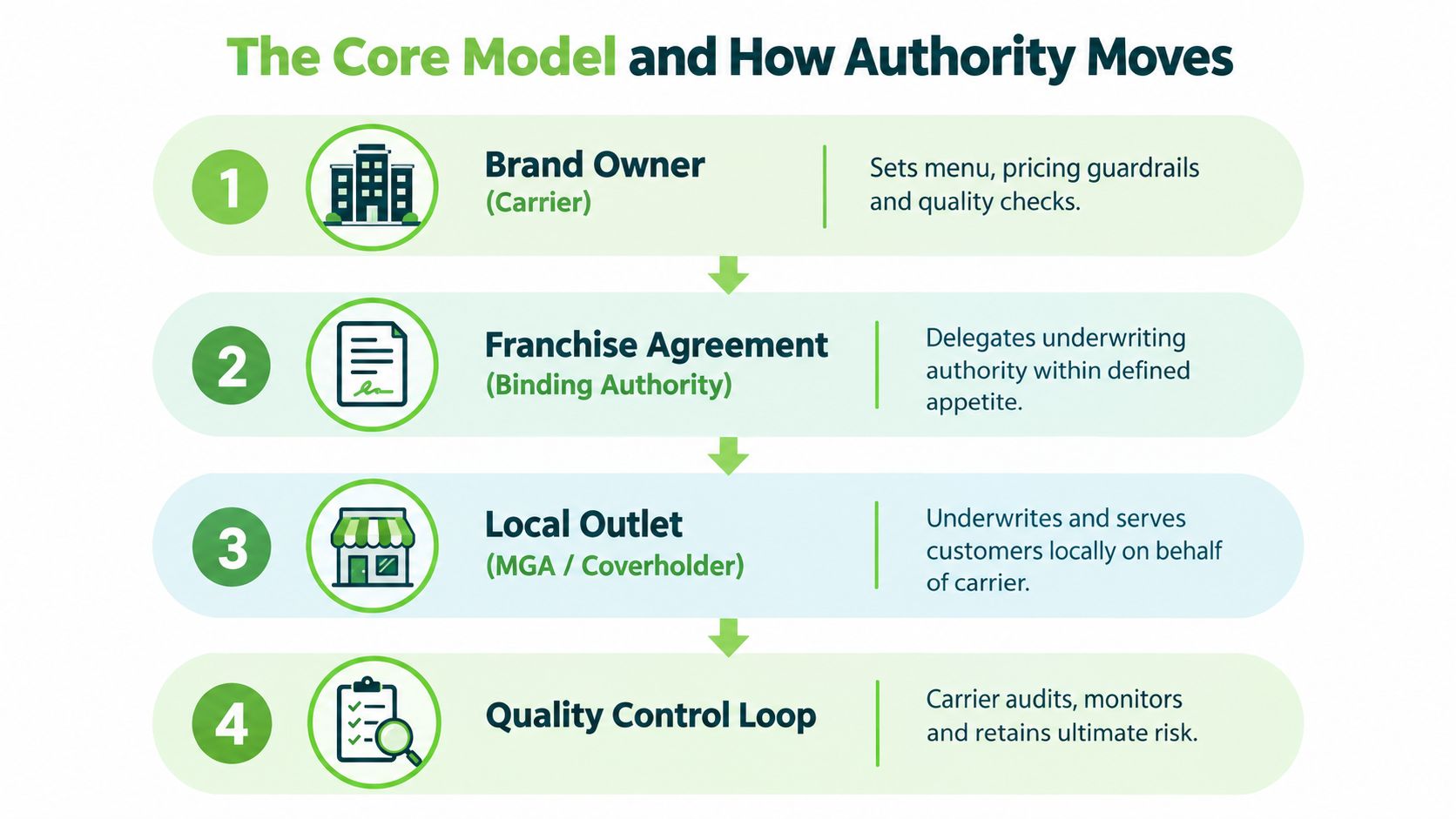
A simple analogy helps. Think of a franchise.
The brand owner sets the menu, pricing guardrails, quality rules, and inspection standards. The local outlet serves customers every day under that framework. The outlet moves quickly because it doesn't ask head office about every sandwich. But it can't invent a new menu, change the price structure freely, or ignore hygiene checks.
Delegated underwriting works in much the same way.
The written grant is the real engine
The model starts with a binding authority or similar delegated underwriting agreement. Lloyd's describes delegated underwriting authority as a contractual arrangement where an insurer or managing agent transfers authority to a third party such as an MGA or coverholder to quote, bind, and sometimes issue policies within pre-agreed appetite and limits, with the authority constrained by the agreement itself, in the Lloyd's delegated underwriting code of practice.
That written agreement usually defines things like:
- Classes of business the delegate may write.
- Territories where business may be accepted.
- Limits by sum insured, line size, or other underwriting threshold.
- Pricing rules such as rate tables, matrices, or minimum premiums.
- Referral triggers for anything outside scope.
- Document authority for endorsements, cancellations, or renewals.
How a risk moves through the chain
Once the authority exists, the chain usually works like this:
- The broker brings the risk to the MGA or coverholder, not directly to the carrier.
- The MGA or coverholder assesses it against the authority agreement and underwriting guidelines.
- If the risk fits, the delegate binds it on the carrier's paper.
- If the risk falls outside authority, the delegate refers it back to the carrier for approval.
- The carrier retains the risk even though it didn't make the first operational decision.
The authority moves by contract. The risk stays with the carrier.
That last point matters. New entrants often assume that the party making the daily decision must also be the ultimate risk bearer. In delegated underwriting, that's often not true.
The policyholder may never interact with the carrier directly unless a claim escalates, a complaint arises, or an exception requires senior review. Operationally, though, the carrier still needs evidence that each delegated action sat inside the written grant. The plumbing looks similar across Lloyd's, the London market, and U.S. delegated environments, even when the labels differ.
Roles of the Carrier, MGA and Coverholder
The easiest way to avoid confusion is to ask one question for each party: what can this party decide without asking someone else?
That's the practical heart of the model.
The carrier's job
The carrier, sometimes called the principal or risk carrier, provides the capital and the paper. It sets underwriting appetite, pricing philosophy, wording constraints, and referral rules. It can grant authority, narrow authority, suspend authority, or remove authority.
What the carrier usually doesn't do in a delegated setup is handle every frontline quote itself. It relies on the delegate for local execution, then monitors whether that execution matched the contract.
The MGA and the coverholder
An MGA usually operates as a fuller underwriting business. It may employ underwriters, use its own systems, issue documentation, and sometimes handle claims administration where the agreement allows.
A coverholder is often a narrower delegated role, especially in Lloyd's structures. It may be approved for a specific class, product, or territory and works within the exact terms of its binding authority.
The distinction matters less than juniors expect. In both cases, the written authority tells you what's allowed. Titles can mislead. The contract usually doesn't.
The broker's role
The broker introduces the risk and helps place it. The broker does not usually hold the authority to bind on the carrier's behalf in this chain.
That's the line many newcomers blur. A broker can negotiate, present, and chase terms. A broker without delegated authority can't decide that cover is bound.
| Decision | Carrier | MGA | Coverholder | Broker |
|---|---|---|---|---|
| Set underwriting appetite | Yes | No, except within delegated framework | No, except within delegated framework | No |
| Price within approved matrix | Approves framework | Often yes, if authorised | Often yes, if authorised | No |
| Approve out-of-appetite exceptions | Yes | Only if specifically authorised | Only if specifically authorised | No |
| Bind cover | Yes | Yes, within authority | Yes, within authority | No |
| Issue policy documents | May do so | Often yes | Often yes | No |
| Approve endorsements outside authority | Yes | No, must refer | No, must refer | No |
| Introduce and present the risk | Sometimes directly | Sometimes | Sometimes | Yes |
The language can vary by market, which is why a shared glossary helps when teams work across platforms, carriers, and delegated partners. A practical reference point is FigTrig's underwriting terms guide.
A Delegated Decision From Quote to Bordereaux
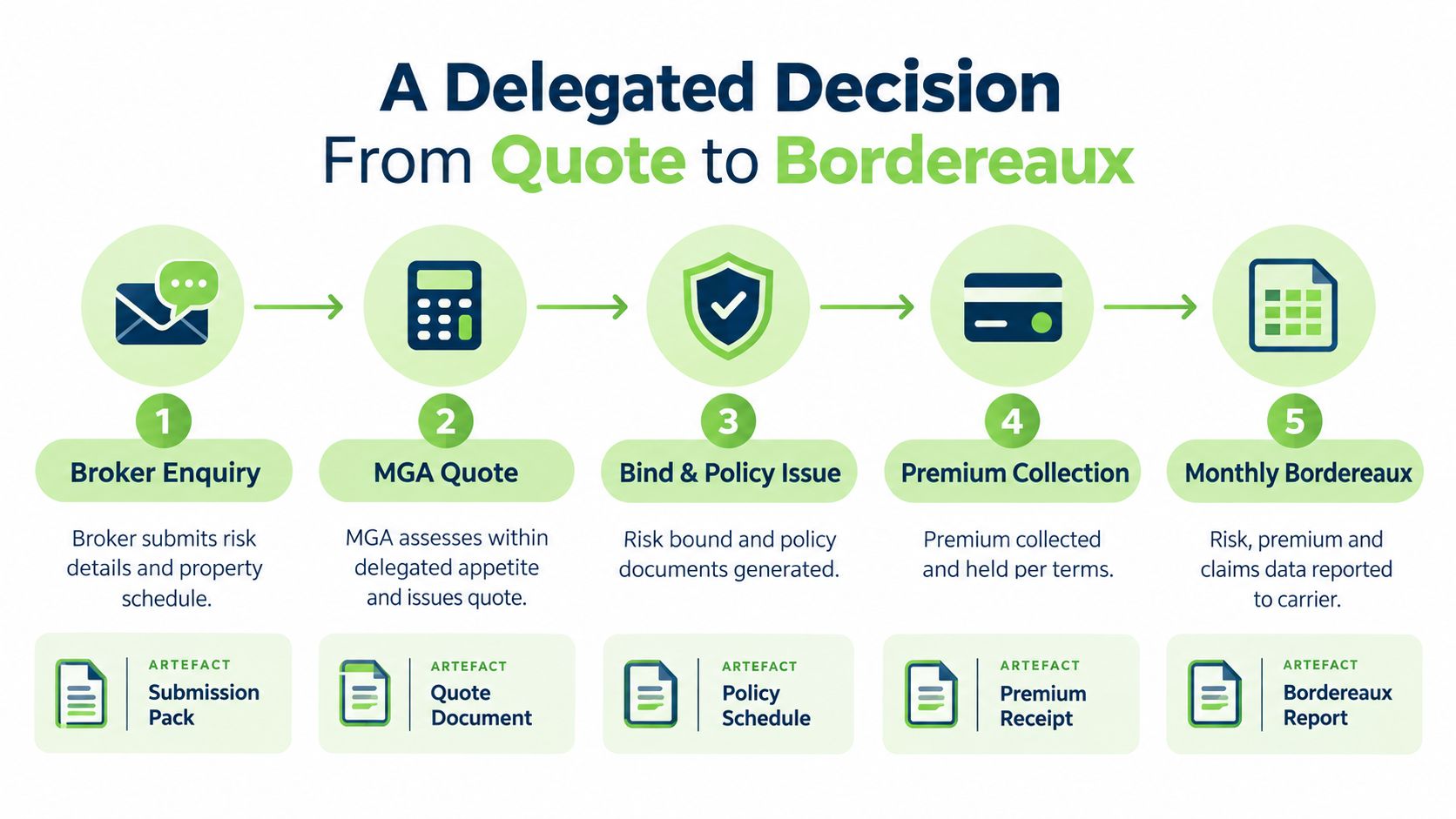
Take a small commercial property risk. A regional broker sends a submission to an MGA that has delegated authority for that class of business in a defined territory.
The submission pack usually includes the proposal details, property schedule, claims history if available, occupancy information, requested cover, and any broker presentation note. In some teams this still arrives by email. In others it lands through a portal.
Step by step in the real world
The underwriter at the MGA checks the file against the binding authority. Is the occupancy permitted? Is the location within territory? Does the requested limit sit inside the authority? Does the pricing fit the matrix or rating tool?
If yes, the MGA issues a quote letter or quote record. If one part falls outside authority, such as an unusual occupancy or a limit above the agreed threshold, the MGA prepares a referral to the carrier with underwriting notes explaining why the risk may still be acceptable.
Once accepted, the MGA sends bind confirmation to the broker and generates the policy schedule and related documents on the carrier's paper.
A simple workflow often looks like this:
- Broker enquiry: Submission pack arrives with risk details.
- MGA review: The underwriter checks appetite, pricing, limits, and wording fit.
- Referral if needed: Anything outside grant goes to the carrier.
- Binding and issuance: The MGA confirms cover and produces policy documents.
- Reporting downstream: The risk appears later in bordereaux to the carrier.
This short video gives a useful visual sense of the operational flow before the reporting stage becomes burden.
Where bordereaux enter
After binding, the file doesn't disappear. It moves into reporting.
The MGA or coverholder submits premium bordereaux and, where relevant, claims bordereaux to the carrier. Those reports tell the carrier what was written, on what terms, for what premium, and with what claims activity. Many people first realise that delegated underwriting is not just about the bind decision. It's also about whether downstream reporting is complete, timely, and reconcilable back to the original decision record.
If the bordereaux entry can't be matched cleanly to the quote, bind record, and policy document, the oversight trail is already weakening.
Where Delegated Underwriting Goes Wrong
Most delegated failures don't start with fraud or dramatic misconduct. They start with ordinary workflow slippage.
A busy underwriter accepts a risk that almost fits. An endorsement is issued but not captured correctly downstream. A bordereaux file lands late and nobody reconciles the missing fields. By the time the carrier sees the pattern, the issue has spread across a portfolio.
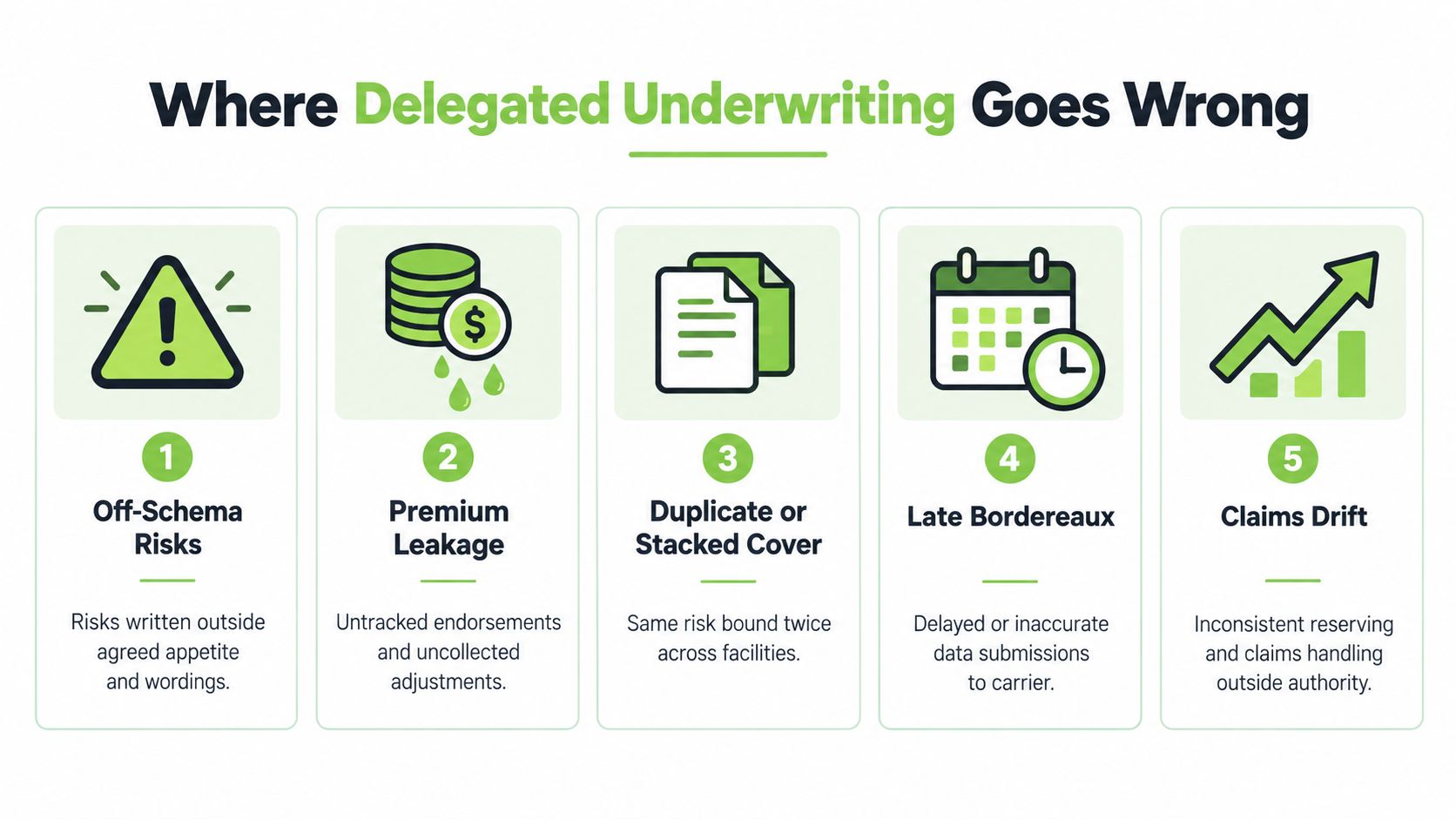
Five common failure points
- Off-schema risks: Business gets written outside the agreed appetite, wording, or class definition. Early signs include unusual occupancies, free-text explanations replacing standard fields, and rising referrals that never receive formal carrier sign-off.
- Premium leakage: Endorsements, mid-term adjustments, or cancellations don't feed through cleanly into accounting and reporting. The warning sign is mismatch between policy activity and premium movement.
- Duplicate or stacked cover: The same risk gets bound twice across facilities or appears in overlapping structures. Teams often spot this late because identifiers differ between systems.
- Rate integrity drift: The pricing matrix says one thing, the quote record shows another, and the reason isn't documented. This usually creeps in through exceptions that stop being exceptional.
- Silent accumulations: Individual risks look acceptable, but concentration builds by geography, class, trade, or wording feature until the carrier's exposure is higher than intended.
Why manual sampling misses the pattern
Quarterly audits still matter. They just don't catch enough on their own.
A sampled review can confirm whether some files were compliant. It can't tell you confidently what happened in the long tail of decisions that never entered the sample. Delegated underwriting generates too many small operational choices for a carrier to rely on periodic spot checks alone, especially where bordereaux are delayed or inconsistent.
The weak point is usually not one dramatic breach. It's a repeated small variance that nobody stitched together early enough.
Controls and Oversight That Actually Work
Good delegated oversight is built from ordinary control tools used consistently. The point isn't to create a glamorous governance framework. The point is to produce evidence that a carrier monitored the delegated book while business was being written.
Industry guidance treats delegated underwriting as an outsourcing model requiring ongoing controls, with risk-based monitoring for the initial decision and the continuing relationship. It also notes that delegated authorities often run on predetermined rating matrices or ranges, with limited underwriting discretion and bordereaux reporting central to detecting authority breaches and pricing drift, as discussed in Pinsent Masons' analysis of delegated underwriting oversight.
What strong oversight looks like in practice
The foundation is still documentary:
- Written agreements: The binding authority and related service contracts define what's delegated and what isn't.
- Underwriting guidelines and rating matrices: These convert appetite into usable frontline rules.
- Referral logs: These show where the delegate escalated decisions outside authority.
- Bordereaux standards: These define the data fields, timing, and reconciliation rules the carrier expects.
- Audit trails: These link the quote, bind action, policy issuance, endorsements, and later reporting back to one decision path.
Then comes the operating rhythm. Carriers review bordereaux quality, challenge missing or inconsistent fields, test files, compare bound risks against authority limits, and document remediation where they find breaches.
| Control | What It Checks | Evidence Produced |
|---|---|---|
| Written binding authority | Scope of delegated powers | Signed agreement, schedules, authority wording |
| Rating matrix and guidelines | Whether pricing and coverage sit within rules | Underwriting file notes, quote rationale, referral evidence |
| Bordereaux review | Completeness and consistency of reported business | Reconciliation logs, exception reports, challenge records |
| File audits | Decision quality and authority compliance | Audit working papers, findings, remediation actions |
| Note-level automated review | Whether underwriting notes reflect required rationale and rule adherence | Flag logs, rule citations, timestamped review records |
The evidence has to be usable
A control only helps if it leaves a trail another person can inspect later.
That matters more now because formal expectations are tightening. The UK 2025-2026 Participating Insurers Agreement says insurers with delegated underwriting authority must maintain appropriate systems and controls to monitor intermediaries, keep a written agreement defining scope and terms, and notify the SRA within 7 days if authority is withdrawn, suspended, or terminated. A cited industry briefing in that same context also notes closer FCA attention to delegated and outsourced arrangements, especially whether firms can show oversight led to fair outcomes rather than merely existing on paper, as reflected in the SRA participating insurers agreement.
One way carriers address the scale problem is to add automated review layers alongside their underwriting and compliance teams. For example, FigTrig's privacy and data controls describe a platform that reviews underwriting notes against insurer guidelines, flags possible authority or documentation issues, and preserves an audit-ready trail tied to the relevant rule text. That doesn't replace delegated audits. It gives teams more complete evidence between audits.
Why Governance Matters More Than Growth
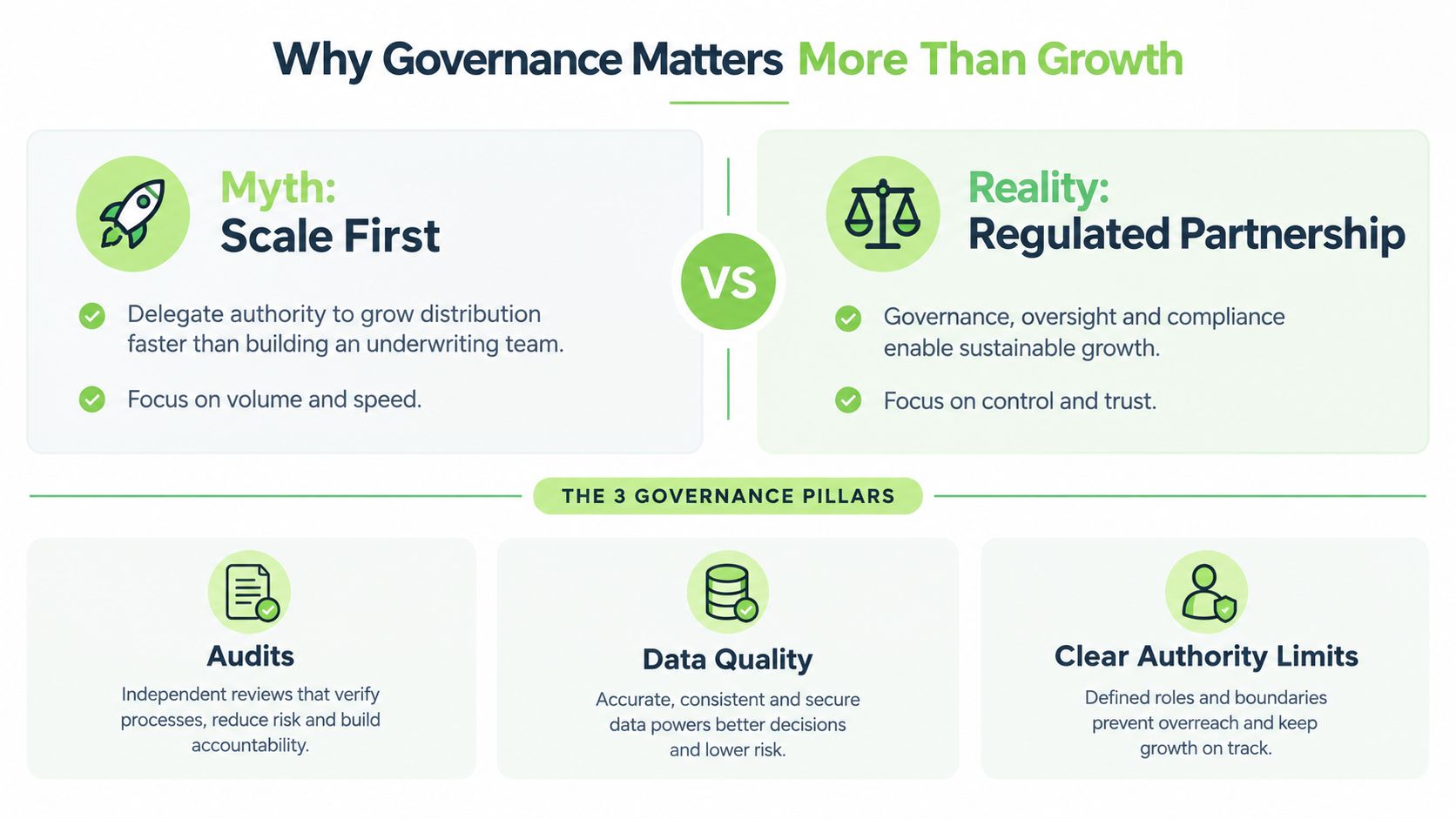
People often explain delegated authority as a growth story. That's only half right.
Yes, carriers use it to reach classes, territories, and niches they can't efficiently staff themselves. But once authority leaves the carrier's desk, the relationship becomes a form of regulated outsourcing. The carrier still stands behind the policy, even if the underwriting decision happened elsewhere.
The real burden sits with the carrier
Inside an in-house underwriting team, the underwriter already works inside the carrier's control perimeter. Managers can review files directly, inspect systems, and enforce process changes quickly.
With delegated underwriting, that perimeter has to be rebuilt by contract, data feed, reporting timetable, audit right, and escalation rule. That's why governance matters so much more than many introductory articles admit.
A delegated relationship is only as strong as the carrier's ability to prove what it supervised, what it challenged, and what it corrected.
This isn't just a best-practice preference. It links directly to conduct and outcome questions. Firms are increasingly expected to show that oversight produced fair customer outcomes, not just that somebody signed an agreement at the start of the relationship.
Growth without evidence becomes fragile
A fast-growing delegated book can still be poorly governed. Those two facts can exist together for a while.
The risk shows up later, usually when complaints rise, claims reveal weak documentation, pricing logic can't be reconstructed, or a regulator asks for proof that oversight was active during the period in question. Carriers that scale delegated portfolios cleanly tend to treat governance evidence as a daily operating discipline rather than an annual file review project.
Three Shifts Reshaping Delegated Underwriting
Delegated underwriting is changing in three quiet but important ways.
The first shift is higher expectations for data lineage and auditability. AM Best reported that U.S. delegated underwriting authority enterprises wrote $108.7 billion in direct premiums in 2025, up 17.8% from $92.3 billion in 2024, marking the fifth consecutive year of growth, in AM Best's report on delegated underwriting authority enterprises. The same verified market summary notes that delegated authority still relies heavily on bordereaux-driven workflows where data can drop out of the digital process and be manually reloaded downstream. As volume grows, that reporting gap matters more.
Three structural changes
- Continuous oversight is replacing periodic comfort. Carriers want cleaner bordereaux, better reconciliation, and decision trails that can be tested throughout the year.
- Note-level review is moving closer to the point of bind. Teams are adding automated quality checks to support underwriters and compliance reviewers, especially where manual sampling leaves blind spots.
- Partner selection is getting more operational. Relationship strength still matters, but carriers increasingly ask whether an MGA or delegated partner can demonstrate controls, reporting discipline, remediation logs, and usable management information.
A short maturity checklist
Use these questions in your next delegated authority review:
- Can you trace a bound risk end to end? From submission to quote, bind, policy issue, and bordereaux entry.
- Can you prove referral discipline? Not just that referrals were allowed, but that out-of-scope cases were escalated and approved properly.
- Can you explain pricing decisions later? Especially where the delegate used discretion within a matrix.
- Can you spot bordereaux defects quickly? Missing fields, late submissions, mismatched premiums, and policy record gaps.
- Can you evidence oversight continuously? Not just during an annual audit visit.
If those answers are weak, the issue usually isn't the delegated model itself. It's the control layer sitting behind it.
If you're reviewing delegated authority operations and need better evidence of what underwriters wrote, FigTrig offers an AI review layer for commercial underwriting that checks notes against your own guidelines, including authority compliance and documentation quality. It's built for teams that need audit-ready oversight across everyday underwriting decisions, not just sampled file reviews, and you can see how it works at FigTrig.