Underwriting Review Explained for Modern Insurance Teams
You bind a commercial policy on a busy Friday afternoon, move to the next submission, and assume the file is clean because nothing looked unusual at the desk. Two weeks later, QA finds a missing pricing rationale in the notes, and now the question isn't just what happened, it's whether the decision can be defended if someone asks why that rate, that limit, or that authority path was used. That's the pressure behind underwriting review, it protects the file before the bind, not just the record after the fact, and it gives managers a way to see quality while there's still time to fix it.
Many teams still treat review like a spot check, but the practical job is broader. A strong review process catches guideline misses early, shows where authority was stretched, and creates a clean trail for audit or market-conduct scrutiny. If you're trying to tighten that control layer without slowing the desk, a useful starting point is to think of it as a quality gate that sits beside underwriting, not a paper exercise after the policy has already left the building. For teams mapping out a better workflow, FigTrig is one example of a platform built around that idea.
Table of Contents
- What Underwriting Review Really Means
- Core Objectives and Quality Signals That Matter
- How the Underwriting Review Workflow Works End to End
- Manual Sampling Versus Automated Full Coverage Review
- Governance Audit Trails and Responsible Automation
- Putting Underwriting Review Into Action With Confidence
What Underwriting Review Really Means
Think of underwriting review as an editorial pass on a decision, not a second underwriter rewriting the story. The underwriter still owns the risk call, but the reviewer checks whether the notes match the insurer's own rulebook, whether the rationale is stated clearly, and whether the file says enough for someone else to understand the decision later. That's why good review is less about “Did we like the answer?” and more about “Can we defend how this answer was reached?”
The file has to answer a few basic questions
A defensible review should make the logic easy to follow. Was the risk identified correctly? Did the pricing rationale line up with the guideline basis? Was the person who touched the file acting within authority? Did the loss history, policy terms, and supporting documents fit together without gaps? Those are the practical checks that matter because they tell you whether the decision is both acceptable and explainable.
A thin note often looks fine in the moment and fails later. It says “approved per guidelines” without pointing to the relevant section, or it records a change without saying who made it and why. That kind of note may get a file through the day, but it won't help a manager, auditor, or regulator reconstruct the logic months later.
Practical rule: If a reviewer can't point to the exact rule that supports the decision, the review note isn't finished yet.

What review is not
Review is not the same thing as approval, and it isn't the same thing as re-underwriting the file from scratch. Approval says the decision can proceed, while review asks whether the decision process was sound and traceable. If those roles get blurred, teams end up with slow handoffs, repeated judgments, and inconsistent accountability.
That distinction matters in delegated authority environments, MGA programs, and carrier operations where many hands may touch the file. The reviewer isn't there to replace judgment, they're there to confirm that judgment stayed inside the lines. When the note is complete, leadership can trust the file. When it's not, the organization is guessing.
Core Objectives and Quality Signals That Matter
The best way to understand underwriting review is to ask what job it's trying to do. It has four core jobs, catch guideline breaches early, keep pricing and authority consistent, give leadership visibility, and leave behind an audit-ready record. If a review program doesn't do all four, it may still create paperwork, but it isn't really controlling underwriting quality.
The four signals that tell you review is doing real work
First, look for guideline alignment. The note should show that the decision was checked against the insurer's own standards, not someone's memory of the rule. Second, look for authority discipline. If a limit, exception, or pricing adjustment needed approval, the record should show who approved it and on what basis. Third, look for documentation quality. Clear loss history, rationale, and policy-term fit matter because they let another person follow the file without guessing. Fourth, look for traceability. Every flag, override, or exception should tie back to the relevant section of the rulebook.
Sample-based review starts to look fragile. In banking and insurance practice, review has often relied on a small slice of cases rather than the whole population, with guidance discussing proportional sampling precision levels of 5%, 10%, 15%, or 20% and underwriting QA audits historically described as about 25 to 50 cases per underwriter (OCC and NAIC-related guidance). Life insurance survey data also showed that five percent, or one in every 20 policies, was the most common holdout rate reported by one-third of responding companies in the same source. That approach can work for governance, but it leaves a gap when the missed file is the one with the authority breach or the unsupported exception.
Sampling is useful when the program is small, stable, and low-risk. It becomes a weak control when rare exceptions carry disproportionate damage.
What good looks like in practice
A useful review program doesn't just say “file reviewed.” It shows what was checked, what was found, and what changed. That can be as simple as a plain-language flag with a rule citation, followed by a corrected note before binding. If leadership can't see that chain, it's hard to tell whether the program is improving behavior or merely recording that someone looked at the file.
The main mistake new QA leads make is confusing coverage with quality. A team can review a sample perfectly and still miss the exception that matters most, because the sample wasn't designed to catch it. Full-population review changes the control design, every decision gets checked, so missing rationale, authority violations, and unsupported terms can be caught while remediation is still possible (full-file review guidance).
How the Underwriting Review Workflow Works End to End
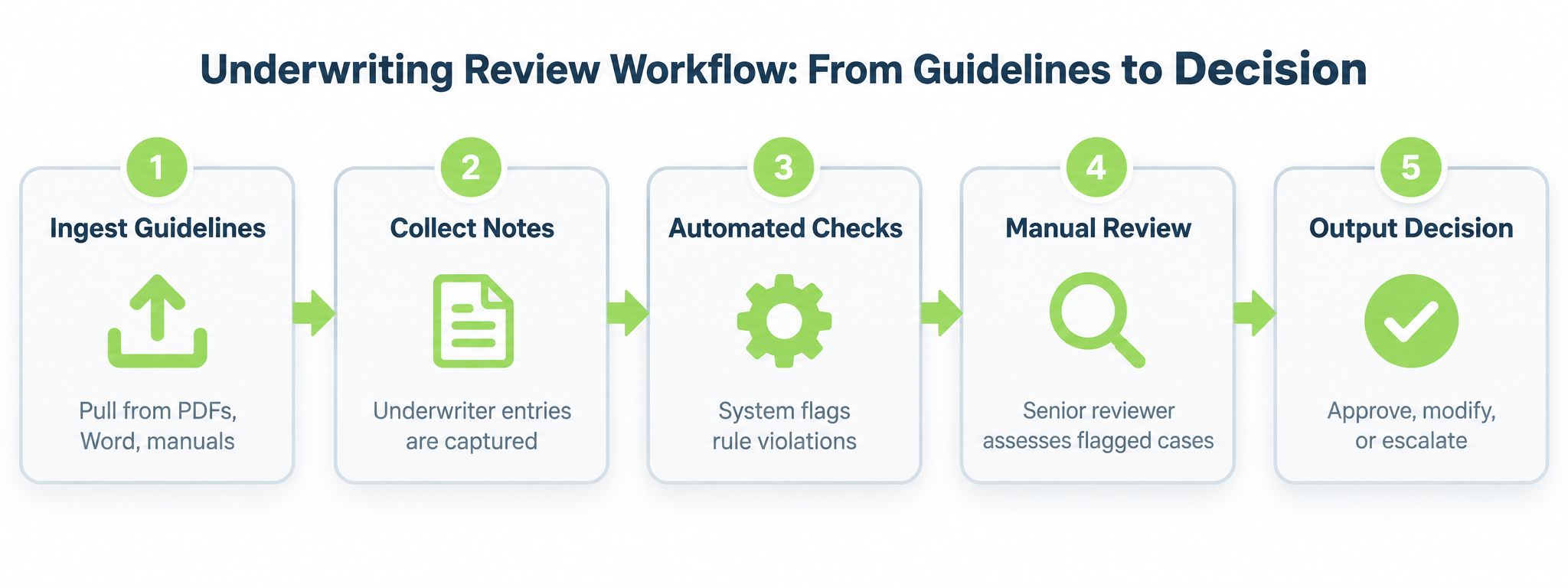
A clean workflow starts with the rulebook, not the file. The insurer's guidelines come in through PDFs, Word documents, or internal manuals, then the underwriter's notes are checked against those rules. The point isn't to make the process fancier, it's to make the logic visible from the start so the file doesn't rely on memory, tribal knowledge, or a late-stage guess.
From guidelines to a decision trail
The strongest review flow follows a simple chain. Guidelines are ingested, the note is captured, checks run against the rule set, and any issue is written in plain language with the relevant citation. If the reviewer or underwriter needs to fix something, that happens while the policy is still open to correction, not after it's already bound and harder to unwind.
That sequence matters because it keeps the final decision with the underwriter while giving the organization a cleaner quality layer. The system or reviewer isn't substituting judgment, it's highlighting where the file no longer matches the insurer's own standards. That distinction is what makes the control practical instead of intrusive.
The key question is simple, can someone reconstruct the path from flag to guideline section months later without chasing side emails or informal notes?
Commercial underwriting audit trails now need event-level lineage for input data, model versioning, decision outputs, human overrides, access logs, consent records, and retention or deletion events, so a regulator can reconstruct the path from intake to final disposition (audit trail requirements). That expectation changes how review notes should be written. A generic file comment isn't enough if the business needs a defensible record.
The checks should be readable, not cryptic
New QA leads sometimes assume traceability means more technical language. It's the opposite. A good flag says what went wrong in ordinary terms, names the rule or policy basis, and shows the reviewer what needs to be fixed. If the note reads like a puzzle, the workflow has already lost time.
The practical goal is to reduce back-and-forth. Underwriters shouldn't have to decode a comment to know whether a missing rationale, an authority issue, or a policy-term mismatch is the problem. When the reason is clear, remediation is faster and the file is easier to defend later.
Manual Sampling Versus Automated Full Coverage Review
Manual sampling still has a place, but it solves a different problem. It gives a team a way to inspect a few files when the portfolio is small, steady, and easy to monitor. What it doesn't do well is protect a large book from rare exceptions, because the control only sees the files it happened to sample.
Side by side comparison
| Criterion | Manual Sample QA | Automated Full Coverage |
|---|---|---|
| Coverage | Reviews a subset of files and infers quality from them | Checks every decision, which removes reliance on inference |
| Speed | Depends on reviewer capacity and queue length | Runs quickly enough to support pre-bind review |
| Consistency | Can vary by reviewer and shift | Applies the same rule logic every time |
| Explainability | Depends on note quality and reviewer discipline | Can return direct flags tied to guideline sections |
| Oversight | Good for periodic governance checks | Better for live management visibility and exception control |
The operational tradeoff is straightforward. Manual sampling saves reviewer time, and that's why it became common, but it leaves blind spots when the issue is rare and expensive. A full-population review changes the question from “Did we see enough files to feel comfortable?” to “Did we check the files that matter before binding?”
When each approach makes sense
Sampling still works when a program is small, stable, and the error pattern is predictable. It also makes sense when teams need a short-term governance readout without changing the operating model. But once volume rises, delegated authority expands, or exceptions start carrying more financial and regulatory risk, the stronger default is full-population review. That's where the signal is, the outliers.
A senior QA lead should ask one blunt question, do we want to document that we looked at some files, or do we want to catch the files that would hurt us most? If the answer is the second one, sample-based control is too weak.
Governance Audit Trails and Responsible Automation
Governance gets real when someone can replay the decision. For modern exams, an audit-ready underwriting record has to show the lineage of the input data, the version of the model or decision logic used, the decision output, any human override and the reason for it, plus access logs, consent records, and retention or deletion events. That is what lets a regulator reconstruct the end-to-end path from intake to disposition without relying on guesswork.
Why traceability and explainability belong together
A flag that says “something looks off” is not enough on its own. The reviewer needs to know which guideline section triggered the flag and how the note maps to that section. That's the difference between a useful control and a vague alarm.
Independent banking and insurance guidance increasingly treats the record as a decision-level artifact, not just a file note. Sources on governance and audit trail expectations emphasize the need for the model or decision logic, human override rationale, and policy basis to be tied together in a way that stands up later (governance and audit trail guidance). In practical terms, that means explainable flags and centralized citations aren't nice extras, they're part of the review quality itself.
How teams can add automation without losing control
Automation works best as a quiet layer beside the existing stack. It should ingest the insurer's own guidelines, apply them to each note, and keep the underwriter in charge of the final call. FigTrig is one example of a platform that reviews underwriting notes against the insurer's guidelines, raises explainable flags, and maintains an audit trail that links each flag to specific rulebook sections. For teams evaluating data handling, the platform's privacy terms are laid out here.
Good automation doesn't replace judgment. It makes the judgment easier to defend.
The governance payoff is practical. CUOs get better visibility into where decisions drift. MGAs get a clearer way to supervise delegated authority. Audit and compliance teams get a record they can trace. And underwriters keep ownership of the file instead of handing control to a black box.
Putting Underwriting Review Into Action With Confidence
Start by looking at the last batch of files your team touched. Ask whether the notes show pricing rationale, authority basis, policy-term fit, and a clear reason for any exception. If those pieces are weak, don't begin with a big transformation program, begin with the controls that are failing most often.
A simple implementation checklist
- Map the weak points first. Find where files lose clarity, especially around rationale, authority, and guideline citations.
- Decide what must be checked on every file. If a control is important enough to defend later, it usually belongs in full-population review.
- Keep the language plain. Review comments should help an underwriter fix the file, not decode it.
- Preserve underwriter ownership. The review layer should flag, cite, and record, not replace the decision.
- Measure what changes before binding. The signal is fewer pre-bind corrections, cleaner documentation, and better management visibility.
For teams that want to pilot a tighter quality layer, the fastest path is usually to test live notes against the existing guideline set and see where the first flags land. That gives you a practical view of control gaps without asking the desk to change everything at once. If your program already has a basic review process, the next step is usually not more sampling, it's better traceability and broader coverage.
The easiest way to judge progress is simple. If the file is easier to defend, the manager can see more clearly where decisions drift, and the underwriter can still work at a normal pace, the review process is doing its job. If you're looking for a way to add that kind of quality layer without disrupting the existing workflow, review FigTrig's terms of use and see how it fits your operating model.
FigTrig helps underwriting teams apply guideline-linked checks to every note, so issues can be flagged before binding and recorded in a way that stands up later. If you want a closer look at how that works in a commercial underwriting workflow, visit FigTrig and explore how a full-population review layer can fit alongside your current systems.