
7 Best Underwriting Software Platforms for Insurers
The best underwriting software isn't one universal platform. A policy administration system manages the policy lifecycle, while an underwriting workbench organizes submissions and referrals. An AI intake layer structures broker documents, an actuarial pricing tool develops rate models, a portfolio-aware RiskOps platform connects appetite to triage, and a continuous QA layer checks whether decisions follow the insurer's own rules. Treating these products as interchangeable creates expensive gaps.
That distinction matters as insurers modernize. The global underwriting software market was valued at USD 7.15 billion in 2025 and is projected to reach USD 12.88 billion by 2030, according to Mordor Intelligence's underwriting software market analysis. Yet adoption isn't uniform. A 2025 industry survey found that 74% of respondents' companies introduced new underwriting tools in 2024, while 83% expected to do so in 2025, as reported by Insurance Business.
This roundup ranks seven platforms by the underwriting problem they solve, not by a misleading feature checklist. The comparison focuses on workflow coverage, implementation model, integration dependency, explainability, governance, and fit by insurer size and operating maturity.
Table of Contents
- 1. FigTrig
- 2. Guidewire UnderwritingCenter
- 3. Duck Creek Policy and Agentic Underwriting Workbench
- 4. Cytora
- 5. Send Underwriting Workbench
- 6. Akur8
- 7. Federato
- Top 7 Underwriting Software Comparison
- Match the Platform to Your Operating Model
1. FigTrig
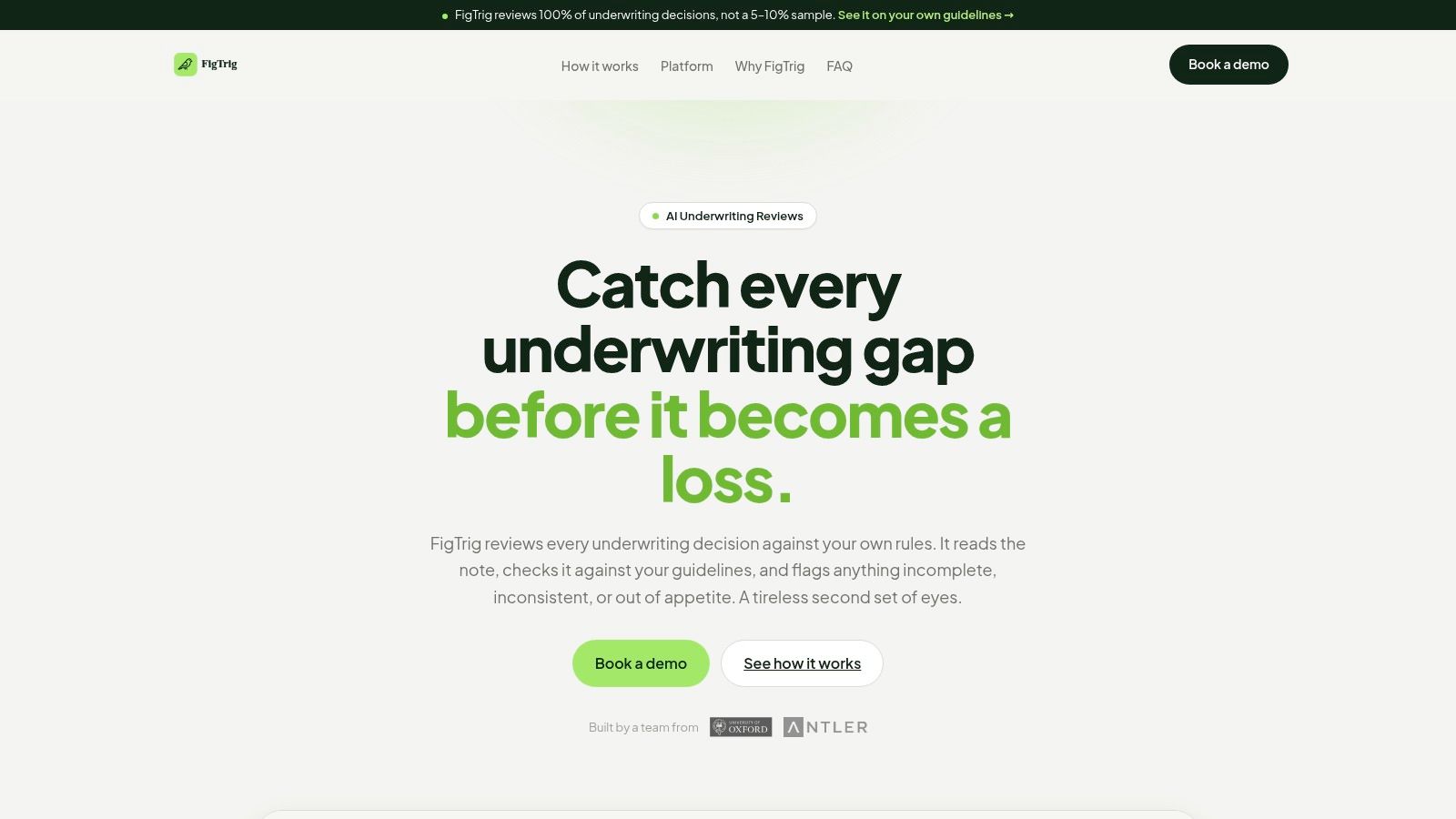
FigTrig solves the problem that many underwriting modernization programs leave behind: continuous quality assurance after the underwriter has made a decision. It's an AI-powered review layer for commercial underwriting notes, checking every decision against the insurer's own guidelines rather than replacing the policy administration system or asking underwriters to work in another core platform.
Teams can upload rulebooks, PDFs, Word documents, and internal manuals. FigTrig then applies checks covering risk identification, pricing rationale, delegated authority, loss history, documentation quality, policy terms, and other insurer-specific requirements. Each flag is written in plain language and cites the exact guideline section behind it, giving underwriting managers, claims teams, compliance leaders, and auditors a traceable explanation rather than an opaque score.
Why FigTrig stands apart
The product runs alongside existing systems through REST API, webhooks, CSV, and SFTP options. That makes it a stronger fit for carriers, MGAs, and delegated authority operations that need better oversight without a rip-and-replace program. Teams can begin reviewing live notes within about one week, according to the product information supplied for this comparison.
Its governance model is equally important. FigTrig provides tenant isolation, data residency choices, GDPR-aligned controls, and a policy that underwriting data isn't used to train models or shared across customers. The system preserves underwriter authority while creating an audit-ready record of the issue, the rulebook citation, and the resulting review trail.
Practical rule: If your primary concern is whether decisions are consistently documented and defensible, don't judge software only by quote speed. Test whether it can connect a flagged decision to the exact guideline that governs it.
The main limitation is scope. FigTrig depends on the quality of the insurer's guidelines and the content of its underwriting notes. It doesn't replace a PAS, rating engine, intake platform, or human judgment. Pricing isn't public, so smaller teams will need to confirm commercial fit directly through a sales conversation. Visit FigTrig's underwriting review platform to evaluate how its QA layer could sit over your current stack.
2. Guidewire UnderwritingCenter
Guidewire UnderwritingCenter is the strongest choice here for carriers treating underwriting as part of a broad P&C core-platform modernization program. It isn't merely an intake tool or a supplemental workbench. Within Guidewire InsuranceSuite, it supports policy lifecycle operations, configurable underwriting rules, referrals, workflow, and centralized issue management.
That breadth is its core advantage. A carrier already standardizing on Guidewire can connect underwriting with rating, billing, claims, and related services through the surrounding InsuranceSuite ecosystem. The platform also benefits from an established API and marketplace environment, which can reduce the need to design every integration from scratch.

Best fit and trade-offs
Guidewire suits large and complex P&C organizations that need enterprise governance, standardized workflows, and a wide partner ecosystem. Its centralized underwriting issues can help management create consistent referral and escalation processes, while its position inside the core stack supports stronger lifecycle traceability than a disconnected point solution.
The trade-off is implementation scope. A program of this kind typically requires substantial configuration, process redesign, data migration, systems integration, and change management. Carriers with heterogeneous legacy cores may need additional work to connect Guidewire to existing rating, billing, claims, or distribution systems. The platform is most compelling when the organization is prepared to align its operating model with the Guidewire environment, not when it wants a narrow fix for document intake or QA.
For buyers focused on governance, ask to see how the system records underwriting issues, referrals, overrides, and downstream policy changes. Also review Guidewire's product information, then assess privacy and data-processing requirements alongside the wider underwriting software privacy considerations.
3. Duck Creek Policy and Agentic Underwriting Workbench
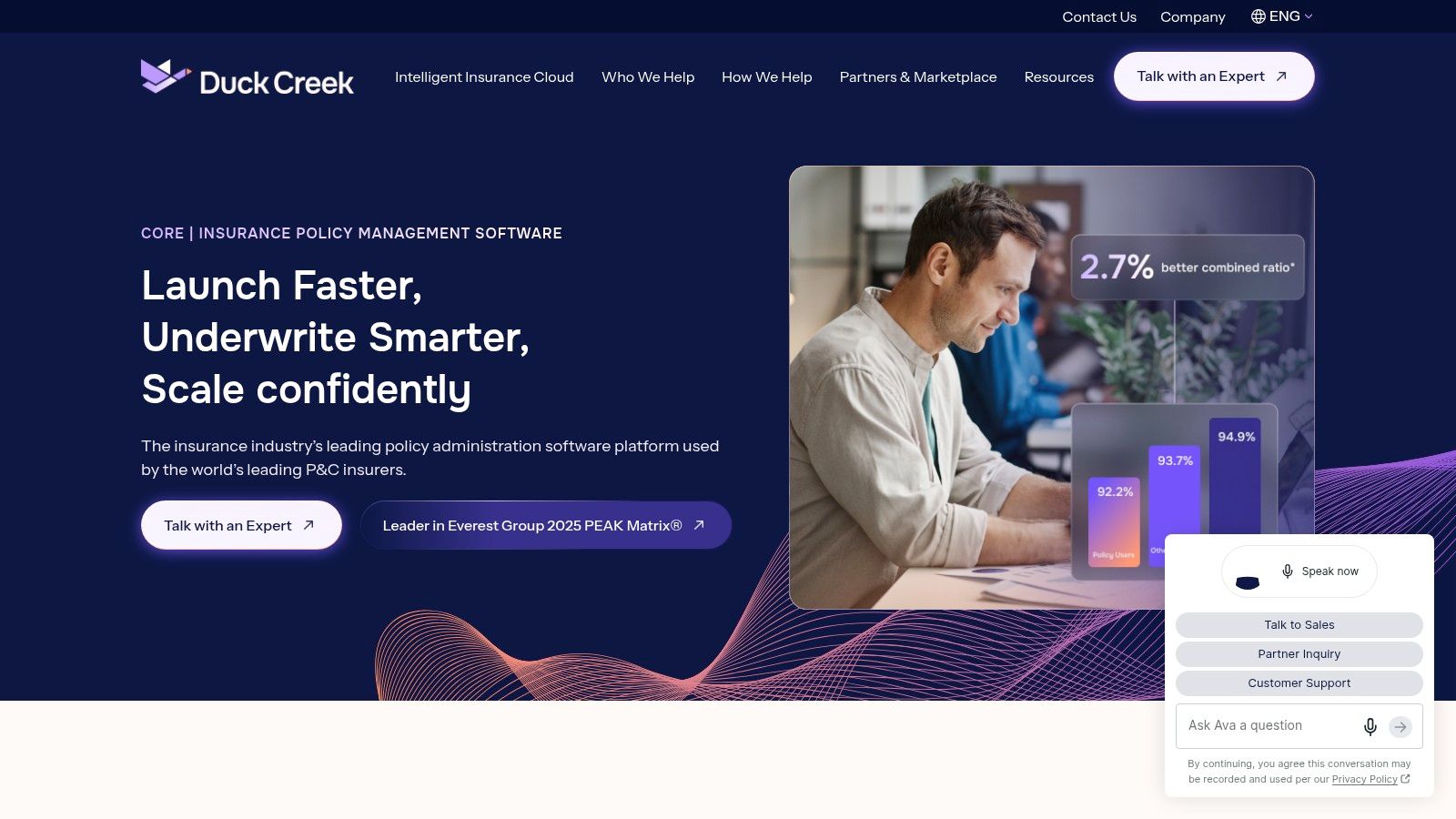
Duck Creek addresses two different modernization needs. Duck Creek Policy provides cloud-native policy administration with rules-driven underwriting, while its Agentic Underwriting Workbench functions as a decisioning and orchestration layer that can operate with or without Duck Creek Policy. That separation makes the product family relevant both to carriers replacing core infrastructure and to teams looking to add underwriting orchestration around an existing environment.
Policy is the broader foundation. It supports rules, automated tasking, and workflow within the policy lifecycle. The workbench is more targeted at underwriting actions, decision support, and AI or machine-learning use cases. Extensive APIs and prebuilt integrations support data enrichment and connections to surrounding workflow systems.
Where it fits
Duck Creek is a sensible option for carriers prioritizing cloud delivery, modular architecture, and an API-first integration model. It can serve organizations that want broad policy administration, as well as those exploring a more focused workbench deployment. That flexibility is valuable for insurers with different lines of business or staged transformation plans.
Buyers should separate the capabilities of Policy from those of the workbench during evaluation. The workbench's scope can vary by deployment, and the product family can become commercially and operationally complex when multiple modules, integrations, and services are involved. Pricing isn't publicly transparent, so a meaningful comparison requires a workflow-specific proposal rather than a generic license estimate.
The key question is whether the organization needs a new core or a decisioning layer. For the former, assess policy, billing, rating, and claims integration. For the latter, test whether the workbench can coordinate existing systems without creating another isolated queue. The Duck Creek Policy platform is best suited to carriers with the technical capacity to manage that distinction.
4. Cytora
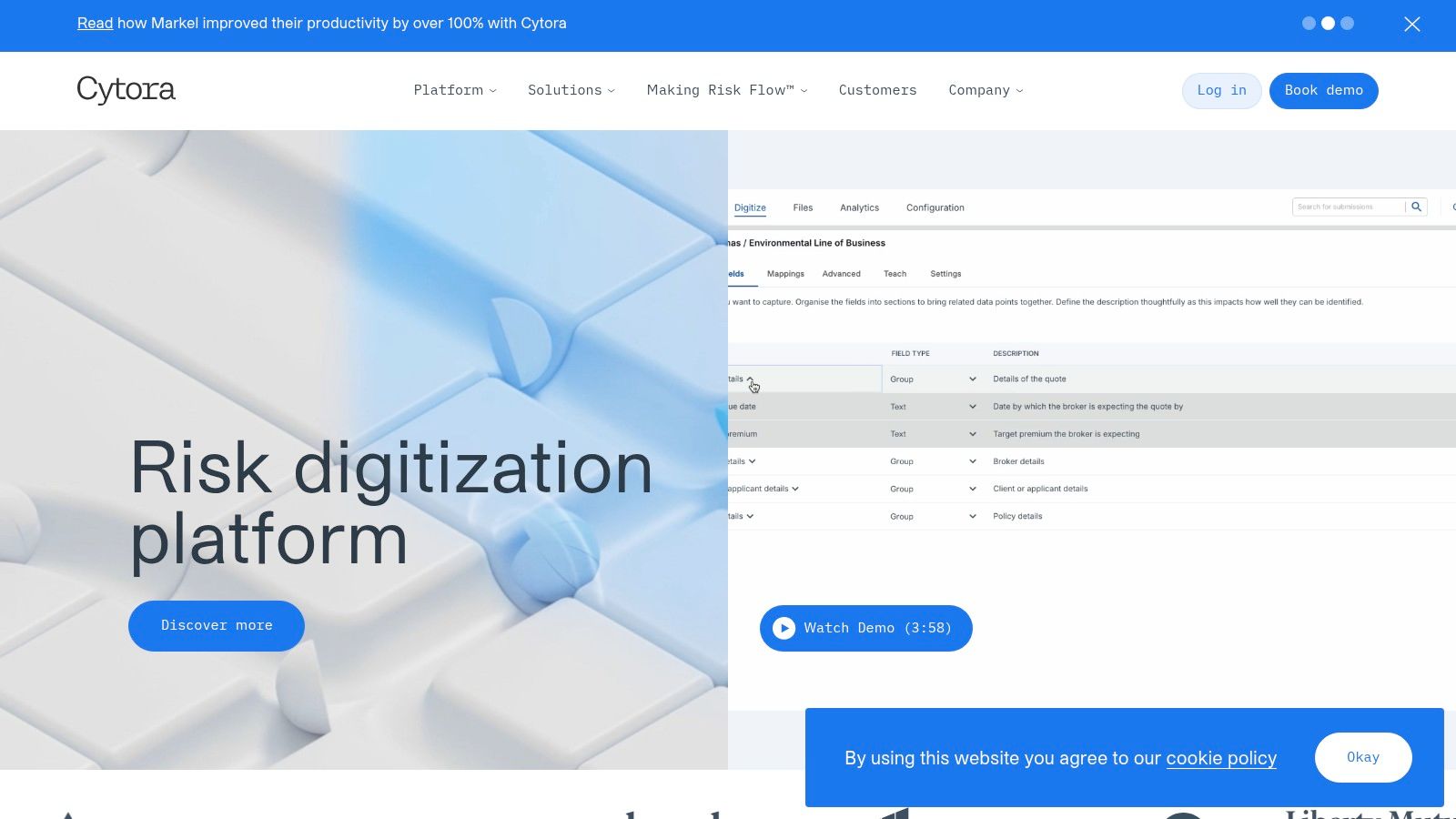
Cytora targets the front end of commercial underwriting, where submissions arrive as emails, PDFs, forms, renewals, and mid-term adjustments. Its central job is to turn that unstructured material into a decision-ready file and evaluate the risk against appetite before an underwriter spends significant time on it.
The platform supports intake digitization across new business, renewals, and MTAs. It uses natural-language configuration, document classification, data extraction, third-party data enrichment, portfolio and appetite evaluation, and agentic workflows with approvals and audit trails. That combination makes Cytora more than a document reader. It connects intake to triage and decision readiness.
The commercial-lines use case
Cytora is a strong fit for carriers and MGAs handling document-heavy commercial submissions, particularly where underwriters lose time classifying documents, re-keying fields, or deciding whether a risk fits appetite. Its low-training approach and rapid-go-live positioning can appeal to teams that want a focused intake improvement rather than a core replacement.
It isn't a complete policy administration system. A carrier may still need a PAS, rating engine, underwriting workbench, or downstream servicing platform after Cytora has prepared the submission. The value also depends on submission mix and data quality. A clean, structured book may offer less room for intake improvement than a portfolio built around varied broker documents and inconsistent attachments.
The best intake platform isn't necessarily the one that extracts the most fields. It's the one that gives an underwriter a reliable, appetite-aware file without hiding uncertainty in the process.
Pricing isn't public, so buyers should request a demonstration using representative broker submissions, renewals, and endorsements. The test should include exceptions, missing documents, contradictory information, and the approval trail, not only clean examples. Explore Cytora's underwriting platform for its intake and risk-evaluation approach.
5. Send Underwriting Workbench
Send is designed for carriers and MGAs that need a commercial and specialty underwriting workbench without replacing the core system. It brings submissions, renewals, and endorsements into a unified console, with insurance-focused APIs through Send Connect and workflow features aimed at complex commercial lines.
That positioning makes Send different from Guidewire and Duck Creek. Those platforms can anchor a broader policy administration transformation. Send is more naturally evaluated as an operating layer for underwriting teams that need a cleaner submission-to-bind process while retaining existing policy administration and downstream systems.

When Send makes sense
Send suits commercial and specialty organizations with complicated workflows, multiple submission sources, and a need to reduce disruption during adoption. Its integration-forward model can help a carrier or MGA avoid forcing every team onto a new core platform at once. The product's market orientation also makes it relevant to London-market and North American operating models, although buyers should verify regional partner and feature coverage for their specific deployment.
The principal constraint is integration dependency. A workbench can organize underwriting activity, but it won't automatically resolve weaknesses in rating, policy issuance, data quality, or bordereaux processes. The implementation team must define which system owns each field, event, approval, and status transition. Without that operating-model work, the workbench can become another interface layered over the same fragmented process.
Pricing isn't transparent, and enterprise procurement may require a substantial sales cycle. Ask for a workflow demonstration that starts with an inbound submission and ends with a bind-ready handoff, including referrals, endorsements, renewals, and audit records. Review the Send underwriting workbench in that context rather than comparing it directly with full PAS products.
6. Akur8
Akur8 solves a different problem entirely: actuarial pricing model development. It supports P&C teams with data preparation, generalized linear models, nonlinear modeling, deployment, demand analysis, and price-sensitivity work. Its transparent AI positioning is designed to give actuaries modern modeling capabilities without turning pricing decisions into an unexplainable black box.
That makes Akur8 complementary to the other products on this list. It doesn't administer policies, manage submissions, or function as the underwriter's daily workbench. Instead, it helps pricing and actuarial teams develop models that can feed rating operations and support strategic decisions about rates, segmentation, and demand.

Governance is the buying criterion
Akur8 is especially relevant where pricing teams need faster model iteration while preserving transparency for governance and regulatory scrutiny. Cloud delivery, ongoing updates, and actuarial support can help organizations modernize a traditional toolchain, but the value only appears when the resulting models connect cleanly to rating and underwriting operations.
That integration is the main caveat. A carrier buying Akur8 still needs a way to deploy approved models, pass the right variables into rating, document assumptions, and monitor performance over time. It also needs clear ownership between actuaries, underwriting leaders, product teams, and model-risk functions.
Pricing is usage- or volume-based and isn't publicly listed, so the commercial evaluation should include data volumes, model development needs, deployment scope, support, and governance requirements. Ask how the platform handles model documentation, approvals, versioning, and change control. The Akur8 pricing and modeling platform is a fit for insurers whose bottleneck sits in actuarial pricing, not intake or policy administration. Buyers should also review relevant underwriting software terms when comparing vendor obligations.
7. Federato
Federato is built around portfolio-aware RiskOps, connecting submission triage, appetite, winnability, workflow orchestration, quoting, and portfolio management in one environment. Rather than treating each submission as an isolated case, it aims to help underwriting teams prioritize risks against live portfolio objectives.
The platform can classify documents, extract data, score appetite and winnability, trigger notifications, run guideline checks, generate briefings, and support quoting and rating workflows. That makes it a useful option for carriers and specialty organizations where the strategic question is not, “Can we process this submission?” but, “Should this risk receive attention given our current portfolio?”

Portfolio intelligence versus workflow automation
Federato's distinction is the connection between appetite guidance and desk-level action. A workbench can organize queues, while a RiskOps platform can help shape those queues around portfolio strategy. It can coexist with legacy workbenches or, depending on the deployment, replace more of that operating layer.
The trade-off is calibration. Portfolio-aware recommendations depend on quality data, clearly defined appetite, and stakeholder agreement about what makes a risk winnable. Newer “AI-native core” positioning may also require education among underwriting, operations, actuarial, distribution, and technology teams. A pilot should therefore test not only extraction accuracy but also the usefulness of prioritization, the handling of overrides, and the auditability of recommendations.
A portfolio-aware system creates value only when portfolio strategy is specific enough to guide individual submissions.
Federato is best suited to carriers, MGAs, and specialty teams with mature appetite management and a need to connect intake-to-quote activity with portfolio objectives. Review the Federato RiskOps platform using live or representative portfolio signals rather than a generic feature tour.
Top 7 Underwriting Software Comparison
| Solution | Implementation Complexity (🔄) | Resource Requirements (⚡) | Expected Outcomes (⭐📊) | Ideal Use Cases (💡) | Key Limitations |
|---|---|---|---|---|---|
| FigTrig | 🔄 Low, API/webhook/SFTP; typically live ~1 week | ⚡ Low–Moderate, ingest rulebook, minor IT effort; enterprise controls | ⭐📊 Continuous 100% QA; audit-ready flags; proven loss prevention (pilots £4.2M+) | 💡 Continuous underwriting QA, compliance, audit trails without replacing PAS | Pricing custom/opaque; depends on guideline/note quality; does not replace judgment |
| Guidewire UnderwritingCenter | 🔄 High, multi-month enterprise implementation | ⚡ High, deep core integrations and Guidewire expertise | ⭐📊 End-to-end underwriting at enterprise scale with mature governance | 💡 Carriers needing full policy/rating/billing/claims integration | Best with Guidewire stack; long implementation and integration effort |
| Duck Creek Policy + Agentic Workbench | 🔄 Medium–High, modular cloud deployment, varying scope | ⚡ Moderate–High, APIs, integration and configuration across modules | ⭐📊 Rules-driven underwriting with decisioning and AI/ML support | 💡 Organizations wanting cloud-native policy admin + decision layer | Workbench features evolving; complex pricing/packaging |
| Cytora | 🔄 Low–Medium, rapid go-live focused on intake automation | ⚡ Low–Moderate, document ingestion, prebuilt data connectors | ⭐📊 Faster triage, higher hit-rates, decision-ready submissions | 💡 Intake digitization, submission triage, document classification | Focused on intake (may need PAS/workbench); pricing not public |
| Send Underwriting Workbench | 🔄 Low–Medium, integrates alongside existing systems | ⚡ Moderate, insurance-focused APIs and integration work | ⭐📊 Unified submission-to-bind workflows with minimal disruption | 💡 Commercial & specialty carriers/MGAs wanting complementary workbench | Stronger EMEA footprint historically; pricing opaque |
| Akur8 | 🔄 Medium, integrates into actuarial/pricing pipelines | ⚡ Moderate, data, actuarial expertise; model deployment resources | ⭐📊 Faster model build/deploy; explainable pricing and sensitivity analysis | 💡 Actuarial teams needing transparent AI pricing and governance | Not a PAS/workbench; usage/volume pricing; needs integration |
| Federato | 🔄 Medium, AI-native platform; can replace or coexist with workbench | ⚡ Moderate, portfolio signals, calibration and data integration | ⭐📊 Portfolio-aware triage, dynamic appetite scoring, improved time-to-quote | 💡 Strategy-to-desk alignment, portfolio management and prioritization | Newer category positioning; outcomes depend on data calibration |
Match the Platform to Your Operating Model
The right choice depends on where underwriting work breaks down. A carrier replacing broad P&C core infrastructure should start with Guidewire UnderwritingCenter or Duck Creek Policy and Agentic Underwriting Workbench, then define the implementation boundary between policy administration, decisioning, rating, billing, and claims.
A team overwhelmed by broker emails, PDFs, renewals, or MTAs should examine Cytora for intake digitization and triage. A commercial or specialty operation that needs a focused submission-to-bind console without abandoning its core system should assess Send. Pricing and actuarial groups looking for transparent model development should consider Akur8, while insurers that need appetite, winnability, and portfolio signals connected to desk activity should evaluate Federato.
FigTrig serves a different but essential role. It fits carriers, MGAs, delegated authority operations, compliance teams, and audit leaders that already have systems in place but need continuous, explainable review of underwriting decisions. The value isn't a faster quote alone. It's the ability to identify issues before binding and preserve a defensible chain from an underwriting note to the relevant rulebook section.
The market context supports this layered view. In a 2026 commercial underwriting survey, 53.6% of respondents said AI was already in at least one production underwriting workflow, 70.6% had introduced new AI underwriting tools in 2025, and 65.9% planned to add more in 2026, according to Insurance Business coverage of the survey. The same report identified manual data entry, legacy technology, and fragmented submission sources as leading bottlenecks.
Before selecting a vendor, confirm:
- Workflow scope: Decide whether you need core administration, intake, workbench orchestration, pricing, portfolio management, QA, or a combination.
- Rulebook configuration: Test how the platform handles your actual guidelines, exceptions, referrals, authority limits, and version changes.
- Integration effort: Map ownership of data, events, approvals, rating outputs, policy records, and audit evidence.
- Explainability and auditability: Require clear records of recommendations, overrides, guideline citations, model versions, and decision reconstruction.
- Data controls: Review residency, tenant isolation, retention, processing, access, and model-training policies.
- Implementation timeline: Separate a focused pilot from the full program and identify the internal resources each requires.
- Total commercial fit: Include licenses, integrations, services, change management, support, and the cost of maintaining parallel systems.
Define the underwriting bottleneck first. Then request a workflow-specific demonstration using representative submissions, underwriting notes, guidelines, exceptions, and approval paths. That test will reveal more than a generic “best underwriting software” ranking.
FigTrig reviews every commercial underwriting note against your insurer's own guidelines, raising plain-language, explainable flags within seconds and preserving an audit-ready record. If your existing stack handles intake, pricing, or policy administration but leaves QA dependent on small manual samples, visit FigTrig to see how continuous review can work alongside it.